Arlington Heights Epoxy Flooring has spent more than 20 years putting down epoxy flooring in Wood Dale and the surrounding suburbs, and every job here starts with a question many contractors skip: what will this floor actually be asked to survive? In a laboratory the answer is reagents, disinfectants and wet cleaning every shift. In a machine shop it is cutting oil and dropped tooling, and in a townhouse garage it is an older slab that may already carry someone else’s failed coating.
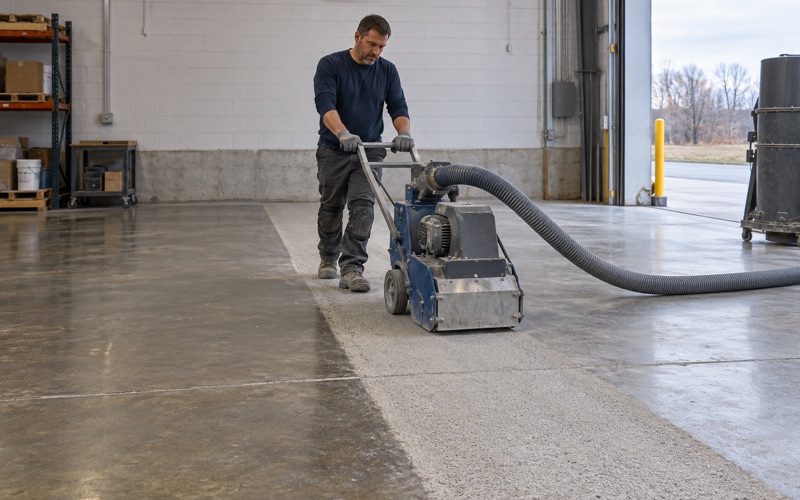
We answer that question before we price anything. Each proposal names the product, the system build and the finished thickness, so the floor that goes down can be checked against the floor that was quoted. Moisture testing sits in the scope as its own line item, and the slab is opened with a diamond grinder or shot blaster, never acid etched.
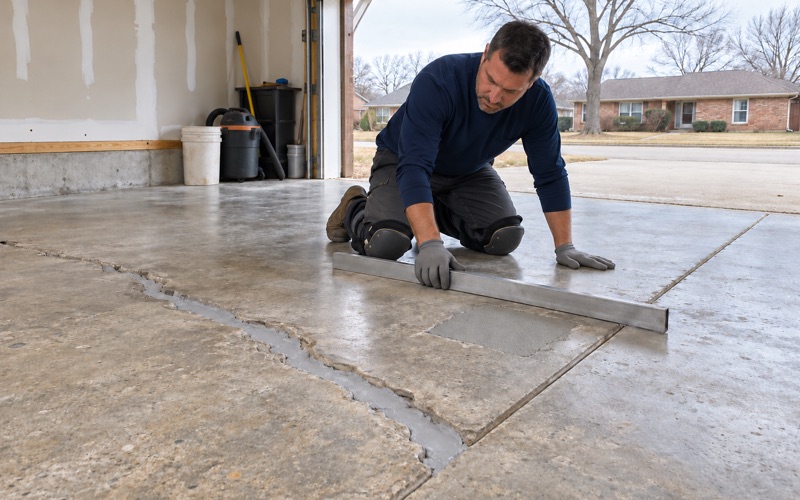
When concrete needs crack or spall repair before it can carry a coating, we say so at the walkthrough. A coating is a film that moves with the slab beneath it, and we would rather explain that up front than promise a finish that hides a structural problem.
A Laboratory Floor Is a Chemical-Resistance Specification
Wood Dale’s 2025 annual comprehensive financial report lists Prime Now LLC first among the city’s principal employers, at 705. Directly behind it is Quest Diagnostics at 550, and Quest lists a licensed laboratory at 1355 N Mittel Blvd. For a flooring contractor, that ranking says something useful about the commercial rooms in this city: benches, sinks and sample handling, not just open storage.
What a lab floor is exposed to
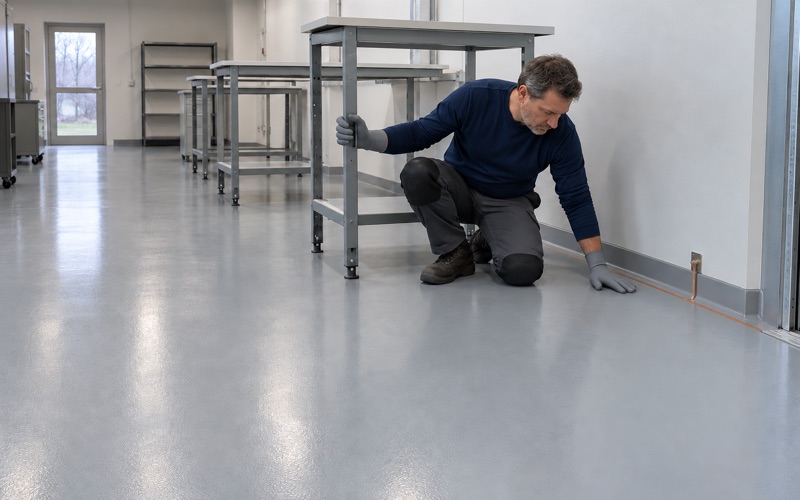
A clinical or testing laboratory floor sees spilled reagents, alcohols, bleach-based disinfectants and mopping several times a day. A garage-grade epoxy can soften, stain or lose its gloss under that routine, which is why we treat a lab floor as a chemical-resistance specification rather than a color choice. We ask for the facility’s chemical list and cleaning protocol first, then match the resin chemistry to it.
For most lab and clean-assembly rooms that means a 100% solids epoxy base with a chemical-resistant topcoat, or a polyaspartic finish where a fast return to service matters. Where hot-water washdown or thermal shock is part of the day, urethane cement is often the better body coat. The proposal names which system we chose and why.
Seams, coves and drains
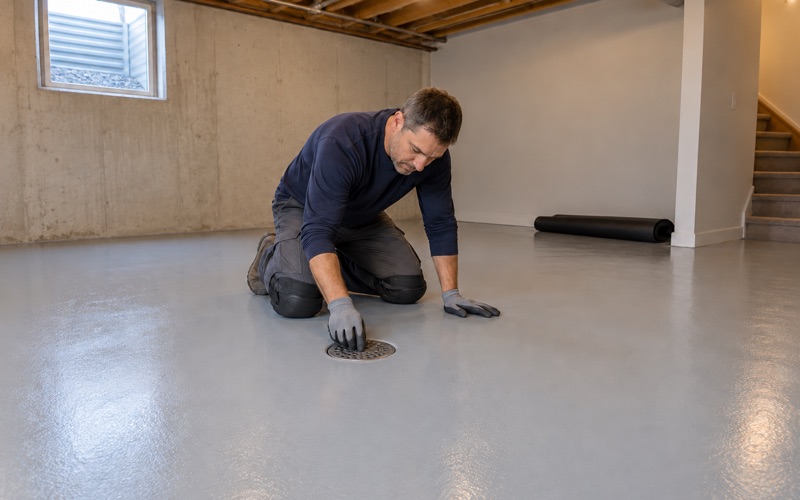
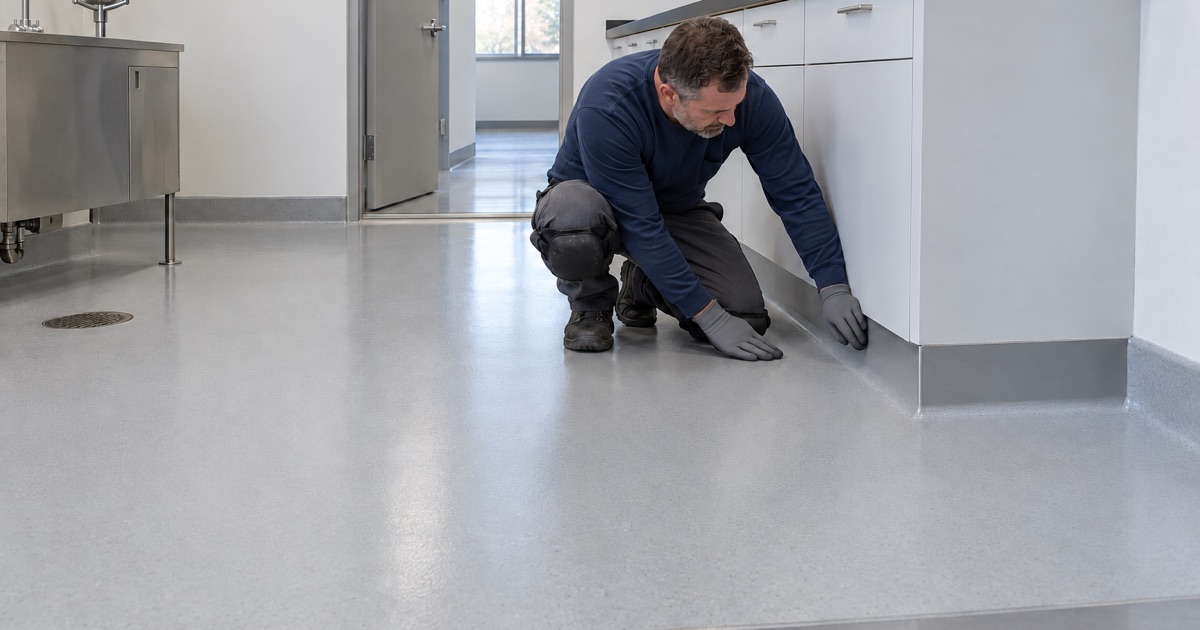
Chemical resistance is usually lost at the edges first. Liquid finds the joint between floor and wall, the gap around a floor drain or an unfilled control joint, and works its way under the film. We detail those points before the field coat goes down, with joints filled, drains sealed into the system and an integral cove base run up the wall where the room calls for one.
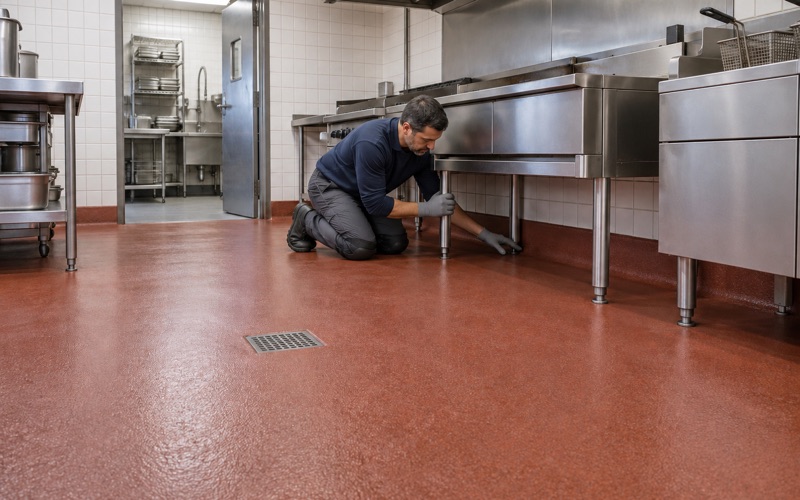
Food establishments in the city answer to the DuPage County Health Department, whose plan review asks for a room-by-room finish schedule covering floors, walls, ceilings, countertops and coved juncture bases. We can supply the floor and cove lines of that schedule with the product named, which heads off a round of questions at review.
Working around a building that stays open
A laboratory rarely closes for a week. We phase commercial work around the hours a building has to keep running, coating one room or zone at a time and choosing a cure chemistry that fits the window. Moisture testing with ASTM F2170 in-situ relative humidity probes comes first, because a reagent-resistant topcoat over a damp slab still blisters.
Where a room cannot hold probes for the 24 hours that method asks for, we say so and talk through an ASTM F1869 calcium chloride test as the alternative. If readings come back high, a moisture-mitigation primer goes into the build as a named layer, priced before the job rather than after a failure.
Looking for epoxy-flooring closer to Bensenville? See Bensenville Epoxy-Flooring.
Mittel Boulevard: Printers, Heaters, Tooling and Shop Floors
Videojet Technologies, the coding-printer maker, is headquartered at 1500 N Mittel Blvd and appears on the city’s employer list at 479. AAR Corp, the aviation-services company, sits at 1100 N Wood Dale Rd with 464. Further down the same roll are Power Solutions at 244, Wiegel Tool Works at 230 and Tempco Electric at 217. Read together, that is an assembly, machine-shop and aviation-shop economy, and each of those floors fails in its own way.
Assembly rooms
Printer and electronics assembly wants a floor that is bright, easy to sweep and does not shed dust from the concrete underneath. A sealed epoxy system with a smooth or lightly textured topcoat does that, and a high-build coat levels minor surface wear so carts roll quietly. We avoid aggressive broadcast textures in these rooms because they hold debris and fight the cleaning crew.
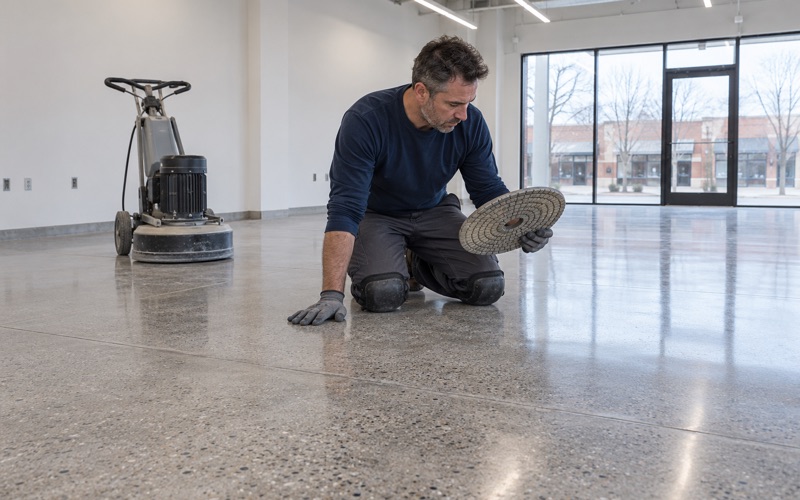
Where a storage room or mezzanine sees only foot traffic, a lithium silicate densifier on ground concrete can be the plainer answer, and we will quote it when it fits better than a film coating. Not every room in a manufacturing building needs the same system, so the proposal breaks the floor plan into zones and prices each one for its use.
Machine shops and tool rooms
Tool and die work, heater manufacturing and engine assembly put cutting fluids, hydraulic oil and heavy dropped parts on the floor. Oil that soaks into bare concrete keeps wicking back out for years, so on an older shop slab we degrease, grind to an ICRI CSP 3 profile or coarser, and test whether the concrete will still accept a bond. A quartz aggregate broadcast built up in 100% solids epoxy gives a thick, impact-tolerant floor with grip where people stand at machines.
We will tell you when a contaminated area needs to be cut out and patched rather than coated over. That conversation costs far less before the job than after a section delaminates.
Aviation-services shop floors
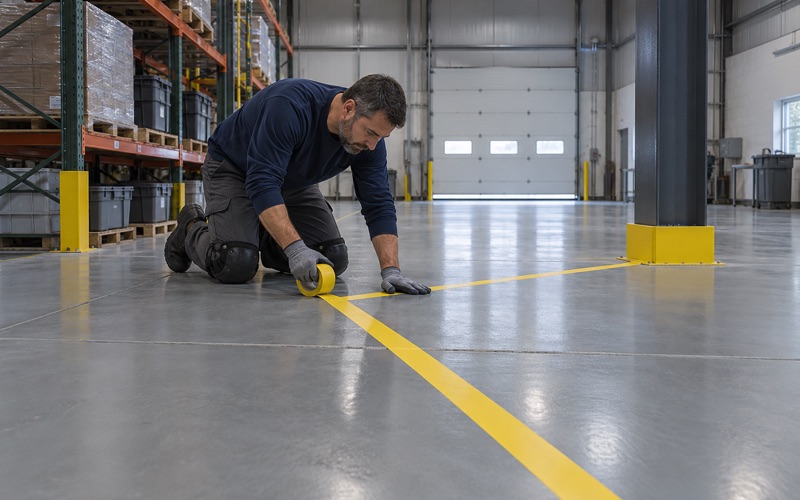
Aviation maintenance shops handle hydraulic fluids, fuels, solvents and heavy rolling equipment. Some aviation hydraulic fluids attack ordinary epoxy, so we check the fluid types against the coating’s chemical-resistance data before quoting. Safety striping and equipment zones go into the topcoat rather than being painted on afterward, so they wear with the floor instead of flaking off it.
Registering With the City Before the Permit
Illinois issues no state license for flooring or coatings work, so a license number is not what a Wood Dale customer should ask us for. What the city does require is registration. The Community Development Department requires every contractor working in the city, from general contractors and concrete trades to electricians, roofers and sign installers, to be registered before a permit is issued.
The $2 million certificate
Registration comes with a certificate of insurance carrying $2,000,000 in public liability coverage, with the City of Wood Dale named as certificate holder. That certificate, together with our bond and insurance, is what we hand a property manager or homeowner who wants proof of who is working in the building. Registration is not a trade license, and we never describe it as one.
When a homeowner does not need it
Homeowners doing non-licensed work on their own property do not register, which is why a do-it-yourself garage kit needs no paperwork with the city. Once a contractor is involved, registration applies. On a commercial job we confirm the permit question with Community Development at 630-766-5133 or permits@wooddale.com before we put a date on the calendar.
Paperwork on a home job
For residential work we also hand over a written contract and the Home Repair: Know Your Consumer Rights pamphlet before any grinding starts, as the Illinois Home Repair and Remodeling Act requires. Warranty exclusions are read out before you sign, with moisture named first, because it is the most common reason a coating lets go. On a commercial job the contract still names the product, build and thickness, along with the hours our crew will be on site so supervisors can plan shifts around us.
Townhouse Garages in a 1960s and 1970s Housing Stock
Wood Dale has 5,454 housing units, and 68.1 percent of them predate 1980. The 1960s and 1970s alone account for 2,760 of those homes, while only 82 went up between 2010 and 2019 and none since 2020. For a coating contractor, that makes the residential work here recoats, repairs and floors someone already tried to finish, not fresh slabs in new construction.
Attached homes and shared walls
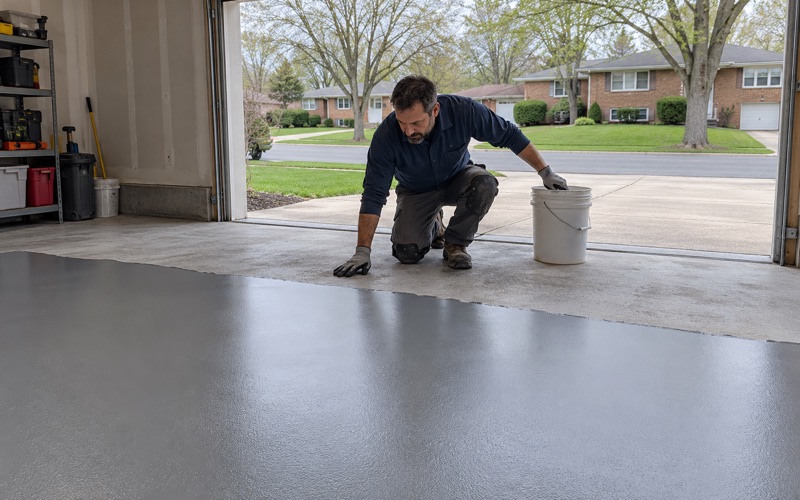
The city counts 870 single-family attached units, and 745 of them are owner-occupied, out of 4,112 owner-occupied homes overall. Townhouse garages are often a single bay that shares a wall, and sometimes a driveway, with a neighbor. We plan grinding with dust extraction, keep cure odor in mind for the unit next door, and check whether an association has rules on garage finishes or work hours before we book the day.
Reading an old coating before quoting
A garage slab poured in the 1960s or 1970s may carry a painted finish, a hardware-store epoxy kit or a sealer that never bonded. We look at where it is peeling, test whether what remains is sound, and grind it all off when it is not, because a new system is only as good as the layer it sits on. Cracks get read the same way: a hairline shrinkage crack is routine, while a crack with one side higher than the other is a slab still moving, and a coating will follow that movement rather than stop it.
A thin water-based kit from a previous owner usually comes off under the grinder quickly. A well-bonded older epoxy can sometimes stay and be abraded for a recoat, and we confirm that with an adhesion check on the slab before it goes into the quote.
Curing on the slab’s schedule
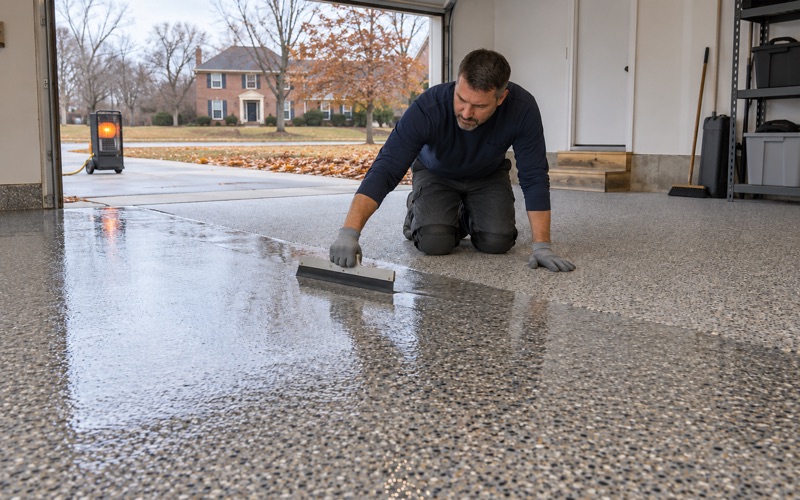
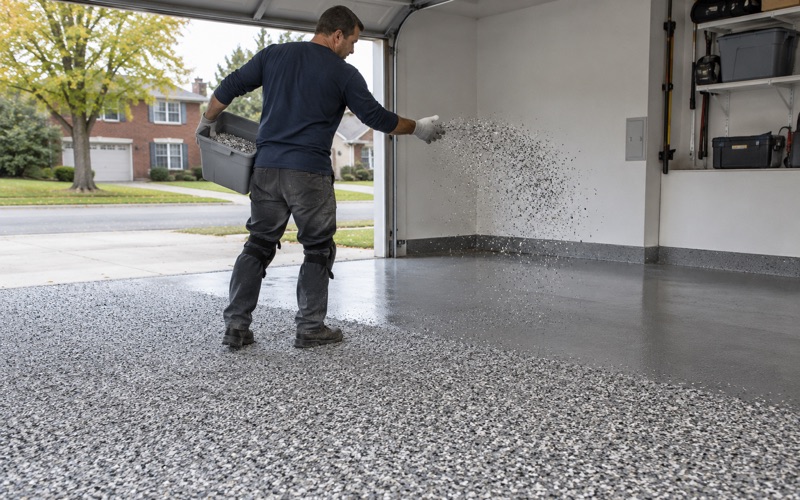
Many older attached garages are unheated. We schedule curing against slab temperature and the dew point spread at the surface, not against the calendar, and we will tell you plainly when a garage needs to wait for spring. A floor rushed onto a cold slab can show amine blush or a soft cure that never reaches full hardness. Once conditions allow, a vinyl flake broadcast under a polyaspartic topcoat suits most of these garages, and the proposal states its finished thickness so you can check it after the crew leaves.
- 20+ Years Coating Concrete
- Moisture Tested Before Quoting
- Itemized Written Proposals