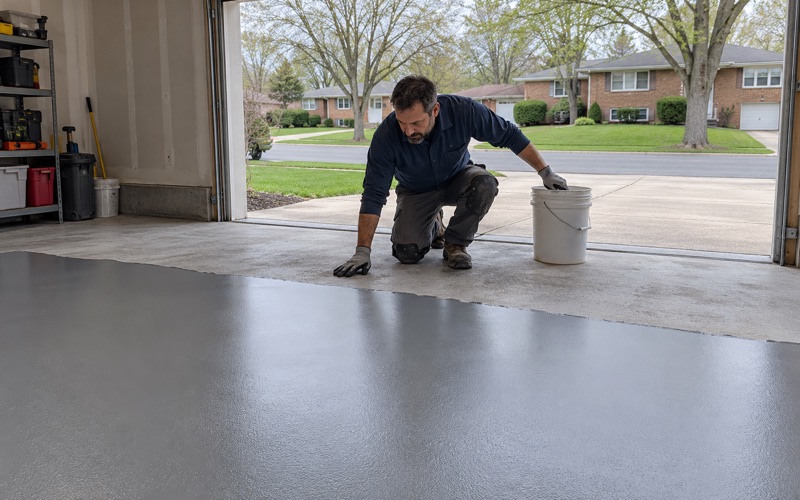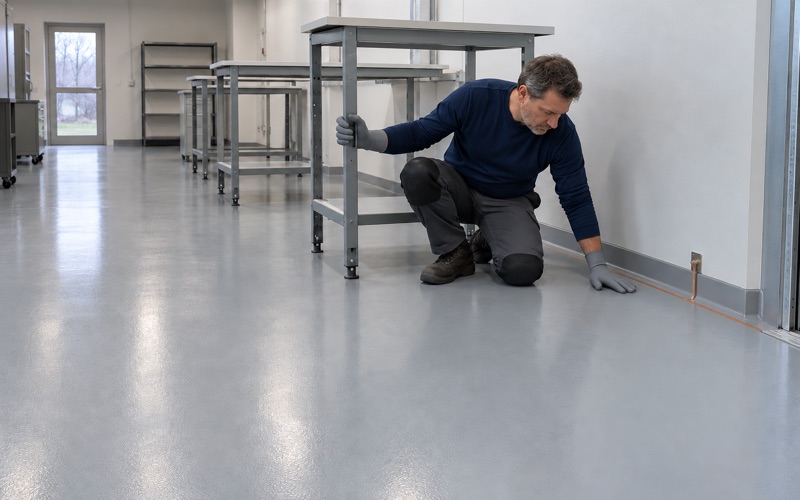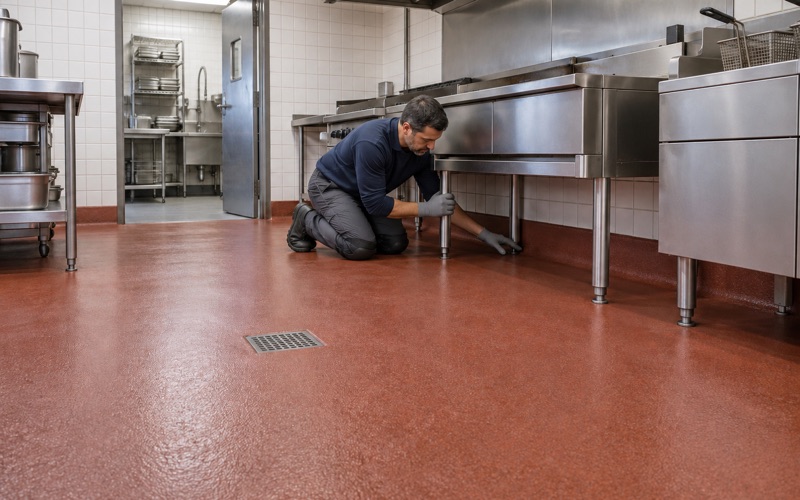
Arlington Heights Epoxy Flooring has more than 20 years behind its epoxy flooring in Winnetka, and on every floor here our first job is finding out how much water is moving up through the concrete. That order matters more in this village than in most places we work, because the slabs are old and the ground beneath them has a long, documented habit of holding water.
Our quotes for garages, basements and workshops carry moisture testing as its own priced line, before any primer or color is chosen. If the readings come back high, we say so and change the system or the schedule rather than coating over the problem and hoping.
The proposal also spells out the product, the layer build and the finished thickness, so a homeowner can hold what was written against what went down. The sections below explain why older Winnetka floors call for that discipline and what the testing actually involves.
Old houses on ground the village calls a marsh
Nearly half the housing stock predates 1940
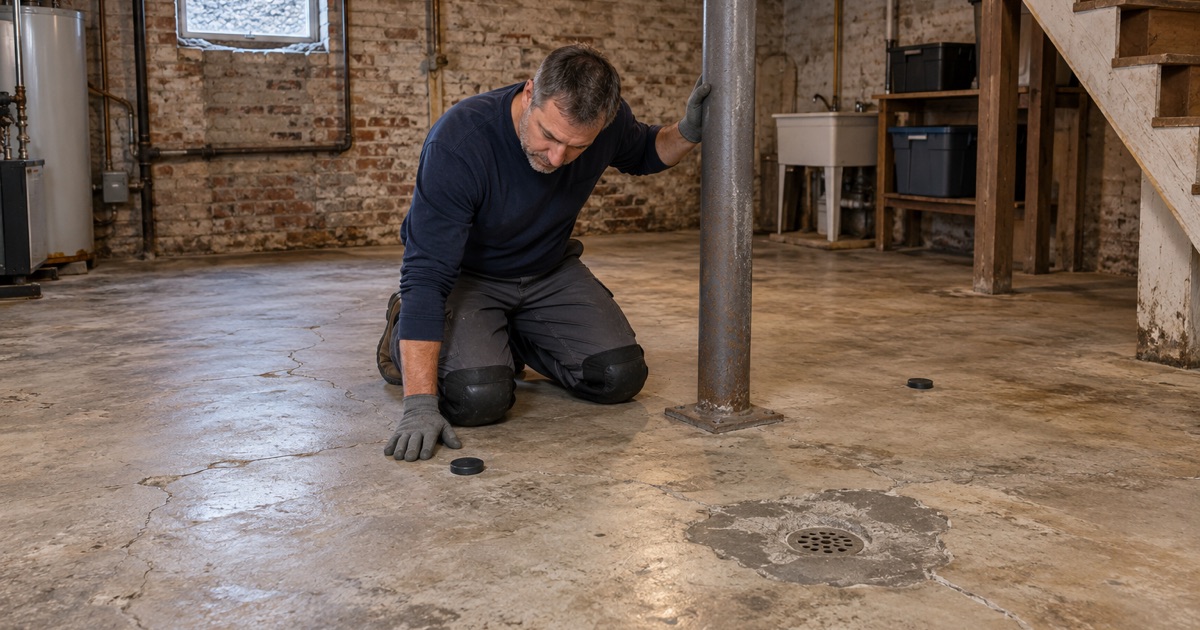
Census survey figures count 2,216 of Winnetka’s 4,539 housing units as built in 1939 or earlier, which is 48.8 percent. Only 59 units date from 2020 or later. When we walk into a garage or basement here, the odds are close to even that the concrete was poured before 1940.
Slabs that old went down before under-slab vapor retarders were normal practice, and long before ASTM E1745 set out how those sheets should perform. Whatever moisture sits in the soil under them has never had a membrane in its way.
Old concrete also carries its history on the surface: paint, sealers, oil, adhesive from a long-gone floor covering, and patches poured at different times. Each of those changes how a coating bonds, so we read the surface before we price it.
The village’s own description of its ground
Winnetka’s stormwater page states that the village is naturally a lowland marsh environment, and that efforts to hold or redirect stormwater have been made here since the 1930s. That is the village describing itself, not a contractor’s sales pitch.
On the west side, storage tanks sit beneath Duke Childs Field, the Park District golf course and the grounds behind Crow Island School, holding runoff and releasing it to the Skokie Lagoons. Crow Island School was declared a National Historic Landmark in 1990, a reminder of how long buildings here are expected to last.
Decades and millions spent moving water
A Willow Road stormwater tunnel was estimated at $35 million in 2013 and $80 million by 2015. In 2016 the village stopped it and turned to a watershed study instead.
In 2022 the village approved a $16.51 million contract with John DiMeo Brothers for a project at the northwest corner of Willow and Hibbard roads, built with New Trier District 203 and the Winnetka Park District. The Willow-Hibbard work adds 79 acre-feet, or 25.7 million gallons, of stormwater relief for west and northwest Winnetka, and an east side study was underway as of April 2024.
None of that tells us what is under any one house, and we never assume a particular street has a water problem. It does make soil moisture a reasonable first question on any old Winnetka slab.
Looking for epoxy-flooring closer to Franklin Park? See Epoxy-Flooring in Franklin Park.
Testing an old slab before anything touches it
Three tests, three different questions
We start with ASTM D4263, the plastic sheet test: a square of clear polyethylene taped to the floor, left in place, then checked for condensation or darkening underneath. It is quick and cheap. It can flag trouble, but it cannot put a number on it.
For numbers we use ASTM F1869, which measures the moisture vapor emission rate with sealed calcium chloride dishes, and ASTM F2170, which places relative humidity probes in holes drilled into the slab. The two tests look at different depths, which is why we run more than one on an old floor. Readings are compared against the coating manufacturer’s limits and the thresholds referenced in ASTM F710, and the numbers go to the homeowner in writing.
Basement and garage slabs are tested the same way. A garage floor sits at grade and a basement floor sits below it, but both can carry moisture up from the soil, and on old Winnetka concrete neither gets a pass because it looks dry on the day we visit.
What the readings change
Low readings mean a standard primer and build can go down. Readings near or above the limit move us to a moisture-mitigation primer under the main coat, or in some cases to urethane cement, which tolerates more vapor than a standard epoxy system.
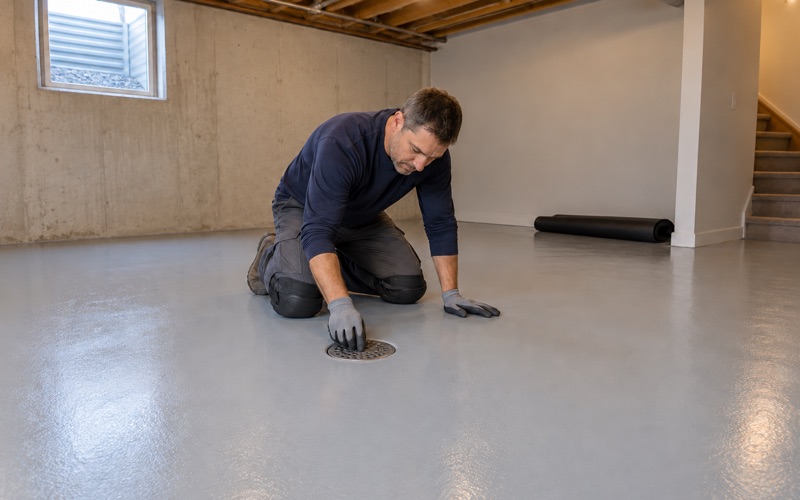
Very high readings, or signs of hydrostatic pressure such as water at cracks or wet efflorescence along the walls, mean the floor is not ready to coat at all. We say so rather than selling a system we expect to blister. Water management at a sump pit or floor drain comes first in that case, and a coating cannot do that job.
Why moisture leads the warranty conversation
Coating warranties commonly exclude moisture failures, and ours names moisture first among the exclusions we read aloud before a contract is signed. That is the honest reason testing is a priced line on the quote: on a pre-1940 slab, skipping it would mean guessing about the one thing the warranty will not cover.
Why the old houses stay, and what that means for their floors
A demolition delay that keeps pre-war houses standing
Demolition in Winnetka goes through the Winnetka Landmark Preservation Commission, which reviews whether a house has historical or architectural significance. A March 2021 ordinance lets the village delay demolition of a significant house by up to 270 days, up from 60, and offers a 20 percent size incentive to owners who preserve one.
The village also holds estates by George Washington Maher, Walter Burley Griffin and John S. Van Bergen. Pre-war houses that survive are renovated rather than replaced, and their original basement and garage slabs stay in service under new finishes.
Reading cracks and old coatings on a slab that has moved
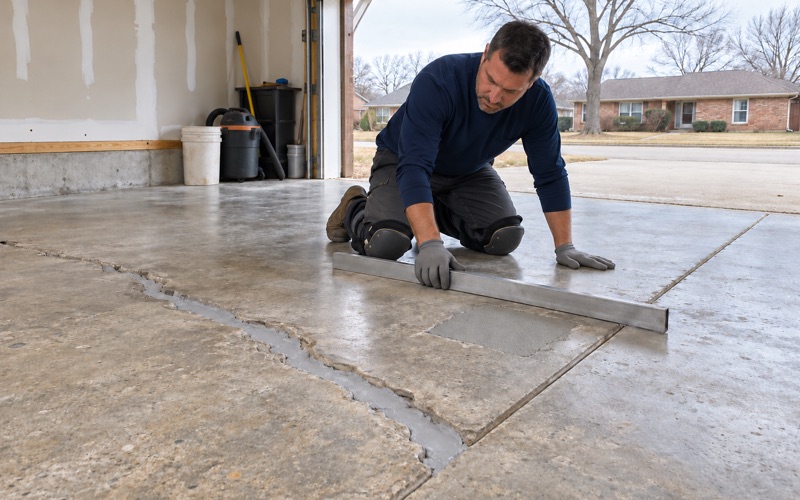
A slab that has stood for eight or nine decades has often cracked, settled or been patched somewhere. Before we quote, we look at each crack for width, offset and whether it is still moving, and we test any old coating or sealer to see whether it is bonded or lifting.
Where the slab needs repair before it can be coated, the proposal says so in plain terms. We also tell owners up front that a coating is a thin film that follows the concrete under it. It will not stop a moving crack from showing through, and we do not promise otherwise.
Opening the surface mechanically
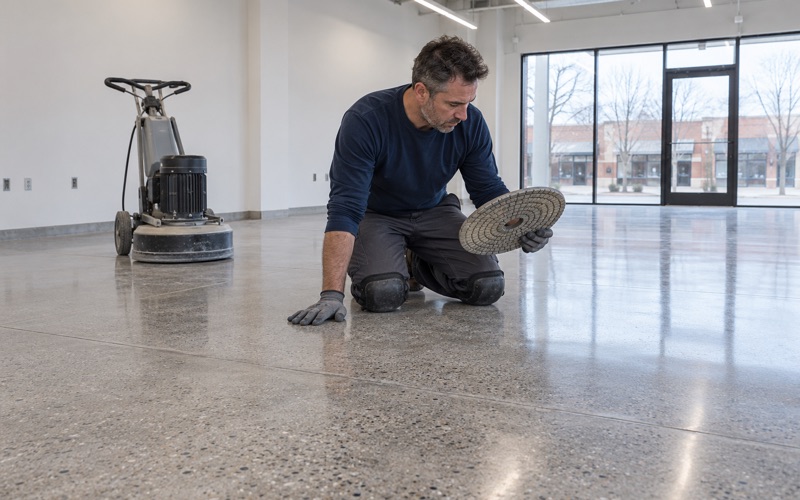
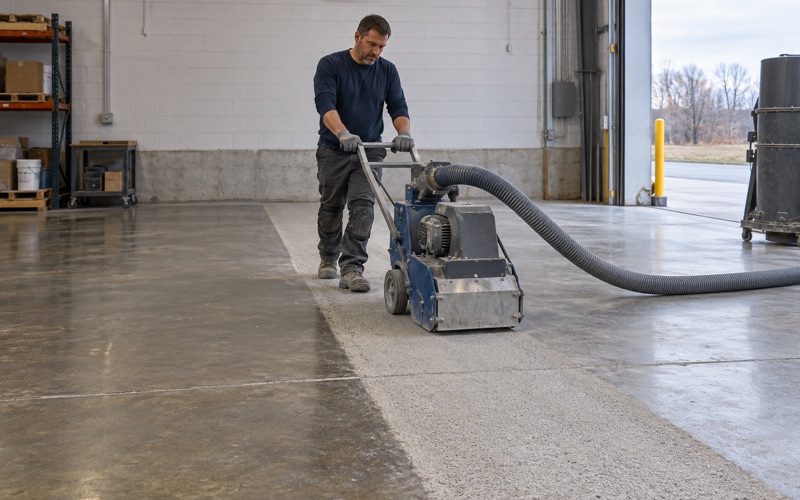
Old concrete is often dense on top, or carries contamination soaked in over many years. We open every slab with diamond grinding or shot blasting to a measured ICRI CSP profile, and we never acid etch, because acid adds water and residue to a floor where moisture is already the main concern. The profile is matched to the system, since a thin polyaspartic topcoat wants a lighter profile than a thick 100% solids epoxy build or a quartz aggregate broadcast.
Choosing a system for an old floor
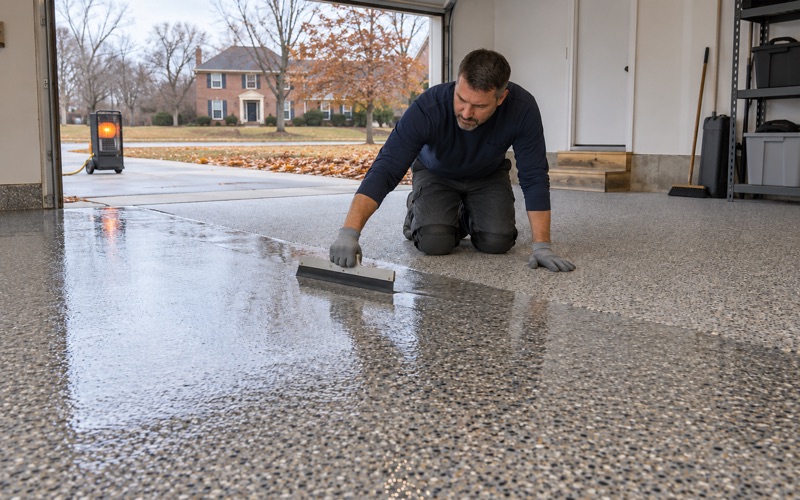
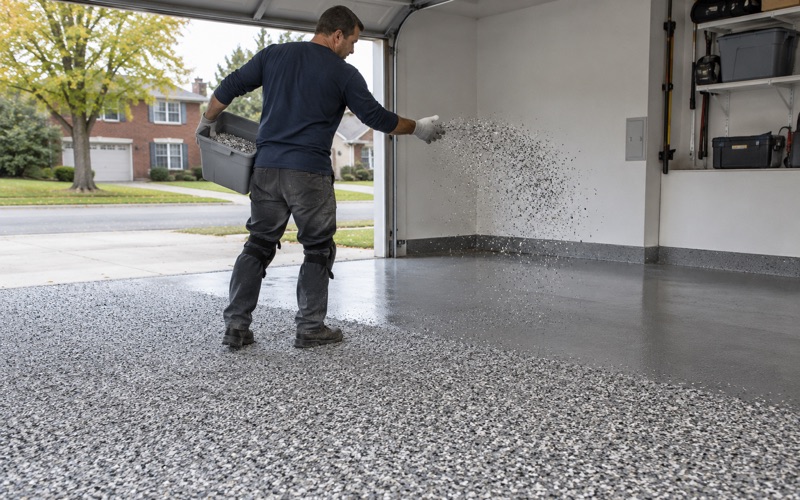
A garage that sees hot tires does best with a 100% solids epoxy base, a vinyl flake broadcast and a polyaspartic or polyurea topcoat, a build designed to resist hot tire pickup. A basement used as a gym or workshop may need less film thickness and more attention to the primer, especially if the moisture readings were borderline. Where a floor only needs dust control, a lithium silicate densifier on ground concrete can be the right answer, and we say so when it is.
On damp days we also watch for amine blush, the waxy film some epoxies form when humidity is high during cure. It has to be removed before the next coat, or that coat will not bond properly.
Permits, bonds and paperwork in the village
What triggers a Winnetka permit
Permits are handled by the Village of Winnetka Department of Community Development. Its list of triggers includes all foundation repairs except minor maintenance and repair, such as epoxy injections, and any work to install, alter or replace an impermeable surface such as a driveway, patio, terrace, walkway or parking lot.
Whether coating an existing driveway or patio counts as an alteration is a call for the building official, and we do not answer it on the village’s behalf. We ask before the job is scheduled, and if a permit is needed, it is in place before work starts.
A bond, not a license
Winnetka runs no contractor licensing program of its own, and Illinois licenses no general, flooring or coatings contractor. What the village does require is a $25,000 License and Permit Bond from the general contractor, and from any subcontractor working in the village right-of-way, before a permit issues.
So instead of a license number, we show the bond, insurance and any registration the village asks for. We also do not market a floor coating as radon reduction, because in Illinois that work takes an IEMA radon mitigation license.
Contracts, products and commercial hours
Every home job gets a written contract and the Home Repair: Know Your Consumer Rights pamphlet before work begins, as the Illinois Home Repair and Remodeling Act requires. Floor coatings are chosen within the Illinois limit on VOC content, which applies to the installer as well as the manufacturer. For the village’s small commercial base, the Winnetka Fire Department’s Fire Prevention Bureau inspects business and multifamily buildings each year and reviews remodel plans, and we schedule our work around the hours those buildings have to stay open.
Curing on the slab’s schedule
Cure timing follows slab temperature and the dew point spread at the surface, not the calendar. An unheated garage behind a pre-war house can sit too cold for a coating to cure properly, and when it does, we tell the owner the job waits for spring.
- 20+ Years Coating Concrete
- Moisture Tested Before Quoting
- Itemized Written Proposals