Arlington Heights Epoxy Flooring brings more than 20 years of epoxy flooring in Winfield to a village where the biggest floor is not in anyone’s garage. It belongs to an institution that cleans its floors around the clock and cannot shut a hallway for a weekend. That one fact shapes how we talk about floors here, whether the slab is under a parked car or under a supply cart.
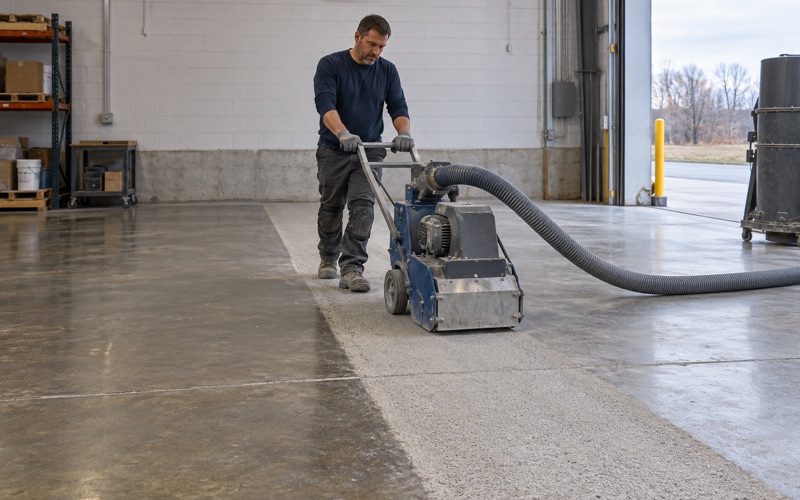
Most of what we do in this village is still residential, and most of it starts the same way. We open the slab mechanically with a diamond grinder or a shot blaster, never with acid, and we measure moisture as a written line item before any product is chosen. The quote then names the product, the system build and the finished thickness, so you can check the floor against the paper.
What follows covers both sides of that picture: the institutional floors that make up the largest commercial floor estate in the village, and the houses built around them. They are different buyers with different priorities, and we would rather explain the gap than blur it.
A Regional Hospital Inside a Village of 4,108 Homes
Where the campus sits
Central DuPage Hospital’s campus coordinate falls inside Winfield village, in Winfield Township of DuPage County, while the village as a whole spans both Milton and Winfield Townships. The hospital’s address is 25 North Winfield Road. For a village this size, that puts a regional hospital among its neighbors.
It began much smaller. The hospital was established in 1958 and opened on September 16, 1964, with 113 beds and 66 physicians on a restored sanitarium site. Its growth since then put a major institutional building at the center of a village that is otherwise overwhelmingly residential.
The 2011 bed tower
A major expansion came in 2011, when a $232 million, five-story bed tower added 202 private rooms and brought the hospital to 390 beds. A building of that kind adds more than patient rooms. It adds corridors, utility spaces, loading routes and back-of-house floors that all have to be specified and maintained.
We mention it because it explains what the commercial floor market in Winfield looks like. We are not the hospital’s contractor and make no claim to have worked there. The point is that an institutional building of this size works to a very different standard from a two-car garage, and the difference is worth understanding before any commercial floor is quoted.
The village around it
The hospital arrived in a place with a history of its own. Winfield began as Gary’s Mill, took its name from Winfield Scott, and incorporated on April 18, 1921, with 310 residents. The DuPage River runs through the village, and Winfield’s Metra station sits on the UP West Line.
Outside the campus, Winfield is a village of owners. Of 4,019 occupied units, 3,695 are owner-occupied, or 91.9 percent, and only 324 are rented. That means a residential floor here is usually bought by the person who will live with it, not a landlord pricing a turnover.
Looking for epoxy-flooring closer to Westchester? See Epoxy-Flooring Services in Westchester.
Floors That Get Cleaned Constantly, Down to the Mechanical Rooms
Cleanability drives the specification
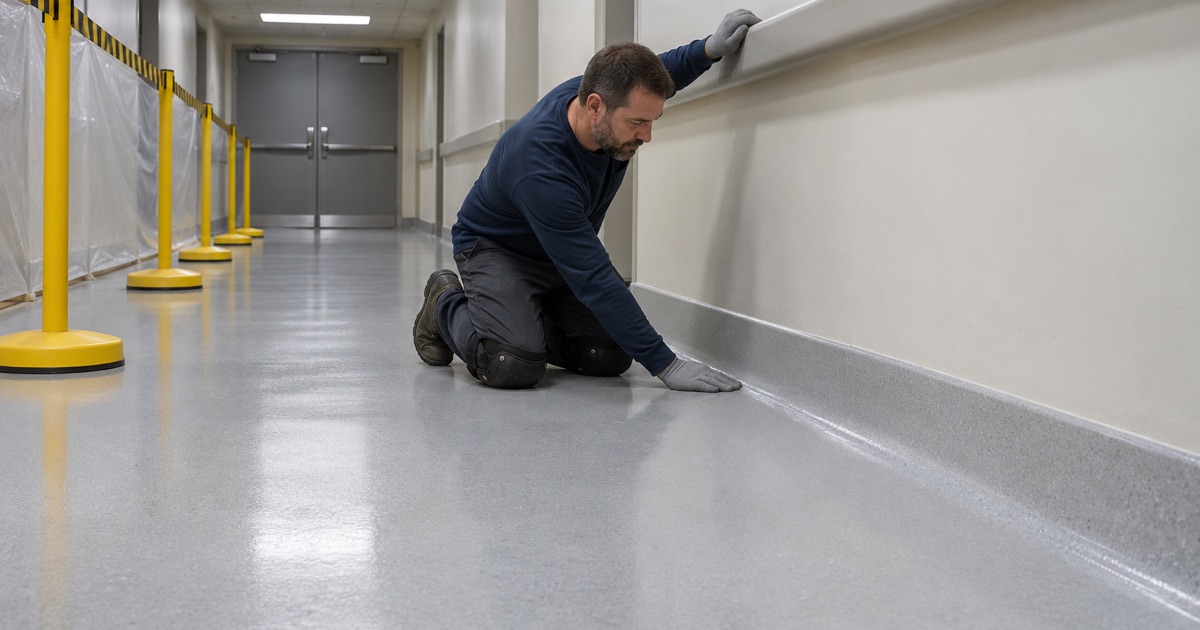
On a hospital campus, a floor is chosen first for how it cleans. Corridors, sterile processing areas, loading zones and parking areas are an institutional specification, and the person writing it is weighing seams, joints and how the surface stands up to constant wet cleaning. That is a different buyer from a homeowner choosing a flake color for a garage.
We are careful about what we say in that setting. A seamless resinous floor has fewer joints to clean than tile, but we make no medical or hygiene performance claim for any coating, and nobody should buy one on that promise. What we can speak to is the build itself: the primer, the body coat, the topcoat and the finished thickness, all written into the proposal.
Corridors, docks and parking areas
Back-of-house floors take a different kind of abuse. A service corridor carries carts, pallet jacks and wheeled equipment all day, and a loading dock adds point loads, dragged freight and whatever comes in from the street. For that traffic we look at troweled 100% solids epoxy with a quartz aggregate broadcast, which builds thickness and traction rather than a thin decorative film.
Parking areas on a campus raise the same questions at a larger scale, with vehicle traffic, deicers and drainage all acting on one slab. Whether a structured parking deck should be coated at all is a specification decision for the owner’s engineer, and we would treat it as one.
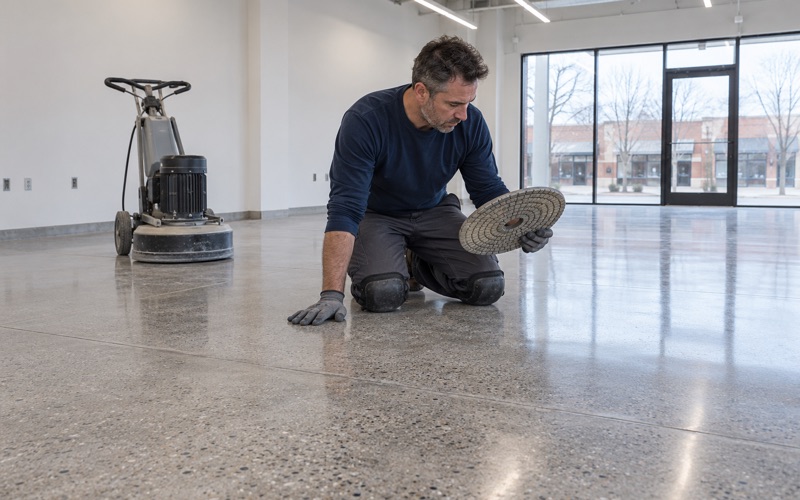
Where traffic is heavy and the space only needs dust control, a lithium silicate densifier on ground concrete can be the honest recommendation. We would rather say that than sell a coating a room does not need.
Mechanical rooms and wet areas
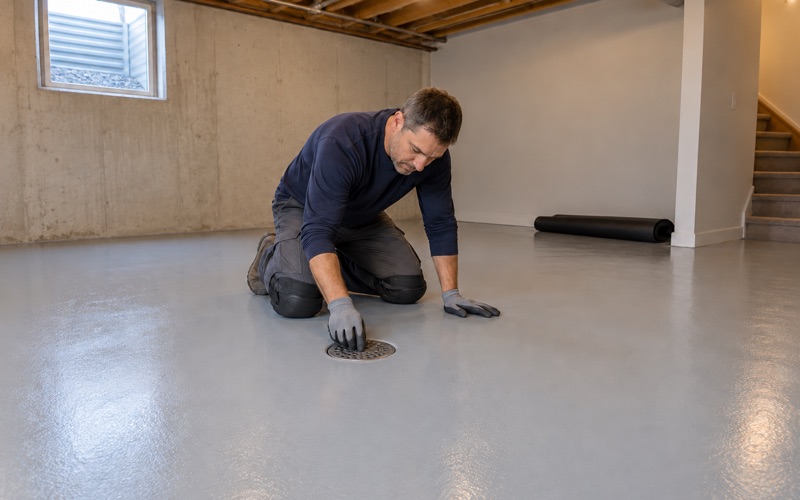
Mechanical rooms are where we look hardest at chemistry and heat. Equipment leaks, hot water and cleaning chemicals are routine there, and urethane cement is often the better fit where thermal shock and chemical exposure are part of the day. Floor drains and sump pits need their own detailing so the coating terminates cleanly instead of peeling at the edge.
Some technical rooms in a large institution also carry electronics, and that is where static-dissipative or ESD flooring enters the conversation. Those systems are specified to a resistance range, and we treat that range as a written requirement rather than a feature on a brochure.
Scheduling Floor Work Around a Building That Runs All Night
Phasing instead of closing
A building that runs around the clock cannot hand over a whole floor for a week. Commercial jobs are scheduled around the hours a building has to stay open, and when the building never closes, that usually means phasing: one section of corridor or one room down while traffic is rerouted around it. Grinding, coating and curing all have to fit inside that window.
Product choice follows the schedule. A polyaspartic topcoat cures fast enough to return a space to traffic sooner than a slow-cure system, while a 100% solids epoxy body coat gives the build its thickness. We plan which coat goes down in which window, so a corridor is not half-finished when the next shift needs it.
Curing to conditions, not to the clock
Even indoors, cure depends on the slab, not on the work order. We schedule curing against slab temperature and the dew point spread at the slab surface, because a coat laid on a surface too close to dew point can pick up amine blush and lose adhesion at the next coat. If the readings say wait, we wait, and we say so before the window is booked.
Moisture and VOCs in an occupied building
The moisture line item we mentioned at the start applies just as much on a big slab. In a large building that can mean ASTM F2170 in-situ relative humidity probes or ASTM F1869 calcium chloride testing, read against ASTM F710 thresholds, and a moisture-mitigation primer where the numbers call for one.
Odor and fumes matter in a building full of people who cannot leave. Every coating we choose sits within the Illinois VOC limits for architectural coatings under 35 Ill. Adm. Code Part 223 Subpart C, a rule that binds the installer as well as the manufacturer.
Two offices are worth keeping straight. Building questions go to the Village of Winfield’s building department at 27W465 Jewell Road, while fire code questions go to the Winfield Fire Protection District, a special district rather than a village department.
The 1980s and 1990s Houses Around the Campus
A builder-grade slab, 35 to 45 years on
Beyond the hospital grounds, the 1980s and 1990s built more of Winfield’s homes than any other two decades. Of the village’s 4,108 housing units, 1,129 went up in the 1980s, the largest single decade, and 766 more in the 1990s; altogether 67.6 percent of the stock dates from 1980 or later. That makes the usual first-coating job here a 35-to-45-year-old builder-grade garage slab.
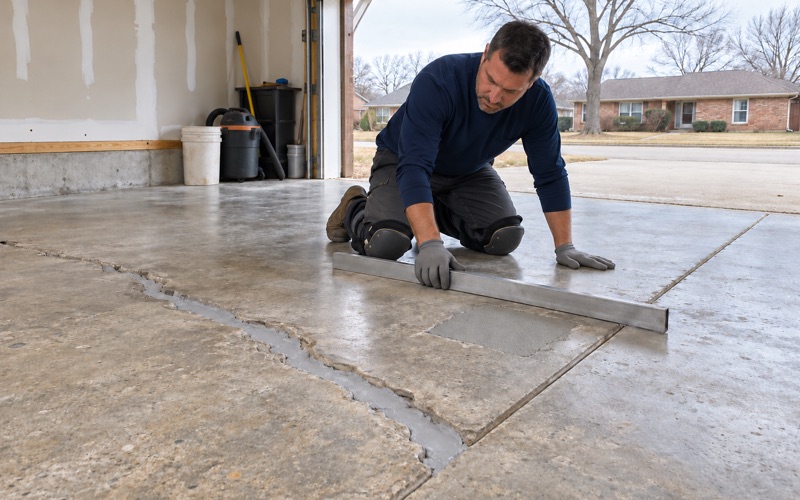
After three or four decades, a garage floor in one of these houses has a history. It may have taken a do-it-yourself coating that failed under hot tires, or a sealer nobody can identify now, and the control joints have had years to open up. Before we price the work, we read those cracks and whatever is left of the old coating, and if repair has to come before coating, that is the first thing we say.
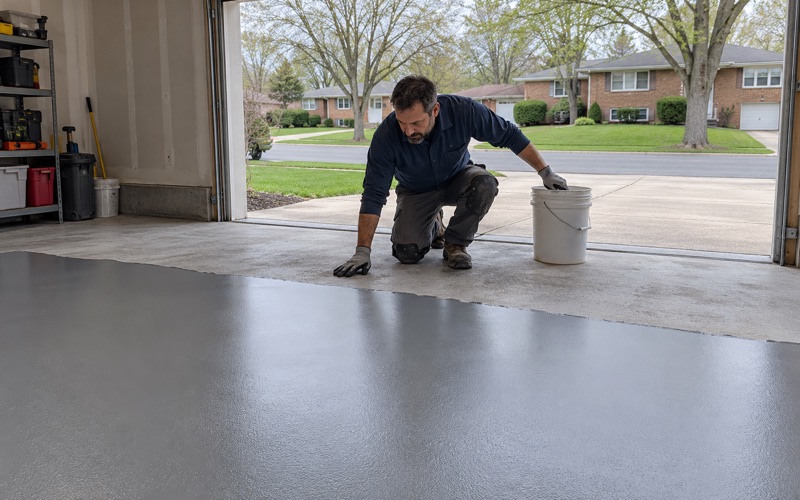
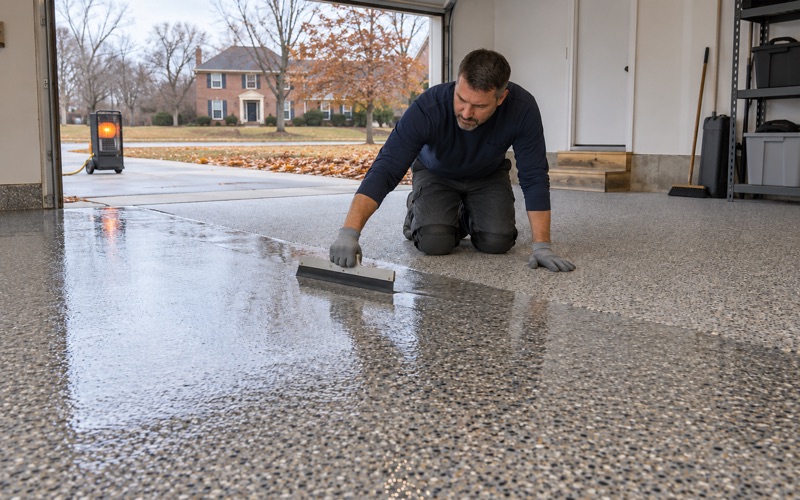
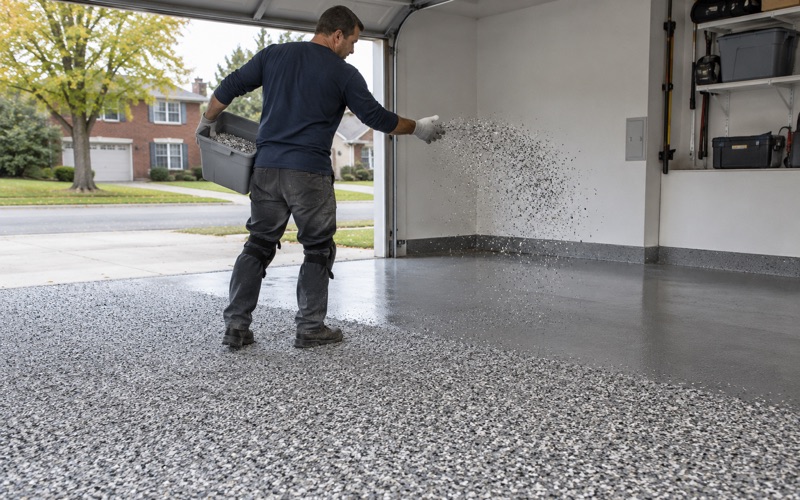
We grind the slab to a suitable ICRI CSP profile, then build with a 100% solids epoxy base, a vinyl flake broadcast and a polyaspartic topcoat that stands up to hot tire pickup and the calcium chloride and rock salt brine of a northern Illinois winter. A coating follows the slab beneath it, so we never promise it will stop a crack from moving. Before you sign, we also read the warranty exclusions aloud, moisture first.
Moisture gets the same written line on a house as on a commercial slab. For a garage that can start with an ASTM D4263 plastic sheet test, moving to calcium chloride or relative humidity testing where a first read raises questions. And when a garage is unheated, a late-season job sometimes has to wait for spring, when the slab is warm enough to cure.
Contracts, credentials and what we will not sell
Every home job gets a written contract and the Home Repair: Know Your Consumer Rights pamphlet before work starts, as the Illinois Home Repair and Remodeling Act requires. Illinois issues no state license for flooring or coatings work, so in place of a license number we show the contractor registration, bond and insurance a municipality asks for.
One more thing we will not do is sell a floor coating as radon reduction. In Illinois that is mitigation work under an IEMA license, and a garage coating is not a substitute for it.
- 20+ Years Coating Concrete
- Moisture Tested Before Quoting
- Itemized Written Proposals