Arlington Heights Epoxy Flooring brings more than 20 years of floor work to epoxy flooring in Western Springs, and most of the floors we look at here were poured long before anyone in the house now was thinking about coatings. That shapes the whole job. A slab that has carried two or three generations of paint, sealer and patching is a different starting point from fresh concrete, and the quote has to say so.
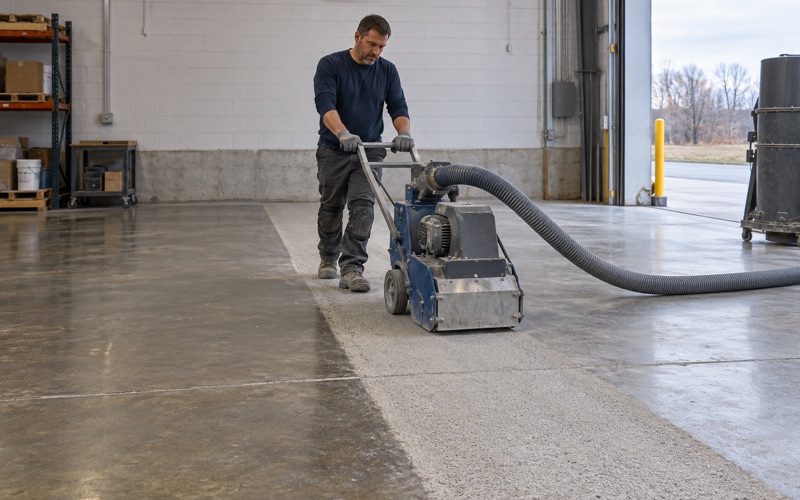
We open every slab with a diamond grinder or a shot blaster, never an acid wash, because the first thing an old floor needs is to have its history taken off. We test for moisture as a written line on the scope before a drop of resin goes down, and the proposal names the product, the system build and the finished thickness so you can check what was quoted against what was installed.
If the slab needs repair first, we tell you before the price, not after the grinder finds it. Garage floors here get a system built for the rock salt and calcium chloride brine that come in on the tires every winter, and basements get one built for what comes up through the concrete.
A Floor Poured When Eisenhower or Kennedy Was President
The numbers on Western Springs housing are unusually lopsided. Of the village’s 4,544 housing units, 1,977, or 43.5 percent, were built in the 1950s and 1960s, and the three decades that followed added only 510 more. That means the typical garage or basement floor we are asked about is an original mid-century slab, somewhere around 55 to 75 years old, and it has had a long life before we ever see it.
What Sixty-Odd Years Does to Concrete
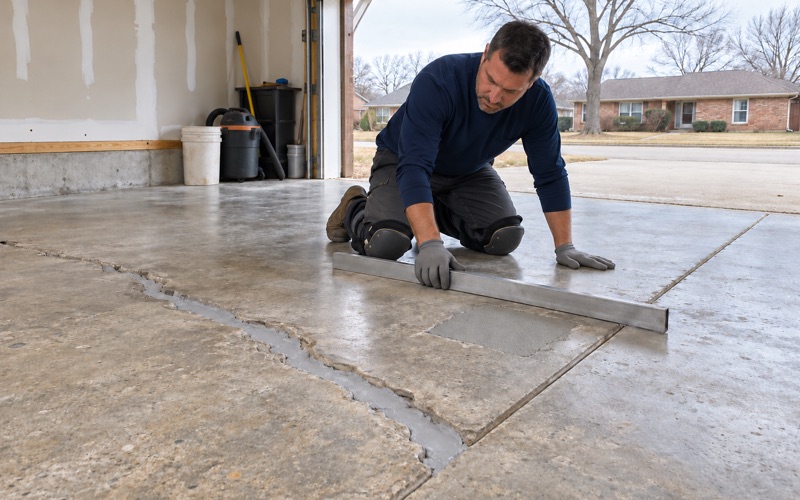
An old slab is rarely flat, clean or quiet. We expect settlement cracks, control joints that have opened up, spalled patches near the garage apron and low spots where water has sat for decades. None of that rules out a coating, but every bit of it has to be read before we put a price on the floor.
We walk the slab, map the cracks and look at whether each one is stable or still moving. A hairline shrinkage crack can be ground out and filled. A crack with one side higher than the other, or one that has visibly widened, is telling you the slab underneath is still shifting.
Older repairs get the same scrutiny. A patch troweled in decades ago with a soft mix, or a leveling compound that was never meant to sit under a coating, has to come out or be cut back to sound material. We would rather replace a small patch properly than bond a new floor to something that crumbles under the grinder.
A Coating Follows the Slab
We say this before the job rather than after: epoxy is a film bonded to the concrete, and it moves with the concrete. It will not hold a heaving slab together or stop a crack that is still working. When a floor needs structural repair or leveling first, we say that plainly and quote it as its own step, and when the honest answer is that the slab should be replaced, you hear that from us too.
Looking for epoxy-flooring closer to Lyons? See Epoxy-Flooring in Lyons.
Sixty Years of Paint, Sealer and Old Coating to Take Off First
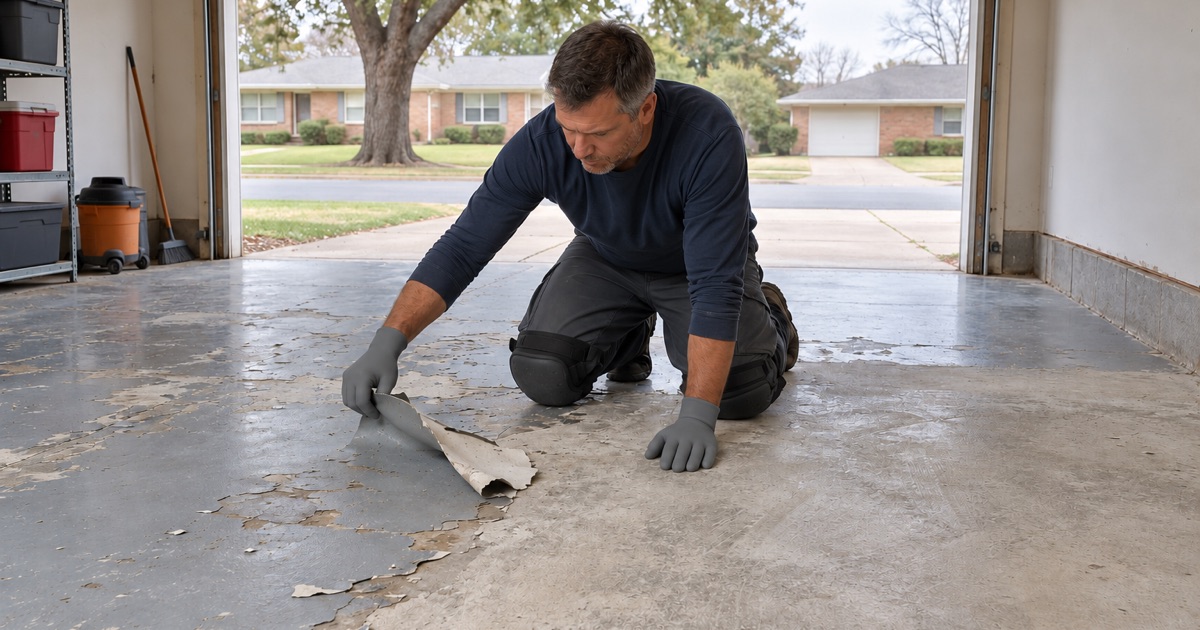
On a 1950s or 1960s floor, the concrete is usually buried under something. Garage floor paint from a weekend project, a clear acrylic sealer from a home sale, a one-part store-bought epoxy that has started peeling at the tire lines, sometimes all three stacked on each other. A new system bonded to any of those layers is only as good as the weakest one underneath.
Why We Grind or Blast Instead of Etching
Acid etching does very little to old paint or sealer, and on bare concrete it leaves a weak, uneven surface and residue that has to be rinsed out of a porous slab. We remove old coatings mechanically, with diamond grinding for most residential floors and shot blasting where the surface and access allow it. The goal is a clean, open profile in the ICRI CSP range the chosen system calls for, with the old film gone down to sound concrete.
Grinding also tells us things. It shows where oil has soaked deep into the slab, where a previous owner patched with a material that will not hold a coating, and where efflorescence has been pushing up through the old paint. Those findings change the plan, and we would rather know them before the resin is mixed than after the floor fails.
Building the New System on Bare Concrete
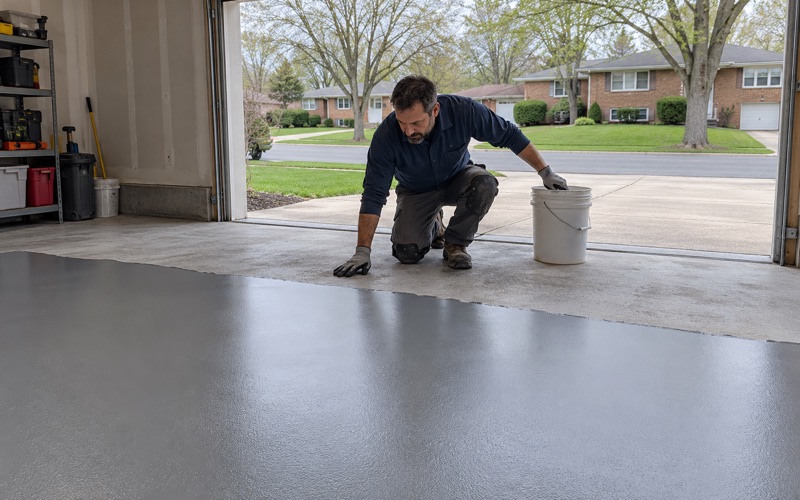
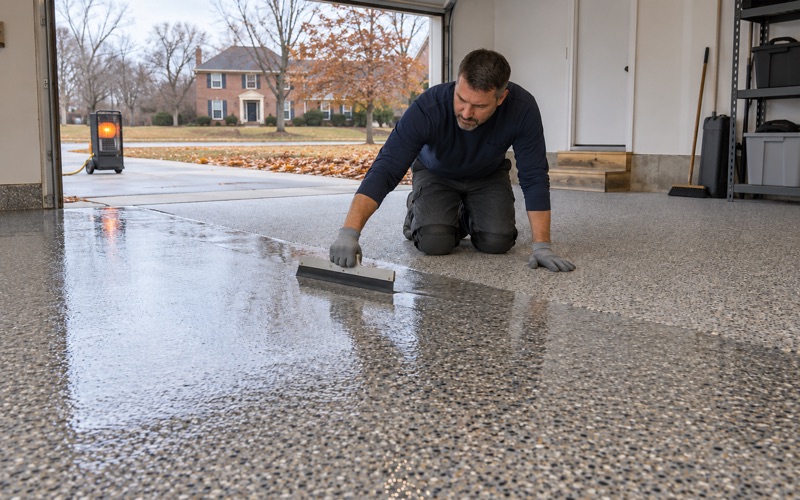
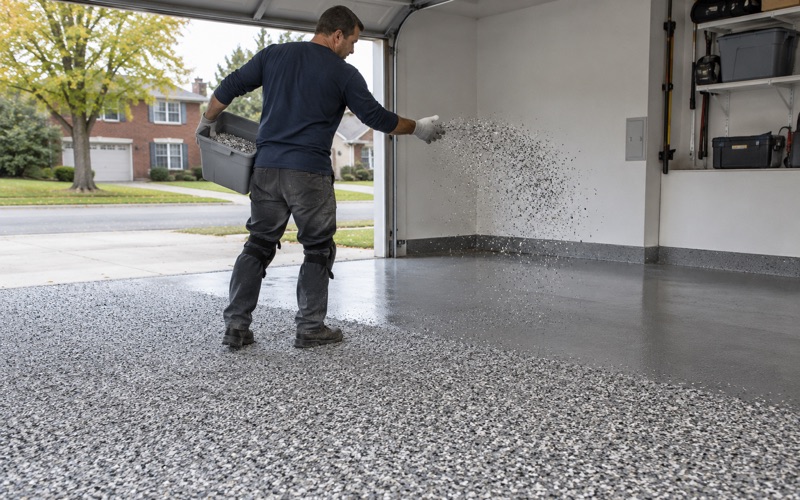
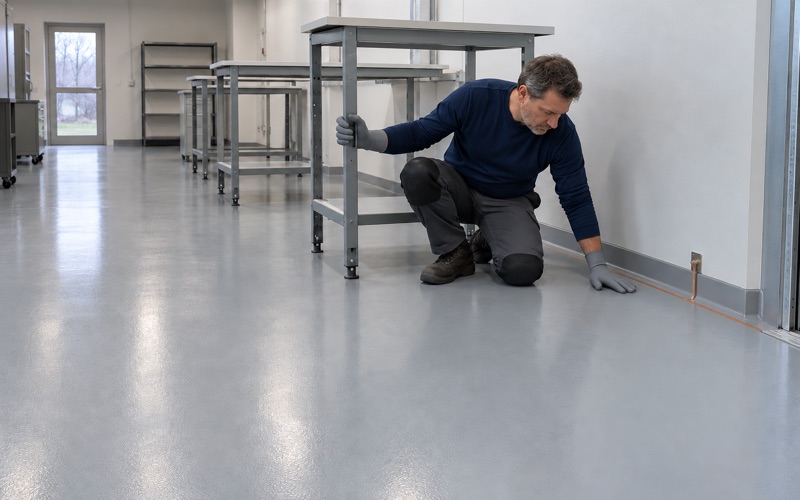
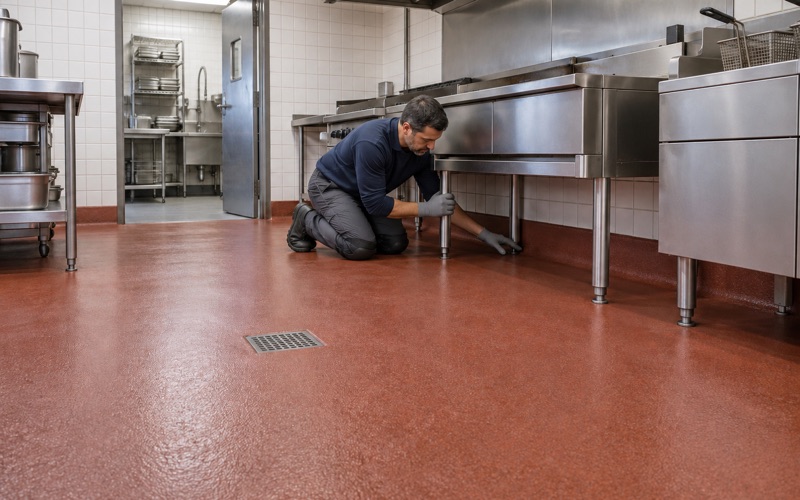
Once the slab is open, the build is matched to the room. A typical garage gets a 100% solids epoxy base coat, a vinyl flake broadcast and a polyaspartic topcoat that resists hot tire pickup and deicing salt. A basement may get a moisture-mitigation primer under the epoxy, or a urethane cement system where the slab conditions call for one. Whatever goes down, the proposal lists it by product and layer, along with the finished thickness, so the floor can be checked against the paperwork.
Moisture Under a Slab With No Vapor Retarder
Every mid-century slab in the village predates ASTM E1745, the 1997 standard for a modern under-slab vapor retarder. Many of these floors were poured straight onto gravel or soil with nothing between the concrete and the ground. That matters most in a basement, where moisture vapor moving up through the slab is the single most common reason a coating blisters or lets go.
The signs are often already there. White efflorescence along the walls, a damp shadow that comes and goes under a rug, or old paint lifting in bubbles near the middle of the floor all point to moisture or hydrostatic pressure working from below. We note every one of them before testing.
Testing Before We Quote a Build
Moisture testing is written into our scope as a line item on every slab, basement and garage alike. Depending on the floor, that means an ASTM D4263 plastic sheet test as a first read, ASTM F1869 calcium chloride vapor emission testing, or ASTM F2170 in-situ relative humidity probes drilled into the slab. We compare the results to the limits the coating manufacturer sets and to the ASTM F710 thresholds, and the numbers decide whether the floor needs a moisture-mitigation primer or a different system altogether.
What the Warranty Will and Will Not Cover
We read the warranty exclusions out loud before you sign, and moisture is the first one we name. If a slab tests high and you choose a build without mitigation, that choice is on paper, not buried in fine print. The same honesty applies to radon: a floor coating is not radon reduction, and in Illinois that work takes a state radon mitigation license from IEMA.
Water From the Neighborhood, Not Just the Slab
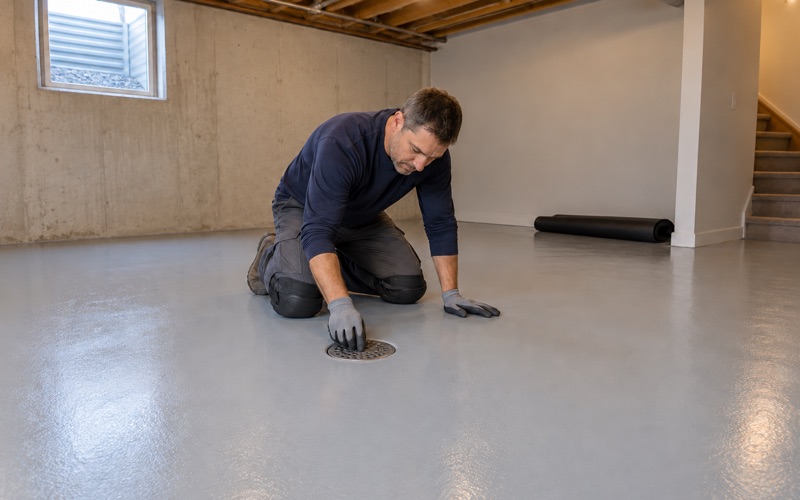
Some parts of the village have their own water story. Western Springs has named Ridgewood and Springdale as flood-prone neighborhoods and is paying for larger storm sewers there, including a pipe to Flagg Creek and a detention basin in Springdale Park, partly through a village stormwater fee. If your basement is in one of those areas, we ask about past backups and look closely at the floor drain and sump pit before we suggest a coating at all.
Timber Trails, Newer Slabs and One Owner Deciding
Some floors in the village are much younger than mid-century. Western Springs annexed the former Timber Trails golf course, 105.9 acres, on March 21, 2005, and 817 of the village’s housing units date from 2000 or later. A house in that newer layer usually sits on a younger slab, more likely to have a vapor retarder under it and less likely to carry decades of old coatings on top.
A Different Starting Point on a Younger Floor
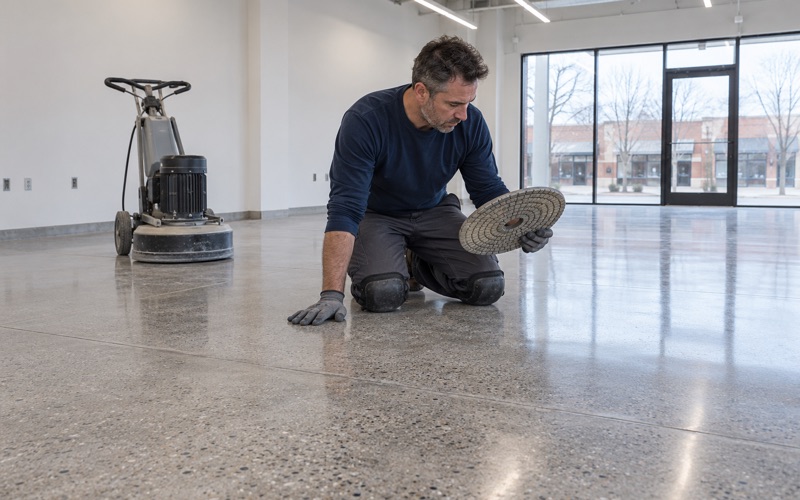
On a newer slab the prep is often lighter, but it is never skipped. We still grind to open the surface, check for curing compounds or sealers the builder may have applied, and run the same moisture tests. A younger floor can let us recommend a thinner build or a densified and polished finish with lithium silicate, where an older one would need more repair and more material to reach the same result.
The Person Who Lives There Makes the Call
Western Springs is close to entirely owner-occupied. Of 4,471 occupied units, 4,275, or 95.6 percent, are lived in by their owners, which means the person asking us about a garage or basement floor is almost always the person who will walk on it for the next decade. There is no landlord to satisfy and no tenant turnover to work around, so we talk through what you actually use the space for and build to that.
That might be a workshop that sees dropped tools and solvents, a basement turned into a family room, or a garage that simply has to shrug off a winter of slush. Each one points to a different system, a different texture and a different topcoat, and we explain the tradeoffs rather than selling the same floor to every house on the block.
Paperwork Before the Work
Every home job gets a written contract and the state’s Home Repair: Know Your Consumer Rights pamphlet before anything starts, as the Illinois Home Repair and Remodeling Act requires. Illinois does not issue a state license for flooring or coating work, so instead of a license number we show the contractor registration, bond and insurance the Village of Western Springs asks for. Our coatings are chosen within the Illinois limits on VOC content, which apply to the installer as well as the manufacturer.
- 20+ Years Coating Concrete
- Moisture Tested Before Quoting
- Itemized Written Proposals