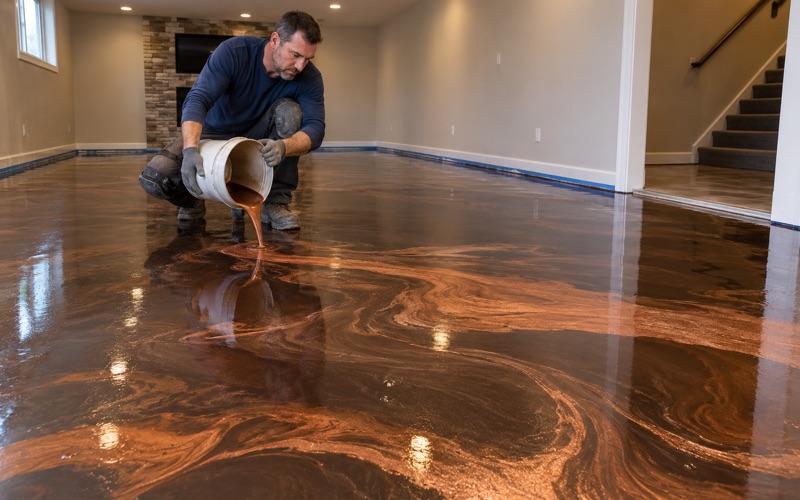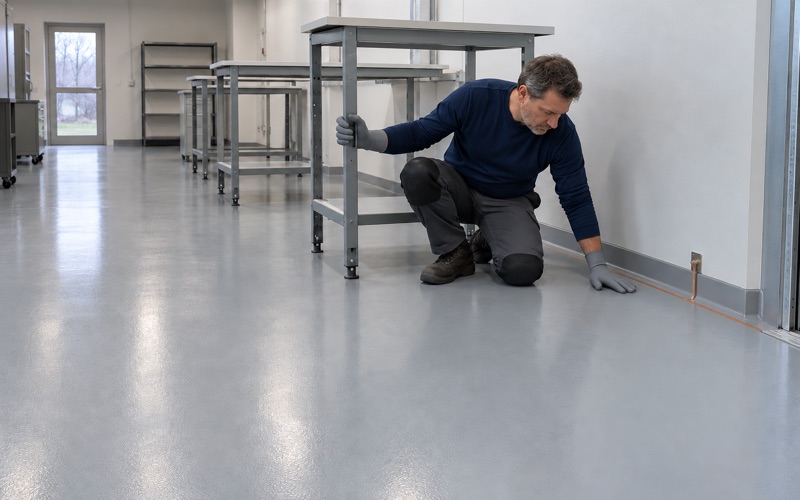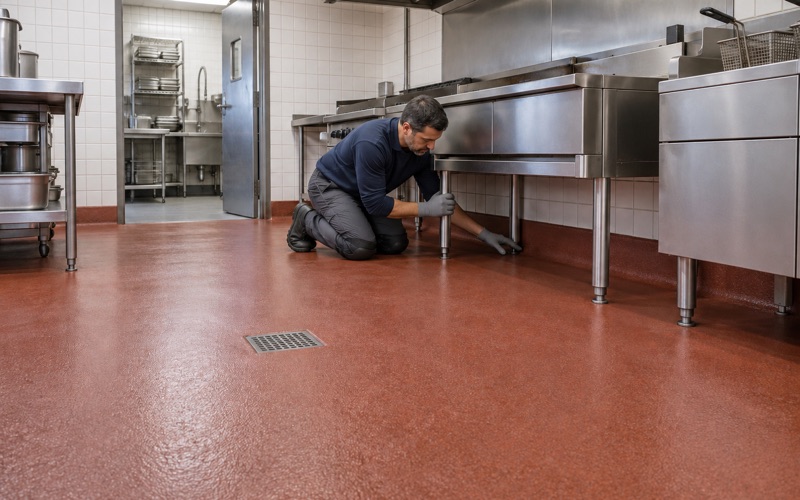
Arlington Heights Epoxy Flooring has spent more than 20 years installing epoxy flooring in Westchester garages and basements, and most of the floors we quote here begin the same way: a homeowner, a slab that has been in service for decades, and a house built to one of three postwar plans. The plan matters more than people expect. Where the garage sits relative to the living space changes how we prep, where the coating stops and what we test before we commit to a system.
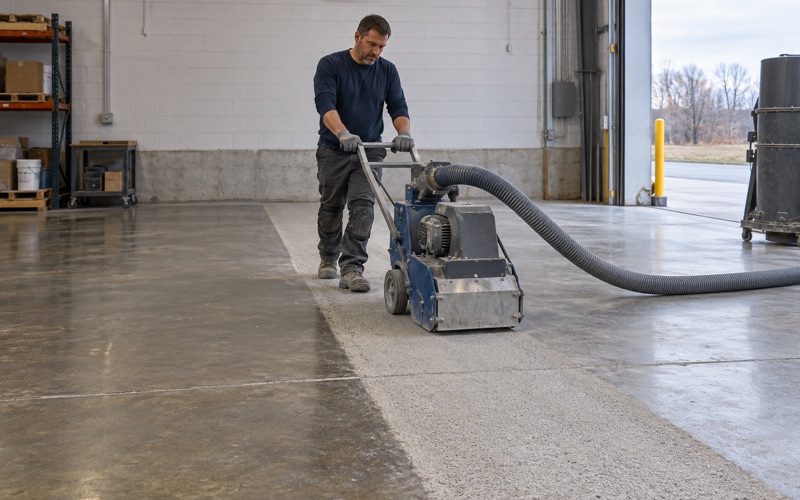
We open every slab mechanically, with a diamond grinder or a shot blaster, and we never acid etch. Moisture testing sits in the scope as its own priced line rather than turning up as an upsell after a coating lets go. When the proposal arrives, it names the product, the system build and the finished thickness, so you can hold the finished floor up against the paper.
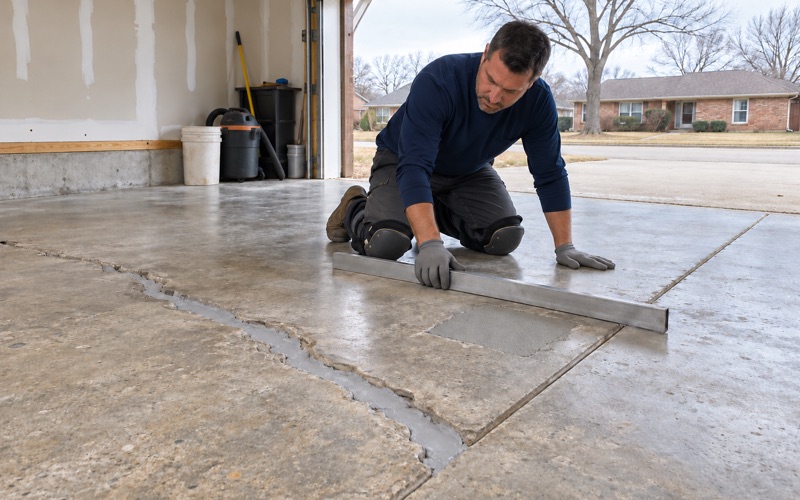
Before we price anything we read the cracks and whatever old coating is still on the concrete. If the slab needs repair before it can carry a coating, we say so plainly and quote that repair as its own step.
Ten years that poured most of the village’s floors
From 4,308 people to 18,092
Westchester is a village in Cook County, a western suburb of Chicago that counted 16,892 residents at the 2020 census. Its shape was set much earlier. Between 1950 and 1960 the population climbed from 4,308 to 18,092, and the houses that went up in that decade still make up the bulk of what we coat here.
The census housing count bears that out. Of 7,181 housing units, 3,475 were built between 1950 and 1959, which is 48.4 percent of the stock, against 26 units from 2010 to 2019 and none since. The decades on either side are smaller by comparison: 612 units date from the 1940s and 1,090 from the 1960s. For a flooring crew that means a recoat or a first coat in this village is almost always going onto concrete poured in the same burst of building.
What Insull’s plan left behind
The boom did not start from an empty field. In 1924 Samuel Insull and his associates bought about 2,200 acres intending to lay out a model English town, and a handful of English-style houses went up before the Depression. The postwar builders then surrounded those few houses with Georgians, ranches and split-levels.
When one of those older English-style houses comes up on our schedule, we treat its floor as a separate assessment. The house predates the boom, so we do not assume its slab behaves like the 1950s concrete next door. We test it, read its crack history and build the scope from what we find.
Looking for epoxy-flooring closer to Forest Park? See Forest Park Epoxy-Flooring.
Ranch, Georgian or split-level: three garages, three floor jobs
Walk any block from the boom years and the three house forms repeat. Each one puts the garage floor in a different relationship to the house, and that changes the job before a single kit of product is opened.
The ranch’s attached bay
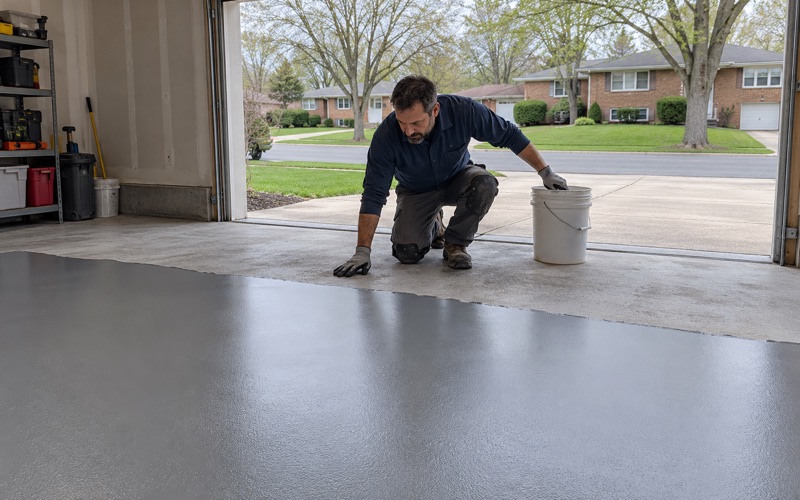
A ranch usually sets its garage beside the living space on roughly the same level, with a door into the house at the back of the bay. That is the most direct of the three jobs: grind the full slab to the profile the system calls for, fill and chase the cracks, then build the coating out to the walls. Our extra attention goes to the threshold at the house door, where the coating has to finish cleanly and foot traffic is heaviest.
Wide two-car bays from that era often carry a sawn control joint or two across the slab. We keep those joints open through the coating rather than burying them, because a film laid straight over a joint tends to crack along it the first time the concrete moves.
The split-level’s offset slab
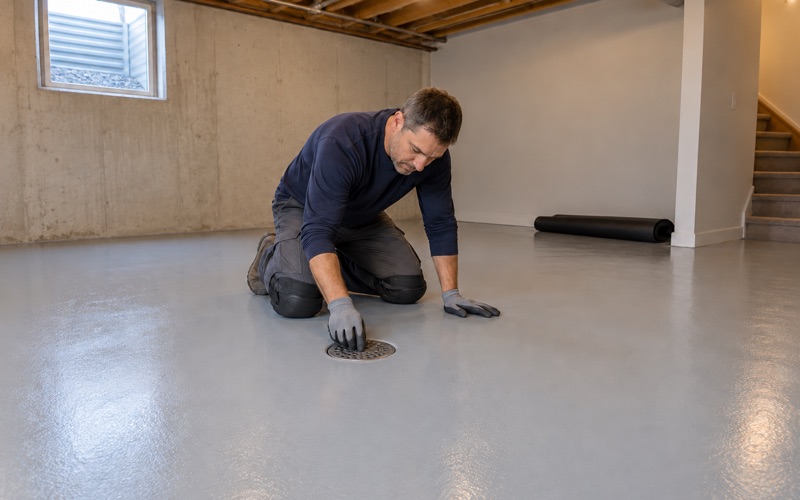
A split-level puts the garage slab at a different grade from the lower living level, which makes it a distinct floor job rather than a variation on the ranch. The step, the slab edge and the junction with any interior stair all need their own detailing. We decide in advance where the system terminates, how that edge is finished, and whether the lower-level floor beyond the door is a separate job with its own moisture test.
That lower level gets screened before anyone talks about color. An ASTM D4263 plastic sheet test is a quick first look, and a relative humidity probe gives the number a system is chosen against. We also do not sell a floor coating as radon reduction; in Illinois that work takes a radon mitigation license from IEMA.
The Georgian’s garage
The two-story Georgians of the same decade get no shortcut either. We do not price one from a photo. The slab’s size, its slope toward the door and its crack pattern decide the scope, and we see those in person before writing a number down.
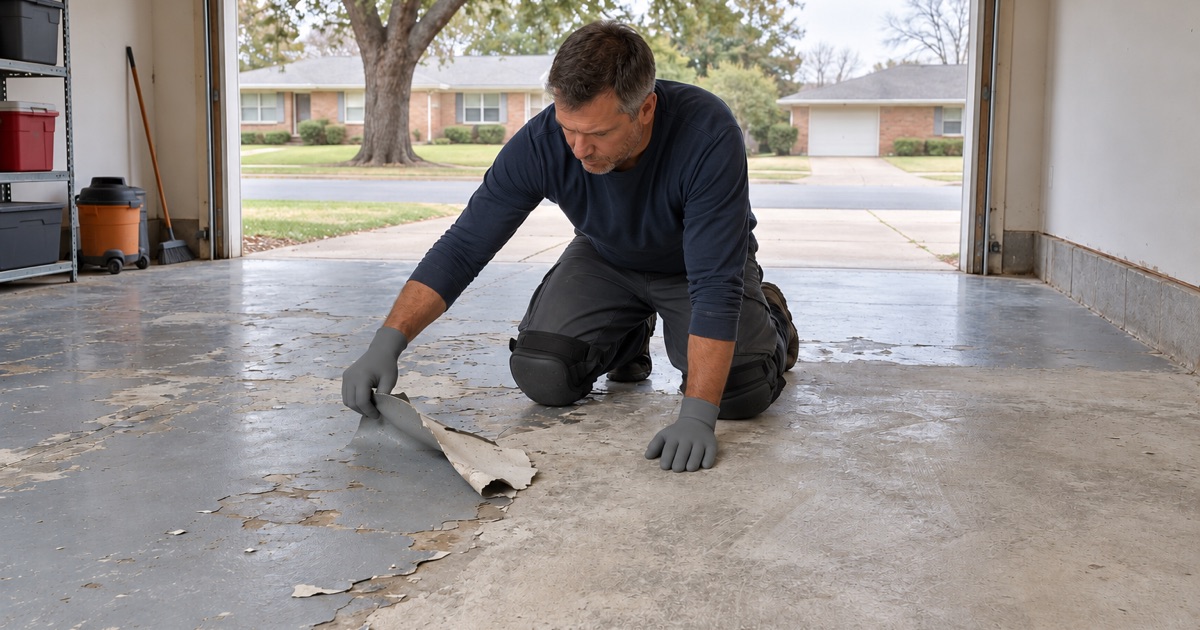
A garage that an earlier owner painted, sealed or patched needs that history removed first. Paint and clear sealers are ground off down to clean concrete, and patches that have lifted or powdered come out before new material goes in, so the finished floor bonds to the slab rather than to an old repair.
A seventy-year-old slab and the household that parks on it
The 1950s concrete under most Westchester garages is now about seventy years old. Slabs that age have usually been through decades of tire traffic and deicing salt, and the surface we grind into is rarely the surface that was poured.
What we check on concrete this old
We start with the cracks and sort the static ones from the ones still moving. A coating is a film that follows the slab under it, so it will mirror a moving crack rather than stop it, and we tell you that before the proposal is written. Spalled or pitted areas get repaired with a compatible patching material before any base coat goes down.
Moisture comes next. Depending on the slab we run an ASTM F2170 in-situ relative humidity probe or an ASTM F1869 calcium chloride test, and when the readings call for it we specify a moisture-mitigation primer under the base coat. Moisture is the first warranty exclusion we read out to you, before anything is signed.
Grinding, profile and cure
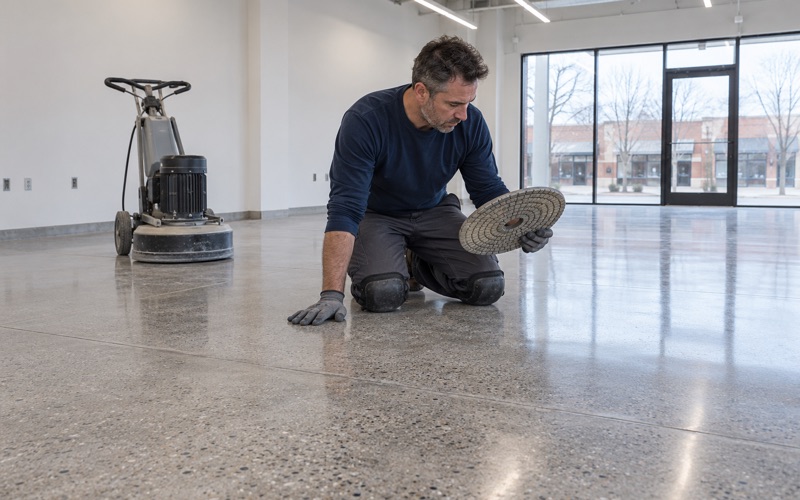
The grinding we described up front leaves an ICRI CSP profile the primer can grip, and on concrete this old it also exposes soft or contaminated spots a visual inspection misses. We schedule curing against slab temperature and dew point rather than the calendar. When an unheated garage is too cold to cure a coating properly, we say so and book the job for spring.
Built for what the tires bring home
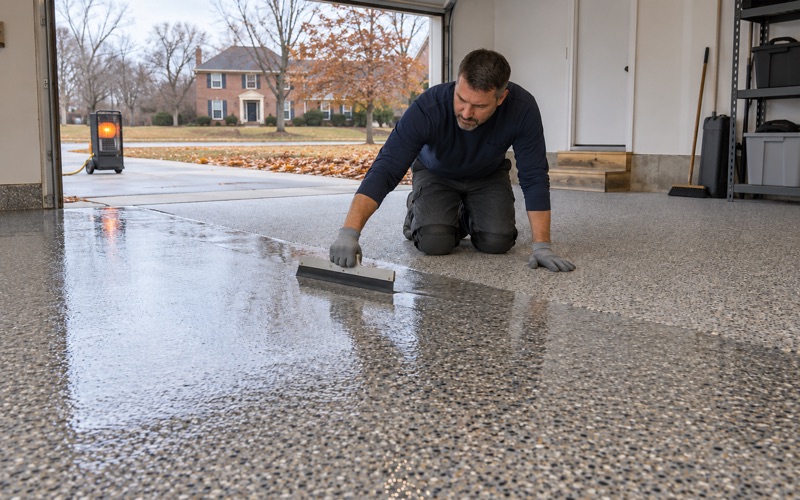
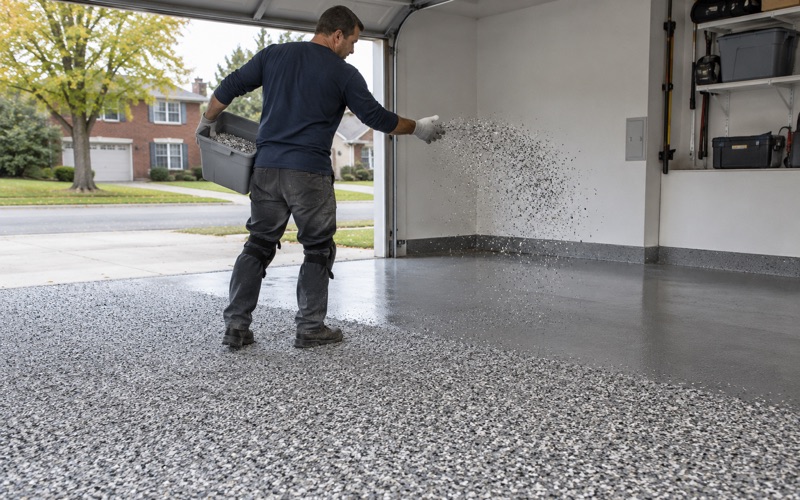
Every car that pulls into a garage here in winter carries calcium chloride brine and rock salt on its tires. For that load we typically build a 100% solids epoxy base with a vinyl flake or quartz aggregate broadcast and a polyaspartic or polyurea topcoat, which stands up to salt and hot tire pickup far better than a thin one-part paint. Every coating we select falls within the Illinois limit on VOC content, a rule that binds the installer as well as the manufacturer.
Hot tire pickup is the failure people notice first: a warm tire softens a weak coating and lifts it off in the shape of the tread. A properly cured topcoat over a ground slab is what prevents it.
Who signs the contract
Of 6,908 occupied units in the village, 6,275 are owner-occupied, or 90.8 percent, and only 234 detached houses are rented. Owner-occupied stock alone includes 5,505 single-family detached houses. In practice the person signing our contract is the person who will park on the floor every morning. Every home job gets a written contract and the state’s Home Repair: Know Your Consumer Rights pamphlet before work begins, as the Illinois Home Repair and Remodeling Act requires.
Office towers on Wolf Road, in a village of houses
The village describes itself as primarily residential and built out, with few developable parcels and edges formed by Forest Preserve District land, cemeteries and a golf course. Its commercial floor estate is small by comparison, and what there is runs to office space rather than warehouse slab.
Westbrook Corporate Center
Westbrook Corporate Center, at Wolf Road and Cermak Road, is five 10-story towers holding more than 1 million square feet of office space, completed in 1986. Ingredion’s headquarters address is 5 Westbrook Corporate Center, Westchester, IL 60154. Floors in a complex like that mean lobbies, service corridors and parking structures, not production floors.
Lobbies, corridors and parking decks
Each part of an office complex asks for something different. A lobby wants a finish that reads as part of the building, which points toward polished concrete with a lithium silicate densifier or a decorative epoxy. Service corridors want texture underfoot, and a quartz aggregate broadcast gives it, while parking areas need a system built for tire traffic, hot tire pickup and the salt cars carry in.
How we schedule commercial work
Office buildings have to keep running while we work, so we plan around the hours a lobby or corridor must stay open, often finishing in sections. Illinois issues no state license for flooring or coatings work, so we bring the village contractor registration, bond and insurance a municipality asks for. Cure times and odor are planned with the building manager before the first night of work.
Permits and the building department
Residential and commercial work alike runs through the Village of Westchester Community Development / Building Department. The village reports it has adopted the 2012 International Codes, and we confirm the edition in force with the department before writing any specification that depends on it.
- 20+ Years Coating Concrete
- Moisture Tested Before Quoting
- Itemized Written Proposals