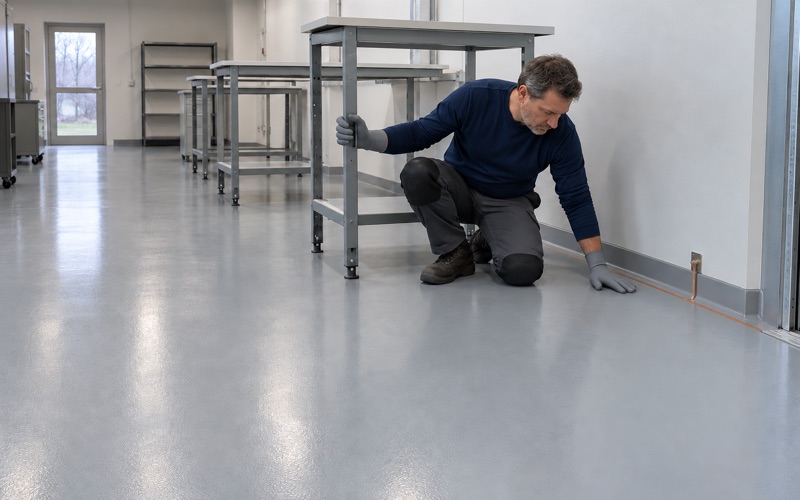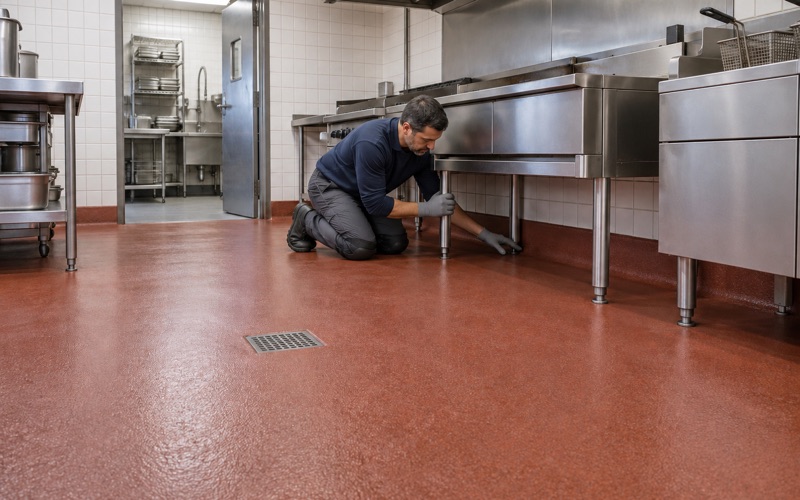
Arlington Heights Epoxy Flooring has spent more than 20 years installing epoxy flooring in Schiller Park and the surrounding northwest suburbs, and the floors we are asked about here lean commercial in a way most residential suburbs do not. A production kitchen that runs wet all shift, a hotel laundry room, a service corridor behind a banquet room: those are the slabs this page is mostly about.
Garage floors still matter, and we coat plenty of them, but a kitchen floor sets a harder test. It has to survive hot water, degreaser and a squeegee every night, it has to stay cleanable for an inspector, and it usually has to be installed while the business keeps serving. We plan commercial jobs around the hours a building has to stay open, which in a kitchen often means working in sections overnight or across a closed weekend.
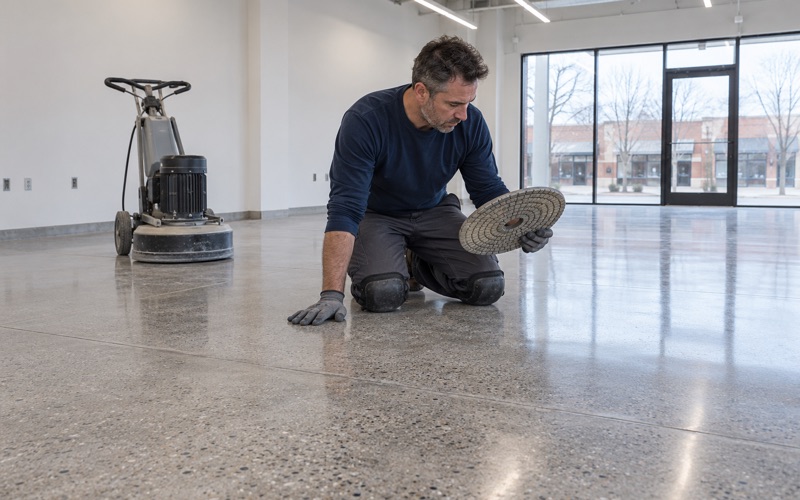
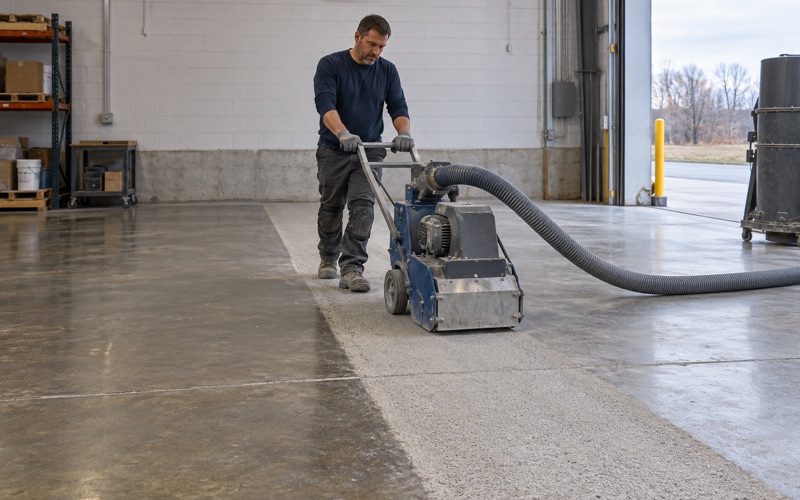
Every quote starts with the slab itself. We open the surface mechanically with a diamond grinder or a shot blaster, never acid, and the proposal names the product, the system build and the finished thickness so the owner can hold us to what was written.
An Airline Caterer Leads the Village Employer List
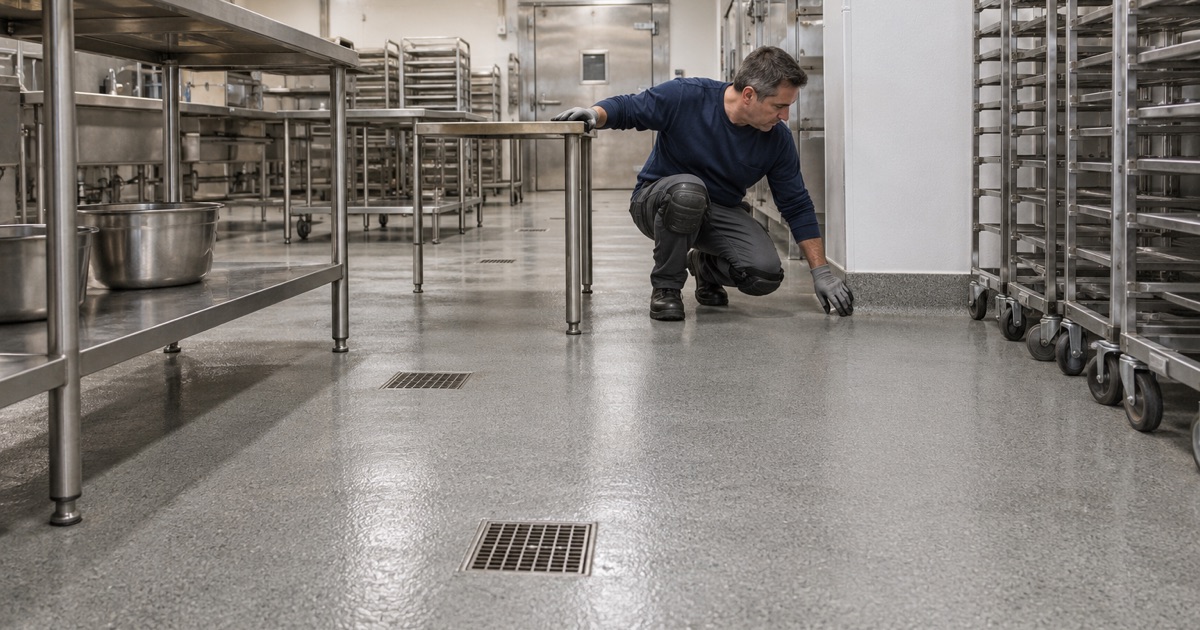
Schiller Park is a village of 11,709 people at the 2020 census in Leyden Township, Cook County, covering 2.77 square miles. Its own FY2024 annual financial report, drawing on village business license records, ranks Gate Gourmet first among employers at 500 workers, or 4.18 percent of village employment. That is an airline caterer at the top of the list, ahead of Arpac at 435 and MJ Celco at 225.
We want to be precise about geography, because a local reader will be. O’Hare International Airport sits across Interstate 294 from the village, and it is City of Chicago property. The Illinois State Fire Marshal records the former Gate Gourmet Flight Kitchen 2 at O’Hare Building 742, Chicago, owned by the Chicago Department of Aviation, so work on the airport side of the tollway is not Schiller Park work and does not run through village permits.
What the employer list does show is the kind of floor the local economy leans on. The village describes its more than 400 businesses as ranging from hospitality and travel firms to machine shops, and RAJA Foods sits on the same employer list at 80. Food rooms and service corridors that rarely dry out are the commercial floors that set this village apart.
Built for hot water, grease and daily washdown
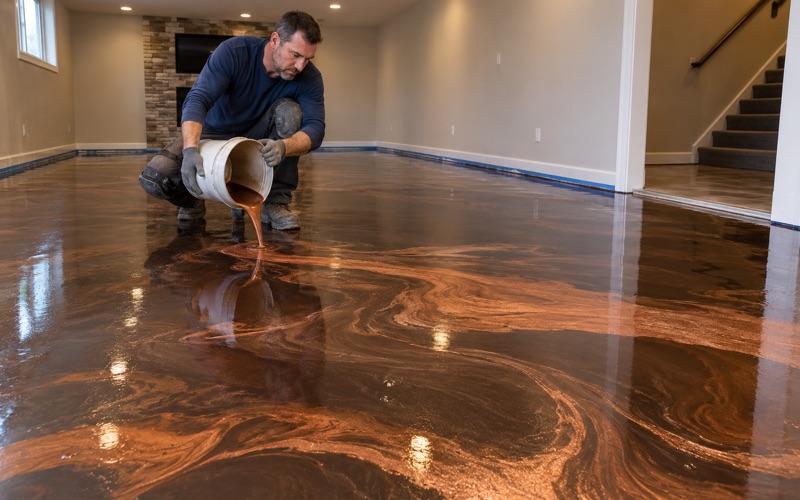
A production kitchen floor takes thermal shock from hot water and steam cleaning, fats that soften weaker coatings, and a nightly scrub. For that service we usually recommend urethane cement rather than a thin epoxy film, because it tolerates heat and repeated wet cleaning far better. Where a 100% solids epoxy is the right call, in a dry storage room or a prep area away from the kettles, we say why in the proposal.
Cleanable surfaces, coved edges and traction
The Illinois Food Code adopts the 2022 FDA Food Code, which asks for floors that are smooth, durable and easily cleanable, and section 6-201.11 carves out an exception that allows antislip floor applications for safety. Section 6-201.13 calls for the floor and wall junctures to be coved and closed. We run the cove base up the wall in the same resin system and set the texture with a quartz aggregate broadcast, so traction and cleanability are balanced rather than traded against each other.
Curing on a timeline the kitchen can live with
Urethane cement and epoxy both need time before they take traffic, and a kitchen cannot simply stay dark until the resin is ready. We schedule curing against slab temperature and the dew point spread at the surface rather than the clock, and we tell the owner how many hours each section needs before equipment rolls back. Cold, humid conditions during the cure can leave amine blush on an epoxy surface, which weakens the bond of the next coat.
Looking for epoxy-flooring closer to Lake Forest? See Epoxy-Flooring Services in Lake Forest.
Hotel Back of House Along the Airport Edge
Four Points Sheraton appears among the village’s ten largest property taxpayers in both 2015 and 2024, ranking fifth in the earlier year and carrying $5,819,447, or 1.18 percent, on the latest list. Commercial property makes up 55 percent of the village’s 2023 equalized assessed value of $491,441,198, which is how a village this small still supports a substantial commercial floor market.
A hotel is really several floors under one roof, and the guest never sees most of them. Behind the lobby there is usually a laundry, a banquet kitchen, housekeeping storage and service corridors that carry carts all day, and each one wears differently. We walk those rooms before quoting, because the right system for a laundry is rarely the right one for a corridor.
Laundry rooms and their drains
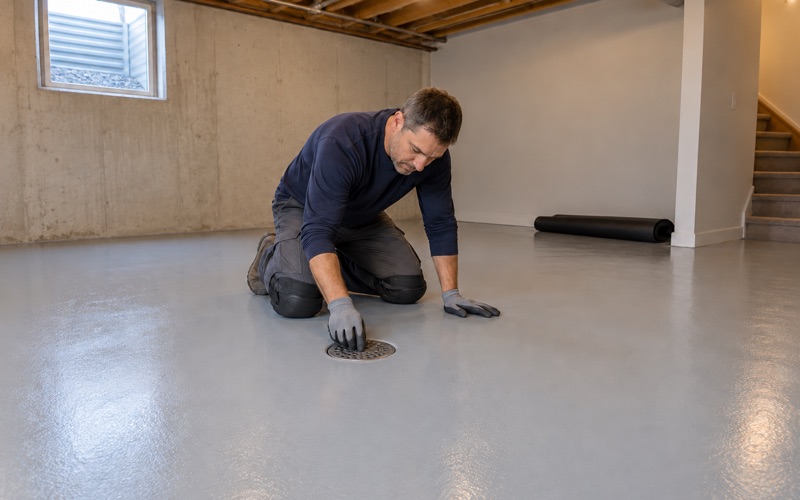
Commercial laundry floors see standing water, detergent and heavy machines that vibrate on their pads. We detail the floor drains and the edges around equipment bases carefully, because that is where water finds its way under a coating first. The slab under a busy laundry may also hold moisture, so we test it before choosing a primer.
Moisture testing as a written line item
We price moisture testing into the scope from the start. On a commercial slab that usually means ASTM F2170 in situ relative humidity probes, sometimes alongside an ASTM F1869 calcium chloride test, read against the coating maker’s limits. If the numbers are high, a moisture mitigation primer goes into the proposal before any finish coat is discussed, and moisture is the first exclusion we read aloud when we explain the warranty.
Corridors and cart traffic
Service corridors take hard rubber wheels, dropped linens and spilled chemicals from housekeeping carts, so the wear pattern is a narrow lane rather than the whole floor. A quartz broadcast system with a urethane or polyaspartic topcoat holds up well in those lanes, and we can recoat the traffic path later without stripping the room.
Working around occupancy
A hotel never closes, so service areas get done in phases with a path kept open for staff and carts. Quick curing polyaspartic topcoats help where a corridor can only be out of service overnight.
Licensed With the Village, Inspected by the County
Illinois issues no state license for flooring or coating work, so the license that matters here is the village’s own. Schiller Park requires contractors to be licensed before construction starts, registering through the Community Core app with the cost and scope of work, a fee by service type, and a state license, certificate of insurance, surety bond and workers’ compensation as applicable. Licenses run from May 1 to April 30 and renew every year.
We show the owner our current village registration, bond and insurance rather than a license number that does not exist for this trade. On a commercial job the village Community Development Department, with its building official, permit coordinator and inspectors, is the office that handles permits, and we ask about permit scope early so a kitchen does not lose a weekend waiting on paperwork.
Food floors answer to the county
Food floors in Schiller Park are not reviewed by a village health office. A kitchen or food production room inside the village falls under the Cook County Department of Public Health, whose jurisdiction covers suburban Cook County outside Chicago, Oak Park, Stickney Township, Evanston and Skokie.
No county office approves a floor product by brand, and we never present a coating as if it carried that kind of approval. What an inspector looks at is the finished surface: whether it is smooth, sealed, coved at the walls and cleanable, so that is what we build and what we document.
New slabs in the New West Gateway TIF
The village names the New West Gateway TIF as its primary remaining development area, so new commercial slabs are most likely to appear there. Fresh concrete holds a great deal of water as it cures, and we will not coat it on a schedule set by the opening date rather than by test results.
Garages on a Housing Stock That Stopped Growing
Schiller Park has 4,514 housing units, and none were built in 2010 or later. The 1950s account for 1,395 of them and the 1960s for 1,425, so most of the village’s housing is more than half a century old. Every residential job here starts from an existing slab, which means repair and recoating rather than new construction.
Owners occupy 2,579 of the 4,353 occupied units, and 1,882 of those owner households live in detached single family homes. That is the heart of the garage market here: an owner with an old slab, often carrying an earlier coating, a few cracks and patches from past repairs. Renters occupy the other 1,774 units, with 708 of them in buildings of five to nine units. Any garage or parking slab on those properties is the owner’s call, and we quote it the same way: test, grind, repair, then coat.
Judging the old finish before a recoat
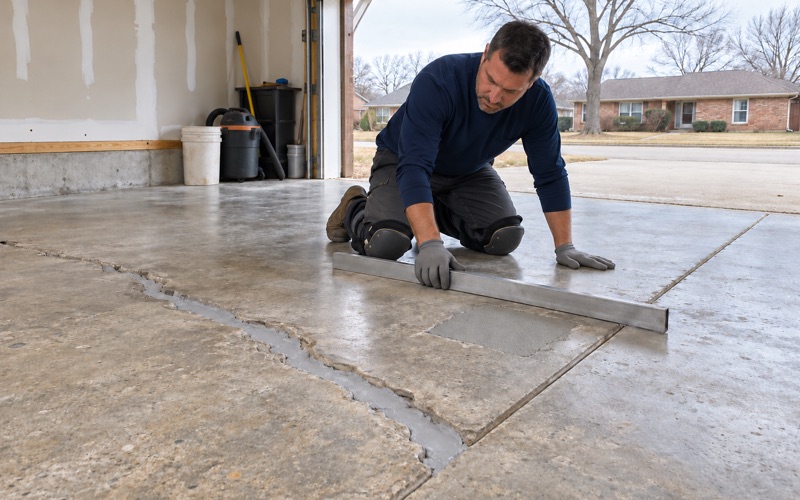
Before we quote a recoat, we look at what is already on the floor and how well it is bonded, because a new system laid over a failing one fails with it. We tell an owner plainly when a slab needs crack repair or spall patching first. A coating is a film that follows the concrete under it, so a moving crack will show through, and we say that before the job rather than after.
Grinding off the old system
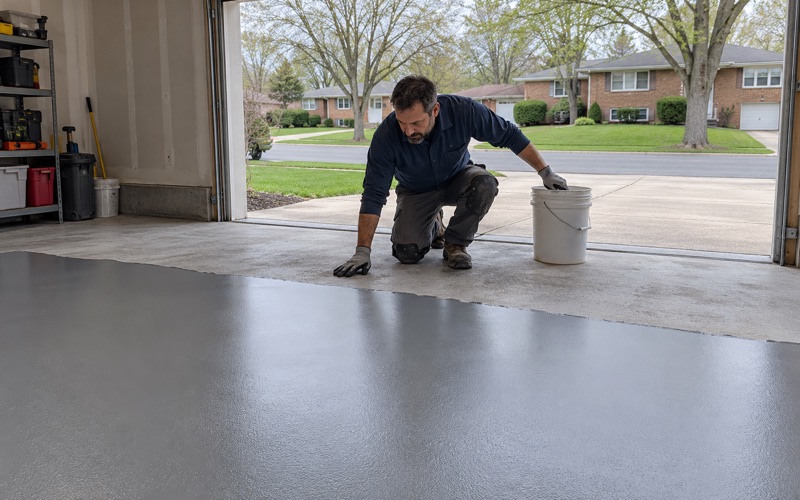
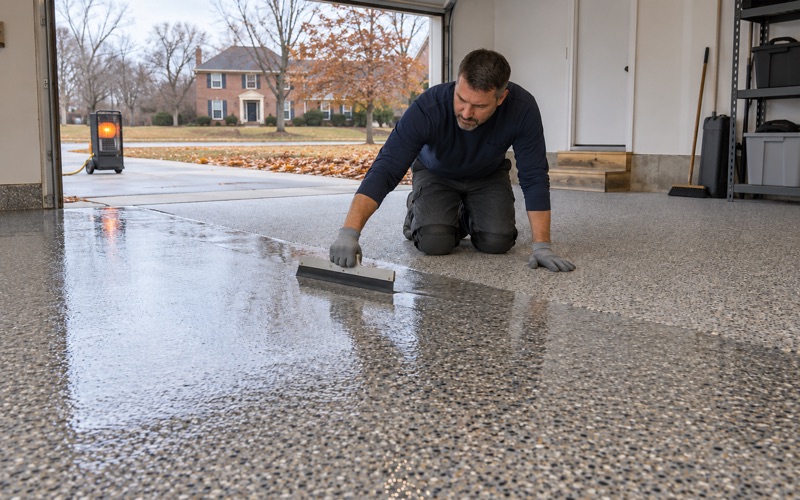
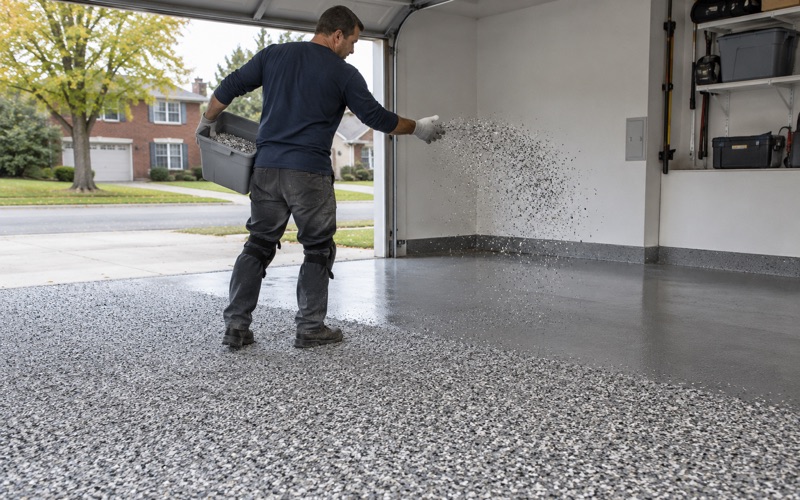
An older garage floor that has been sealed, painted or coated before needs that layer ground off, not etched, to reach sound concrete at the right ICRI surface profile. From there a typical garage build is a 100% solids epoxy base with a vinyl flake broadcast and a polyaspartic topcoat, which resists hot tire pickup far better than a thin retail kit.
The paperwork on a home job
Every residential job gets a written contract and the Home Repair: Know Your Consumer Rights pamphlet before work begins, as the Illinois Home Repair and Remodeling Act requires. The contract spells out what is being repaired, what is being coated and what the warranty leaves out, so nothing about the job depends on memory.
- 20+ Years Coating Concrete
- Moisture Tested Before Quoting
- Itemized Written Proposals