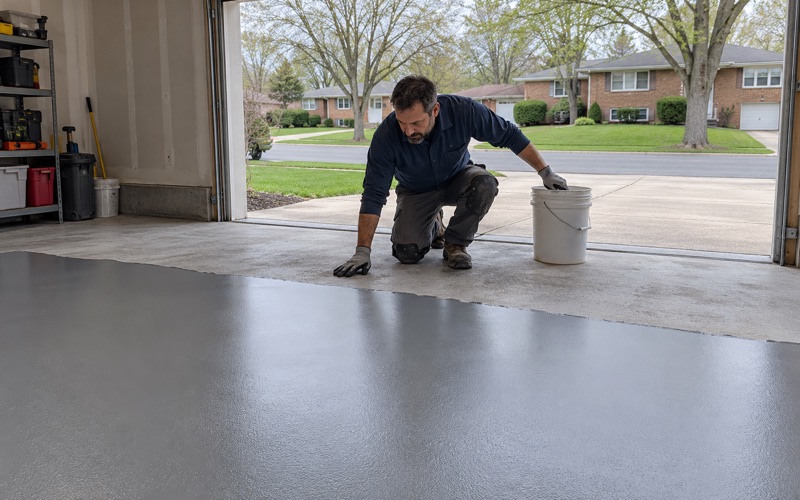
Arlington Heights Epoxy Flooring has spent more than 20 years on epoxy flooring, and in Round Lake that work has an unusual shape: most of the garage slabs we are asked to coat were poured within a few years of each other. When a whole street of builder-grade floors reaches the same age, the questions owners bring us tend to match too. Is the slab sound enough to coat, how much preparation does a plain broom finish need, and does a floor that is barely twenty years old really need a moisture test?
Our answer to the last question is yes, and it is written into the proposal as its own line item. Every quote also names the product, the system build and the finished thickness, so the owner can compare the floor that went down against the paper that sold it. We look at the cracks and any previous sealer before we price anything, and we tell you when a slab needs repair first.
The sections below explain why Round Lake’s slabs behave as a group, what changes in a townhome garage, and how we confirm which village actually issues the paperwork for your address.
A Village That Tripled in Ten Years
Round Lake is a northern suburb of Chicago in Lake County, incorporated in 1909, but its housing stock is overwhelmingly young. Census figures put 3,953 of the village’s 6,627 housing units, or 59.6 percent, in the 2000 to 2009 build years. Over that same decade the population climbed from 5,842 to 18,289, a 213.1 percent jump, and the 2020 count reached 18,721.
The decades on either side make the contrast plain. The 1980s added 411 units, the 1990s added 752 and the 2010s added 492, so the 2000s alone produced more than twice as many homes as those three decades combined. For us, that means the typical Round Lake garage is not an outlier to diagnose from scratch but one of thousands that started life the same way.
What a single-decade build-out means for a floor
A village that grows that fast is built by production builders working subdivision by subdivision. Production-built garage slabs are commonly poured, troweled and handed over bare, with no densifier and no coating. That is not a defect, but it means most of these floors have spent their entire service life absorbing whatever the household tracked in, and their surfaces show it in similar ways.
Planned subdivisions with their own taxing areas
Lake County’s district-map index lists Round Lake Special Service Area 1 for Madrona Village, SSA 2 for Prairie Walk, and SSAs 3 and 4 for Lakewood Grove. An SSA of that kind is a taxing area drawn around one subdivision, which tells us these neighborhoods were laid out as planned developments with their own common-area arrangements. We do not assume what any given SSA funds, and the floor work itself is the same inside or outside one.
What the planned-development pattern does tell us is that neighboring garages in Madrona Village or Lakewood Grove often share a builder, a pour season and a finish. When we have already ground and tested one slab on a street, we know what to look for on the next, though each floor still gets its own readings.
Looking for epoxy-flooring closer to La Grange Park? See Epoxy-Flooring Services in La Grange Park.
Builder-Grade Slabs That Turned Twenty Together
A slab poured in 2005 is now about twenty years old, and the oldest homes from that boom are older still. That is the age at which bare concrete usually tells you what it is made of: dusting at the surface, shallow pop-outs, control joints that have opened, and stains that have worked their way into the paste.
Opening the surface properly
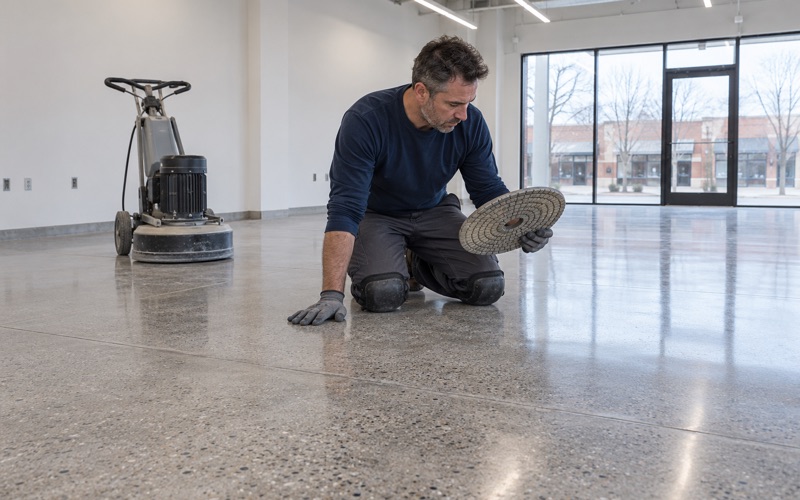
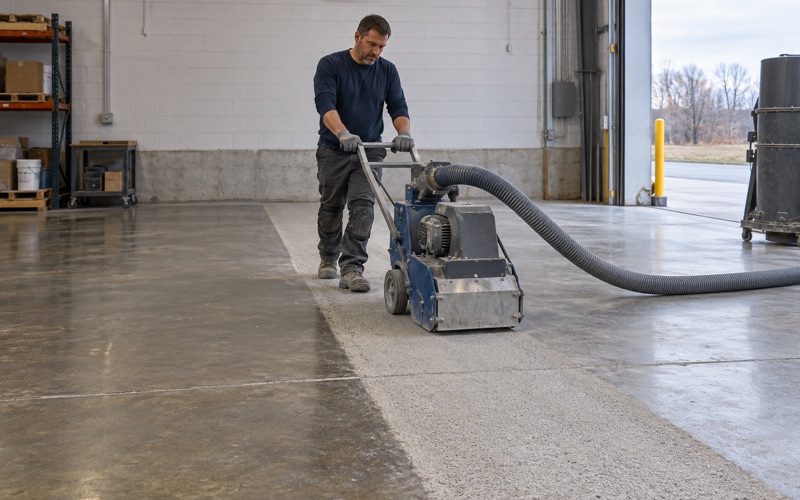
We do not acid etch. Every Round Lake slab is opened mechanically, with diamond grinding or shot blasting, to an ICRI CSP profile that matches the system going down. A tight troweled finish from a production pour can be surprisingly dense on top and weak a quarter inch below, and only mechanical preparation tells us which one we are dealing with.
Grinding also removes the clear acrylic sealers some owners rolled on years ago. Those films look harmless, but a 100% solids epoxy or a polyaspartic topcoat bonded to a peeling sealer will peel with it. If the old coating is failing, we say so and price its removal rather than burying it.
Reading the cracks before quoting
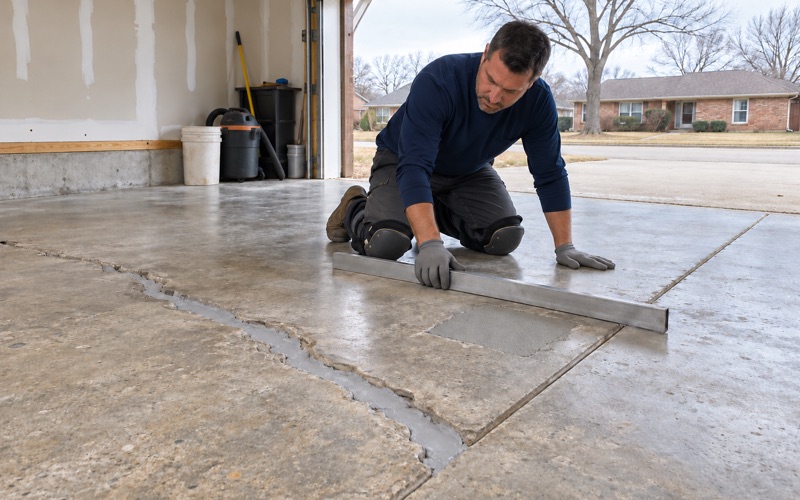
Twenty years of settling often leaves a garage like these with a few cracks. We separate hairline shrinkage cracks, which we can fill and coat over, from cracks with offset or movement, which need repair first. A coating is a film that follows the slab under it, so we tell owners plainly that it will not stop a moving crack from reappearing.
Choosing the system for a family garage
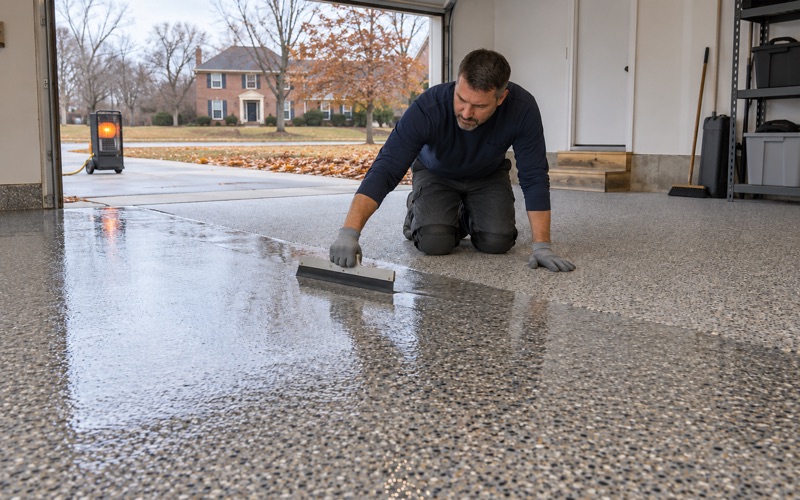
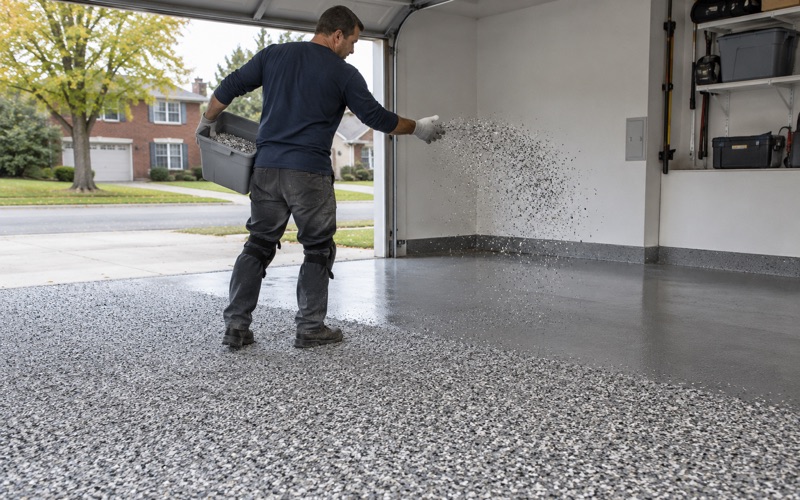
For a family garage here we usually propose a 100% solids epoxy base, a vinyl flake broadcast and a polyaspartic topcoat, because that build resists hot tire pickup and cleans easily. Where an owner wants more texture underfoot, a quartz aggregate broadcast is an option. Whatever the build, the proposal states the product and finished thickness so nothing is left to memory.
When a densifier is the better answer
Not every owner wants a broadcast floor. For a garage that mostly holds storage or a workbench, a ground surface treated with a lithium silicate densifier hardens the top of the paste and cuts down on dusting without adding a film that can peel. We lay out both routes side by side when the slab and the use support either one.
A densified floor will still show the stains and patches already in the concrete, while a flake system hides them. The choice comes down to how the garage is used, and the proposal spells out what each route does and does not do.
Townhome Garages and Their Moisture Check
Not every Round Lake garage sits under a detached house. Of the village’s 6,627 units, 1,897 are single-family attached, and 1,310 owner households, about 26.4 percent of all owners, live in them. That is a large share of floors in single-bay garages tucked between shared walls.
Working in a single bay
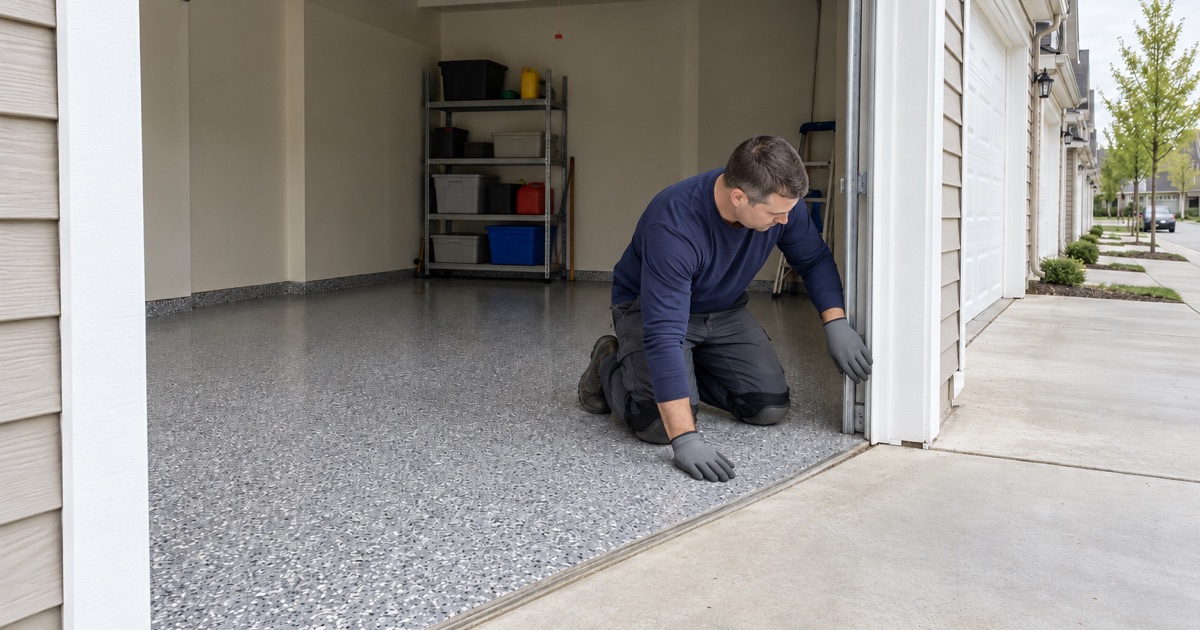
A townhome garage changes the logistics more than the chemistry. Grinding a narrow bay means careful dust control at the shared wall and the door into the living space, and staging equipment so a neighbor’s driveway stays clear. We plan the cure window so the owner knows exactly how long the car stays outside, since there is rarely a second bay to borrow.
Why a 2005 slab still gets tested
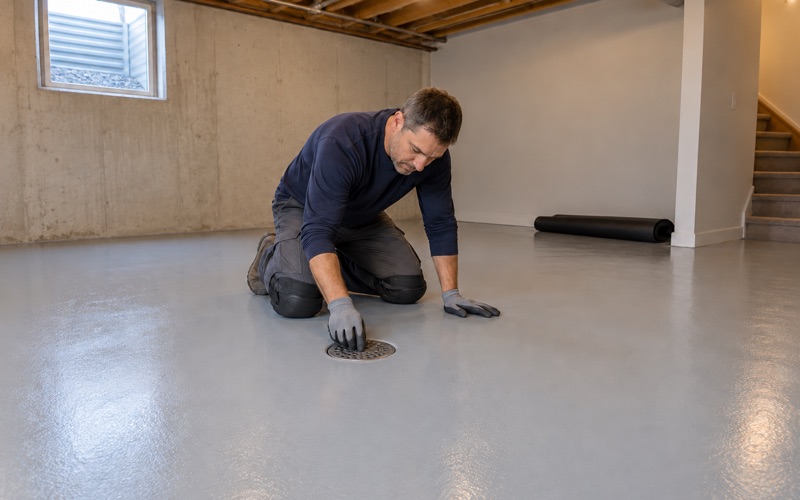
The residential code has never required an under-slab vapor retarder beneath a garage slab, so a young garage floor can carry as much moisture from the ground as an old one. Being twenty years old instead of sixty is not a reason to skip the test. Coatings that blister in the first year often trace back to vapor pushing up through a slab nobody measured.
We start with an ASTM D4263 plastic sheet test as a quick screen, then use ASTM F1869 calcium chloride kits or ASTM F2170 in-situ relative humidity probes for numbers we can compare against the product’s limits. If readings come back high, the proposal adds a moisture-mitigation primer rather than gambling on the standard build.
Amine blush is the other surface problem we watch for in a closed garage. It can form when a curing epoxy meets cool, humid air, and a topcoat laid over it may not bond, so we check for it before every recoat.
Warranty terms, read out first
Before any job is sold, we go through the warranty exclusions with the owner, and moisture is the first one we name. Because the testing is already part of the scope, that conversation is grounded in readings from your own slab rather than a general caution. We also schedule the cure against slab temperature and the dew point spread at the surface, not just the date on the calendar.
Round Lake or Round Lake Beach? Checking Which Village
The name on a mailing address in this area does not settle which government you live under. Round Lake, Round Lake Beach, Round Lake Park and Round Lake Heights are four separate villages, and each one issues its own permits, even though they sit side by side.
One fire district, four building departments
The Greater Round Lake Fire Protection District serves about 52,000 residents across roughly 15 square miles, and its territory overlaps the villages of Round Lake, Round Lake Beach, Round Lake Park, Round Lake Heights and Hainesville. A shared fire district can make the villages feel like one place, but permits and contractor paperwork still come from whichever village actually contains the property.
For homes in the Village of Round Lake itself, that office is the Building Department at the village hall, 442 N. Cedar Lake Road in Avon Township. Before we schedule a job, we confirm the address against the geocoder rather than the mailing label, so the right department sees our paperwork.
Round Lake spans portions of Avon, Grant and Fremont townships and has its own Metra station on the Milwaukee District North line. Those details help us orient a job, but the address check is what decides the permit office.
What we bring instead of a state license
Illinois issues no state license for flooring or coatings contractors, so there is no license number to quote. Instead we provide whatever contractor registration, bond and insurance the village in question asks for. Every home job also comes with a written contract and the state’s Home Repair: Know Your Consumer Rights pamphlet before work begins, as the Illinois Home Repair and Remodeling Act requires.
Beyond the attached garage
The village’s housing also includes 213 mobile homes, 160 of them owner-occupied, along with homes built well before the 2000s boom. We walk each of those floors on its own terms. For commercial spaces in the village, we schedule around the hours the business has to stay open, and every coating we apply falls within the Illinois limit on VOC content.
- 20+ Years Coating Concrete
- Moisture Tested Before Quoting
- Itemized Written Proposals