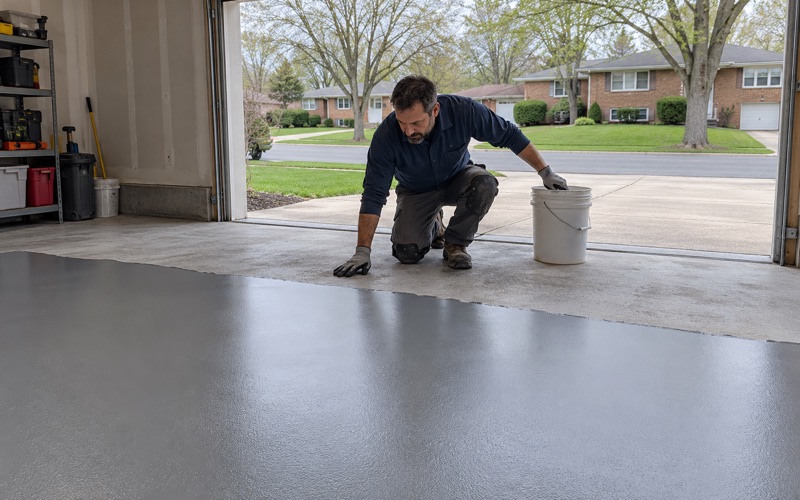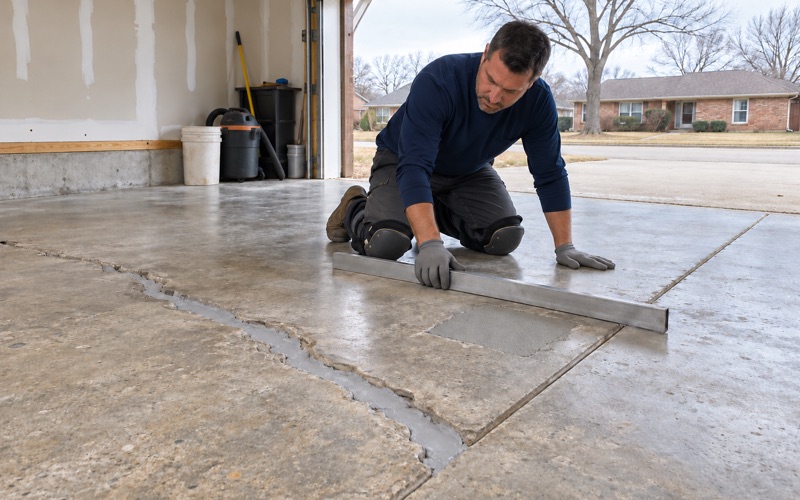
Arlington Heights Epoxy Flooring brings more than 20 years of slab work to epoxy flooring in River Grove, and the first thing we want to know about a floor here is whether water has ever stood on it. The answer shapes everything that follows, from the testing we write into the scope to the primer we specify and the warranty language we read aloud.
A slab that has soaked and dried, sometimes more than once, is a different job from a clean pour. It can carry trapped moisture, mineral deposits, lifted paint and patches laid down in a hurry after a cleanup. We find those things before we name a price, because finding them halfway through a grind is how a quote turns into an argument.
We are also direct about what a coating can and cannot do. An epoxy or polyaspartic system is a thin film bonded to concrete; it gives a floor a hard, cleanable, good-looking surface, but it does not hold river water out of a garage or a basement. Anyone selling it as a flood barrier is selling something that does not exist.
Twenty-Five Repeat Claims and the River Road Corners
River Grove is a village on the Des Plaines River, and its flood record is written down rather than remembered. The Cook County multi-jurisdictional hazard mitigation plan carries a River Grove annex, dated 2019, and that annex is where most of what we know about local high water comes from.
What the FEMA count actually says
The annex lists 25 properties that FEMA identifies as repetitive loss, plus one severe repetitive loss property, and it records none of them as mitigated. Repetitive loss means flood insurance has paid on the same address more than once. It is a count of specific properties, not a share of the village’s 4,573 housing units, and we never treat it as a statement about every basement in town.
The same annex lists flood events in October 1986, August 1987, 1995, February 1997, September 2008, July 2010, July 2011 and April 2013. When the plan asked whether the village’s flood maps were adequate, River Grove answered no and pointed to the extreme flooding of April 2013. That honesty is useful to a floor contractor, because it tells us not to lean on a map line when an owner says the garage took water.
Grand Avenue, Fullerton Avenue and River Road
The annex names two intersections where floods have made the street impassable: Grand Avenue at River Road, and Fullerton Avenue at River Road. For our crews, a closed intersection is a scheduling fact before it is anything else. A multi-coat system needs an uninterrupted stretch from grinding through final cure, and we will not start one when a property’s access depends on a road the village has seen go under.
Keeping the hazard in proportion
The village’s own hazard scoring places flood sixth of seven, with a score of 24. We mention that because it keeps the conversation level: high water here recurs at particular addresses, and the right response is to test the slab in front of us rather than assume the worst about every floor in the village.
Looking for epoxy-flooring closer to Lincolnwood? See Epoxy-Flooring Services in Lincolnwood.
Coating a Floor That Has Already Been Wet
When an owner tells us a floor has flooded, the job begins with the concrete rather than the color chart. Moisture testing is a written line item in every one of our scopes, basement or garage, and on a slab with a flood history it carries more weight than anything else we measure.
Testing the slab, not just its surface
Concrete can feel dry to the hand while the top inches still hold water from the last event. We start with an ASTM D4263 plastic sheet test to see whether moisture is moving up, then use ASTM F2170 in-situ relative humidity probes set into the slab, and the ASTM F1869 calcium chloride test where it fits the job. A basement slab can also sit under hydrostatic pressure from below, and the readings tell us whether that pressure is something a primer can manage or something a coating should not be asked to handle.
If the numbers say wait, we say wait. A floor that has to dry for several more weeks before primer goes down is a floor we would rather schedule later than repair next year.
Grinding off what the water left behind
Flooded concrete often shows efflorescence, the white mineral crust that water carries to the surface as it evaporates. It also tends to carry failed paint, old sealer and patching compound that loosened during the soak. We take all of it off with diamond grinding or shot blasting to a measured ICRI CSP profile, and we do not acid etch, since acid leaves residue in a damp slab and does nothing for a surface that is already contaminated.
The cracks get read at the same time. Where a section has settled or a crack is still moving, we tell the owner it needs repair before coating and price that repair separately. A coating follows the slab beneath it, and we explain that at the walk-through rather than after a crack telegraphs through a new floor.
Building the system, and naming its limits
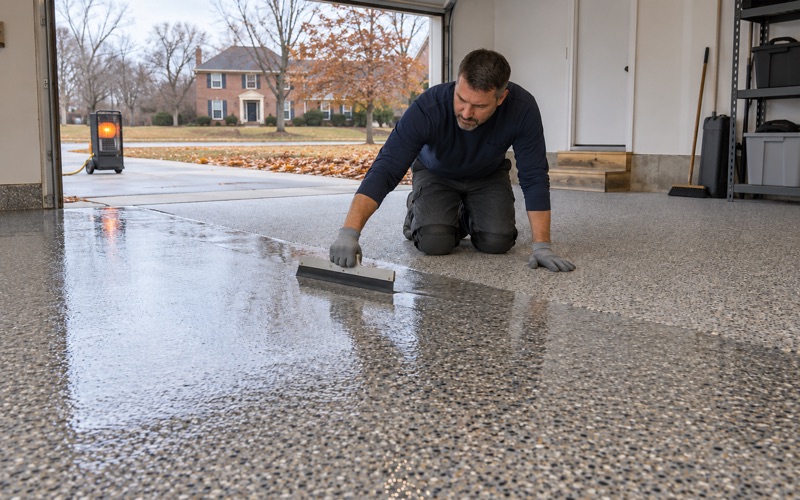
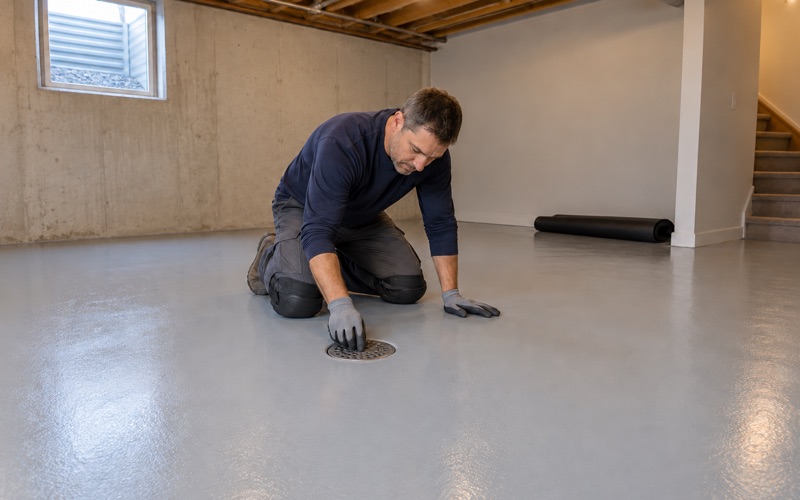
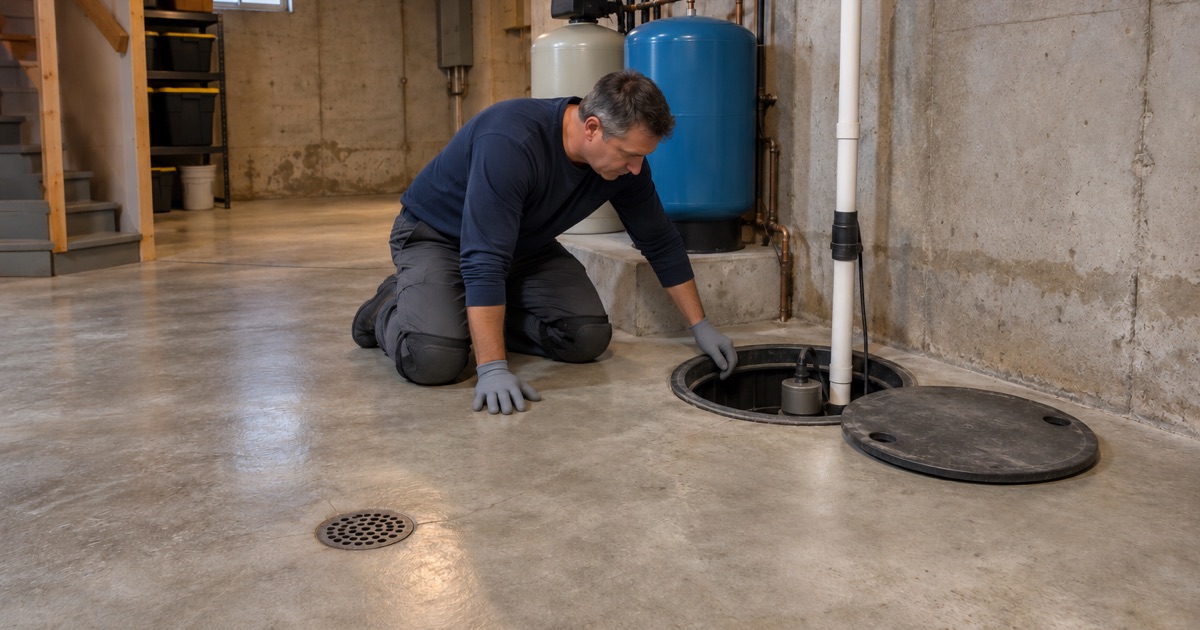
On a slab with moisture history we usually start with a moisture-mitigation primer, then build with 100% solids epoxy and a polyaspartic topcoat, often with a vinyl flake or quartz aggregate broadcast for texture. Floor drains and sump pits get their own detailing so the coating terminates cleanly at the edge instead of peeling back from it. The written proposal names the product, the system build and the finished thickness, so an owner can check the finished floor against the quote.
Before anything is signed, we read the warranty exclusions out loud, and moisture is the first one we name. A coating that shed its bond because river water came back through the slab is not a product defect, and an owner deserves to hear that from us before the job is sold.
One House in Six Predates 1940
Flood history is half the story on River Grove floors; age is the other half. Of the village’s 4,573 housing units, 762 were built in 1939 or earlier, which is roughly one in six. Another 1,252 went up in the 1940s and 1950s, so 44.0 percent of the housing stock predates 1960.
Chicago Home Gardens and the early slabs
Much of that early stock traces to the Chicago Home Gardens subdivision, established in 1920. The village counted 484 residents that year and 2,741 by 1930, a jump that tells you how quickly those lots filled with houses and outbuildings. Concrete poured in that era was rarely laid over anything like a modern under-slab vapor retarder meeting ASTM E1745, which is one more reason we test before we quote.
Only 180 housing units have been added since 2000, so there is little new construction to change the picture. A River Grove garage floor is far more likely to be decades old, patched and previously painted than freshly poured.
Owners, renters and the paperwork
Of 4,196 occupied units, 2,332 are owner occupied, about 55.6 percent, and 1,579 of those are single-family detached homes. Those detached houses are where most residential garage and basement work happens. Every home job we take gets a written contract and the Home Repair: Know Your Consumer Rights pamphlet before work starts, as the Illinois Home Repair and Remodeling Act requires.
Triton College and the commercial floors
Triton College, which opened in 1964, sits at 2000 N 5th Avenue inside the village limits, and the village lists it as a principal employer with 1,450 people. A campus of that size runs classrooms, workshops, corridors and service spaces that cannot all close at once. On institutional and commercial jobs like that, we phase the work around the hours a building has to stay open and plan each area’s cure so traffic returns to a finished floor rather than a soft one.
Licensed by the Calendar Year, Permitted From $100 Up
Illinois issues no state license for flooring or coatings work, so the paperwork that matters is the village’s. The Village of River Grove Building Department, at 2621 N Thatcher Avenue, handles contractor licensing, permits and floodplain management, with the Village Engineer serving as floodplain administrator under the flood damage prevention ordinance adopted in August 2008.
Licenses that run January to December
River Grove contractor licenses run from January 1 to December 31 no matter when the application is filed. A general contractor license costs $150 and a subcontractor license $125, and each comes with a $10,000 trade-specific license and permit bond and a certificate of liability insurance naming the village. Instead of a state license number we cannot have, we hand over that village registration, the bond and the insurance certificate.
The calendar year matters for timing. A floor quoted in late fall and installed after New Year’s spans two license years, so we confirm the renewal is on file before the crew arrives.
The $100 permit threshold
The village requires a building permit for any remodeling valued over $100, and its own list includes concrete work. That threshold catches almost any coating job worth doing, so we treat the permit as part of the schedule rather than an afterthought. On a property with a flood history, questions about work in the floodplain go to the Village Engineer, not to us.
Commercial jobs and the fire department
River Grove’s fire department runs from one station at 2601 Thatcher Avenue, staffed by part-time firefighters who hold full-time jobs with other departments, with six on duty at all times. On a commercial floor, fire-code questions go to that department, and we build its answers into the plan before the first pass of the grinder.
- 20+ Years Coating Concrete
- Moisture Tested Before Quoting
- Itemized Written Proposals