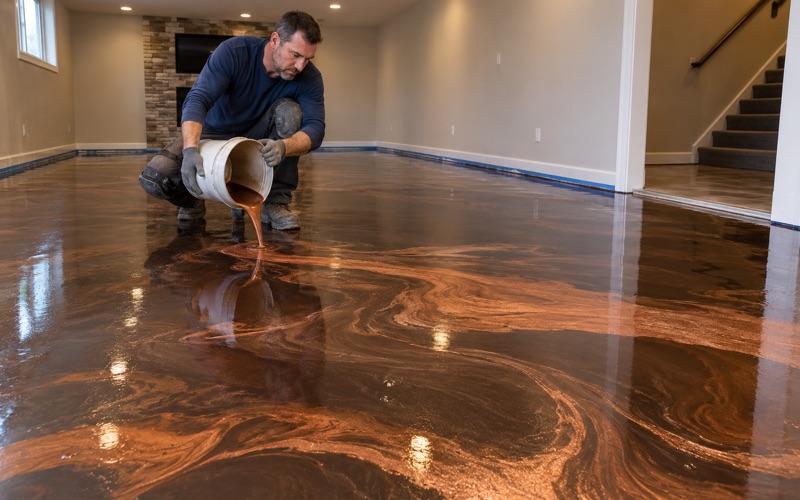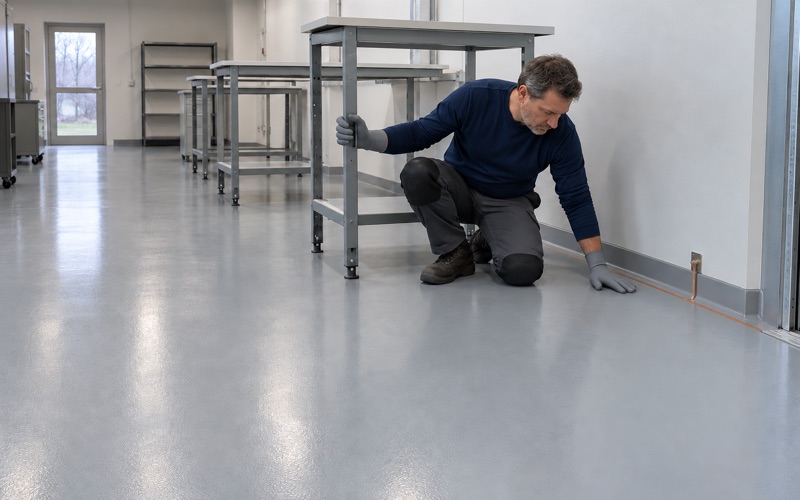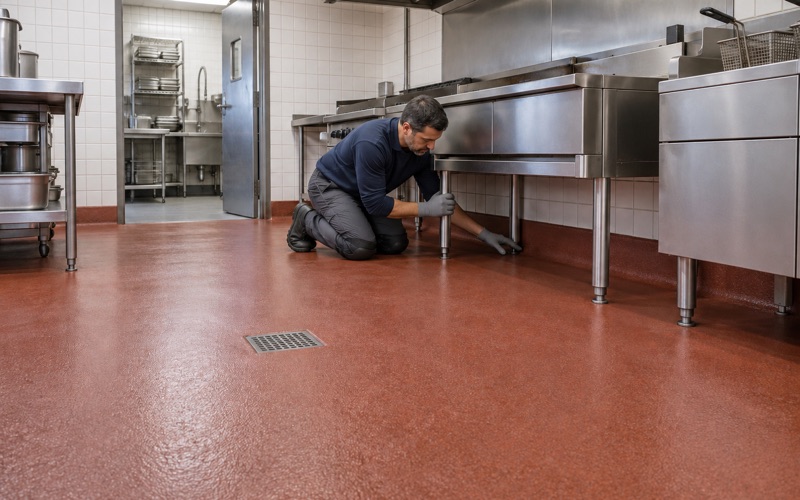
Arlington Heights Epoxy Flooring has spent more than 20 years putting down epoxy flooring in Prospect Heights and across the northwest suburbs, and the first thing we ask about a floor here is what is standing on it. A garage slab carrying two cars is one job. A basement or utility slab carrying a pressure tank, a softener and a tangle of supply lines is a different one, and the quote should say which it is.
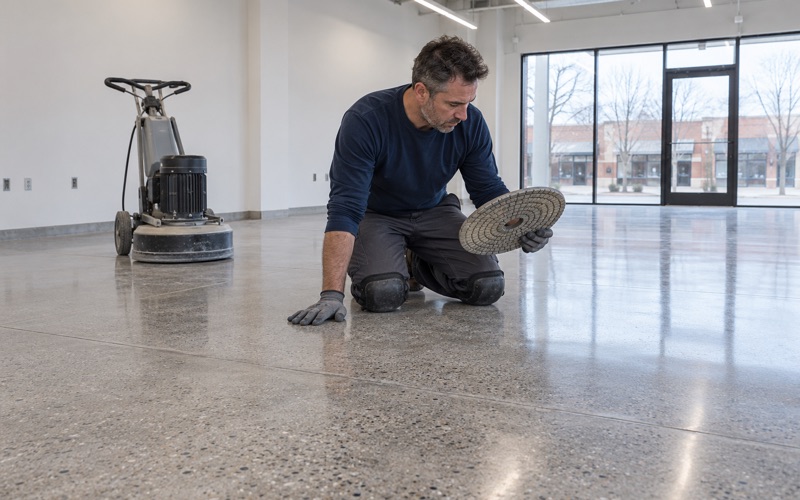
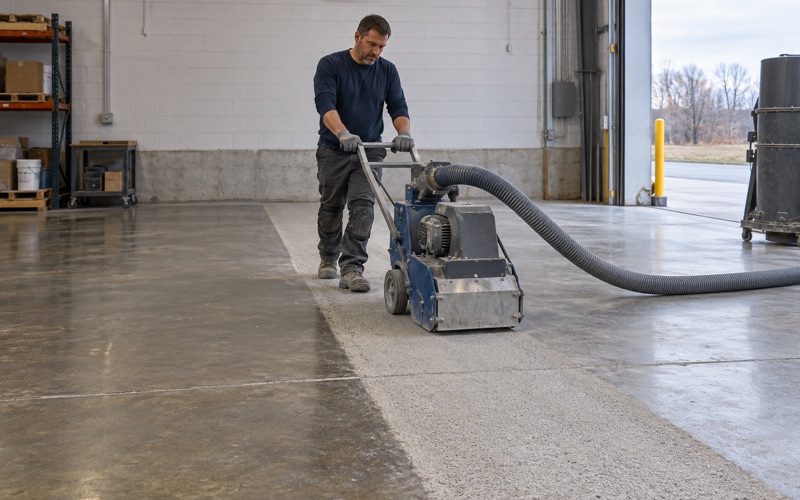
Our process does not change with the address: the concrete is opened with a diamond grinder or a shot blaster, never acid, and a moisture test is a priced line on the proposal rather than an afterthought. What changes in Prospect Heights is the equipment, the ownership of the floor and the age of the slab underneath.
That is why we walk the room before we write a number. A floor that has to be coated in sections around fixed equipment, or one that belongs partly to an association, takes a different schedule than an open two-car bay.
Two water systems in one city, and what that puts on the floor
Prospect Heights does not run on a single water supply. The city’s own system carries Lake Michigan water produced by the Village of Wilmette, moved through mains owned by the Village of Glenview and bought from Illinois American Water Company. That system serves only part of the city.
The city’s 2013 Water System Study, prepared by Baxter and Woodman, counted about 1,080 service connections on that system, serving roughly 2,700 people in places such as the Rob Roy development, the Lake Claire subdivision and along Camp McDonald Road and Wheeling Road. The same study found approximately 2,140 residences, about 6,500 people, plus commercial and institutional property served by private wells. Expansion was planned in phases, so we never assume which side of that line a given address sits on in 2026.
Why the water source matters to a coating crew
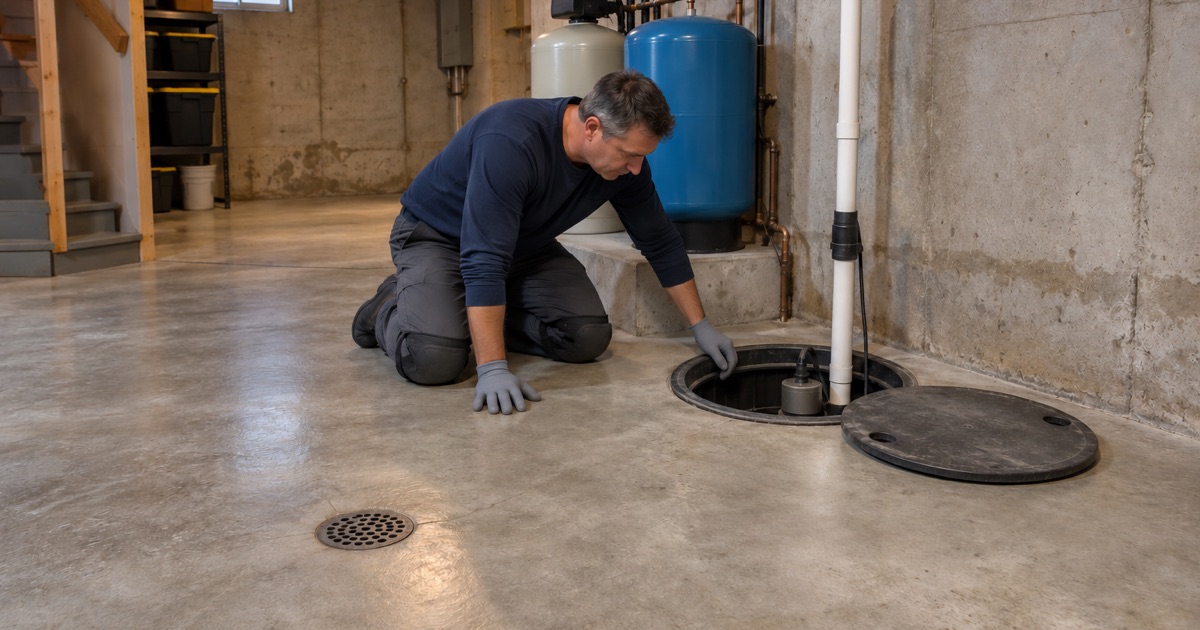
The City of Prospect Heights does not regulate private wells, and the owner is responsible for keeping one running. A house on a well typically keeps its own water system indoors: pump controls, a pressure tank and often treatment equipment such as a softener or filter. When that hardware sits on a basement or utility-room slab, it is the reason the floor exists in the first place, and it cannot be unplugged for three days while a coating cures.
To be clear about what this does and does not mean: a well does not make a slab damp, and we will not tell you it does. The concern is practical. It is about access, about water that lands on top of the floor, and about equipment that stays connected the whole time we work.
Coating around a well tank and softener
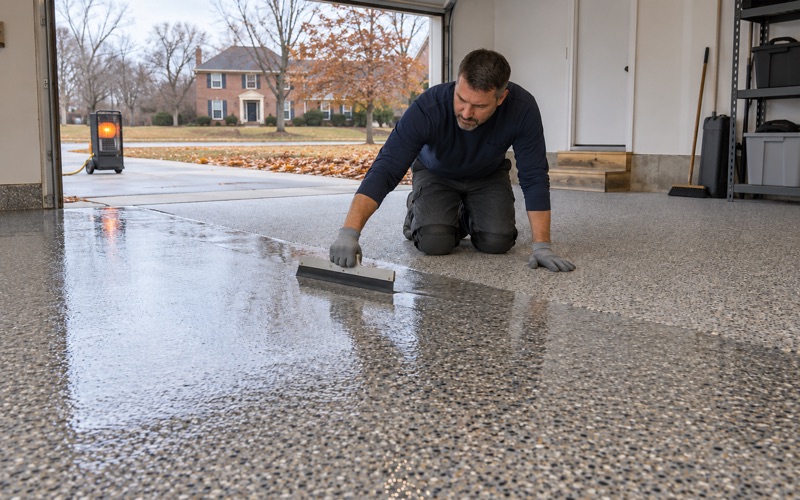
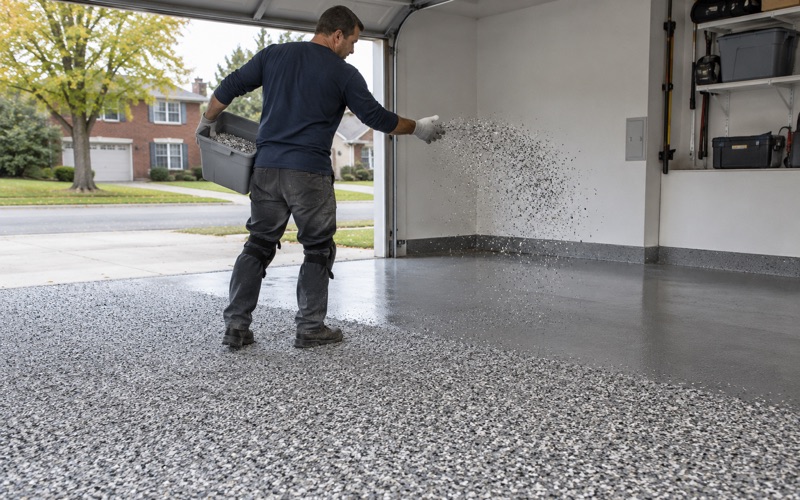
We plan these rooms in sequence. Where a tank or softener can be shifted on its base, we coat beneath it in a first pass and set it back once the film has cured; where it cannot move, we grind and coat tight to the footing and seal the edge. Softener discharge, filter backwashes and the occasional drip from a tank fitting all land on the floor, so we lean toward a 100% solids epoxy base with a polyaspartic topcoat that wipes clean, and we keep a light quartz aggregate broadcast near the equipment where a wet floor is likely.
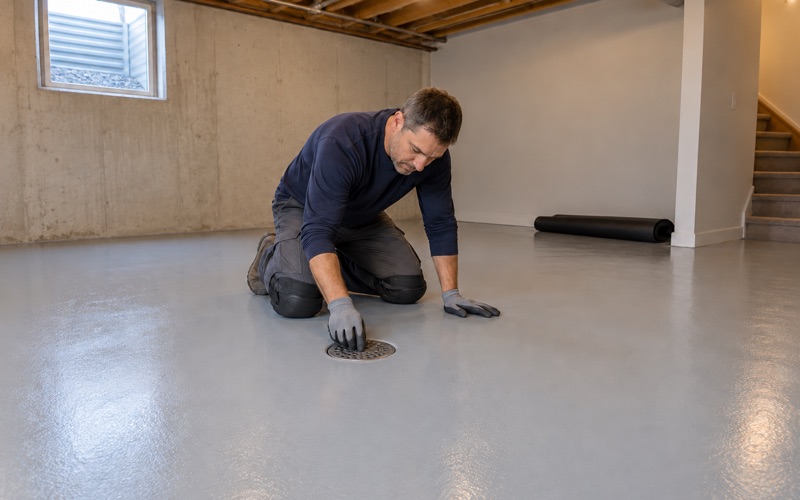
Floor drains and sump pits get detailed rather than painted over. The coating is turned down into the drain body and finished cleanly at the pit rim, so water headed for the drain reaches it instead of creeping under the edge of the film.
Looking for epoxy-flooring closer to Deerfield? See Epoxy-Flooring Services in Deerfield.
Testing for moisture before the coating, not after
Most coating failures we are called to look at started as a moisture question nobody asked. A slab can look and feel dry and still push vapor up through the concrete, and once a film is bonded on top, that vapor has nowhere to go but into the bond line. Blisters and peeling follow.
So the test comes first, on basement and garage slabs alike, and it is written into the scope with its own price. We start with an ASTM D4263 plastic sheet test as a quick screen, then use ASTM F1869 calcium chloride kits or ASTM F2170 in-situ relative humidity probes when the room or the result calls for a firmer reading. The numbers are read against the coating manufacturer’s limits, not guessed.
We also ask what a basement has been through. On the west side of the Des Plaines River, Levee 37 runs from Palatine Road to Euclid Avenue and protects more than 600 homes and dozens of businesses in Mount Prospect and Prospect Heights. Whether a particular house sits in a floodplain is a parcel-by-parcel question, so we ask the owner rather than guess from the street name, and a history of water in the room shapes the system we recommend.
What a high reading changes
A reading over the line does not automatically end the project. It usually means a moisture-mitigation primer under the system, which adds cost and a step, and we would rather price that on day one than explain a blister in year two. In some rooms the honest answer is that the slab needs another approach entirely.
We also read the warranty exclusions aloud before you sign, and moisture is the first one on that list. You should know what a coating covers and what it does not while the decision is still yours.
Curing on the slab’s schedule
A basement stays fairly even through the year, but a detached or unheated garage does not. We time each coat against the slab temperature and the dew point spread at the surface rather than the date on the calendar, because a cold, sweating slab is how amine blush and a weak bond start. When an unheated garage is too cold to cure properly, we say so and book it for spring.
Townhome and condominium garages: whose floor is it?
A large share of Prospect Heights housing is not a detached house. More than half of the city’s housing units sit in buildings of three or more units, and another 749 are single-family attached homes. In that kind of building, the garage floor or storage room you use every day may legally belong to everyone.
Start with the association
Before we schedule, we ask the owner to confirm with the association or property manager who owns the slab, whether a coating needs approval, and whether there are rules on color, finish or work hours. Some associations want the work done the same way across every unit; others leave it to each owner. Either way, the answer belongs in writing before a grinder comes off the truck.
On a shared building we also confirm which fire authority the manager deals with. In Prospect Heights that is the Prospect Heights Fire Protection District, a separate taxing district rather than a city department, and its roughly 5 square miles do not line up exactly with the city limits.
Working in a shared building
Diamond grinding with dust extraction keeps the work contained, which matters when the garage next door is still in use. We stage equipment so neighbors can come and go, keep the shared drive clear, and give the manager a cure schedule so nobody drives onto a fresh floor. For an owner-occupied townhome, the job still runs under a written contract, and the state’s Home Repair: Know Your Consumer Rights pamphlet is handed over before work starts, as the Illinois Home Repair and Remodeling Act requires.
Floors in houses from the 1960s, 1970s and 1980s
The city’s housing stock leans heavily on three decades. Of the city’s 6,915 housing units, 1,630 were built in the 1970s and 1,568 in the 1980s, the two largest building decades, with another 1,237 from the 1960s. That means most slabs we coat here have had well over three decades to collect paint, sealer, adhesive, oil and patchwork.
Reading the old coating and the cracks
We look at what is already on the floor before we quote it. A worn sealer or flaking garage paint has to come off completely, and grinding to a proper ICRI concrete surface profile is how we know the new system is bonding to concrete rather than to the last owner’s coating. Stained or contaminated patches near a furnace or a workbench get cut out or treated before anything goes down.
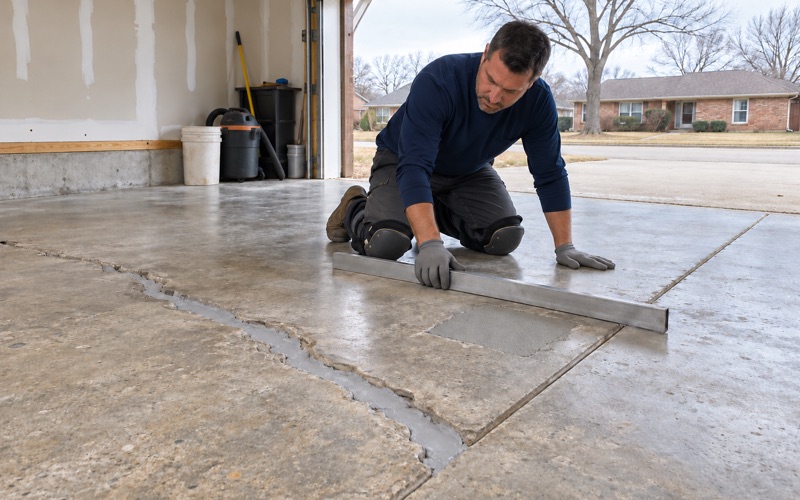
Cracks get the same scrutiny. Some are cosmetic and can be filled and ground flush; others show a slab that is still moving or has heaved. When a floor needs repair before it can be coated, we say that plainly and price it separately.
What a coating can and cannot do
A coating is a thin film that follows the concrete beneath it. If a joint opens or a crack shifts after the job, the film will follow that movement, and we explain this before the work rather than promising a floor that will never crack. What we can promise is in the proposal itself: the named product, the full system build and the finished thickness, so you can check what was quoted against what went down.
Illinois issues no state license for flooring or coatings work, so instead of a license number we show the contractor registration, bond and insurance a municipality asks for. And while we are in a basement, one more line we hold: a floor coating is not radon reduction. In Illinois, that work takes a state radon mitigation license, and we will point you to a licensed mitigator rather than sell an epoxy floor as a substitute.
- 20+ Years Coating Concrete
- Moisture Tested Before Quoting
- Itemized Written Proposals