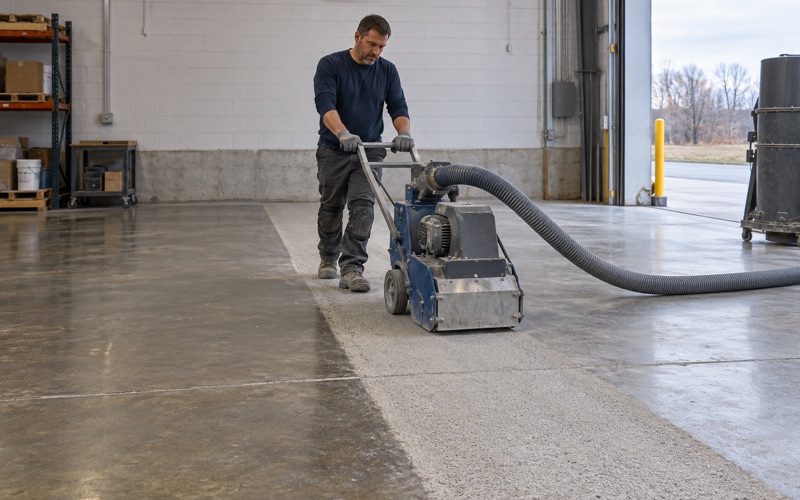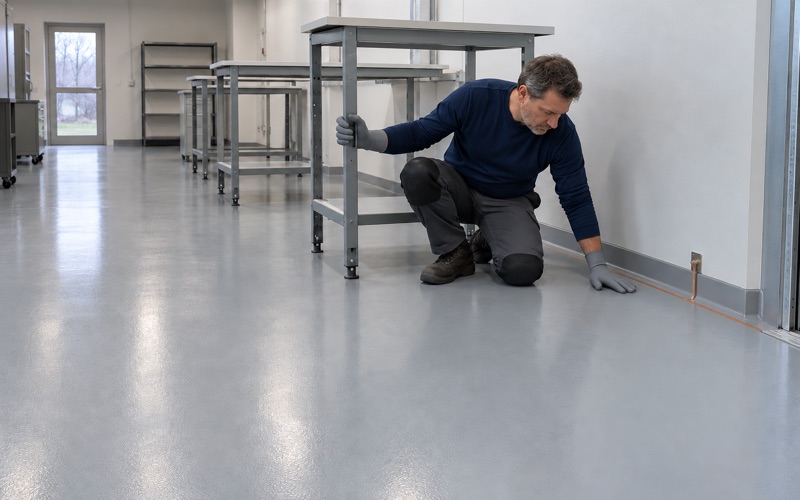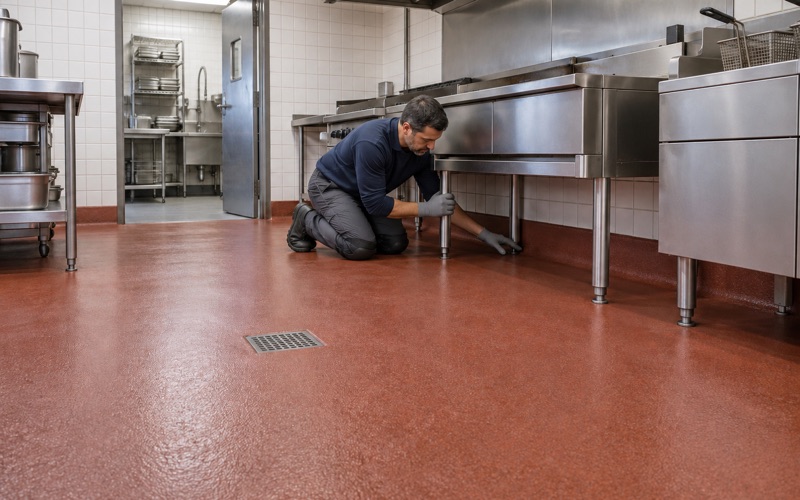
Arlington Heights Epoxy Flooring brings more than 20 years of epoxy flooring in Northlake to two very different kinds of slab: refrigerated and frozen floors on the industrial side of town, and garage and basement floors in houses whose owners often finished them by hand. Both start the same way with us. We open the concrete mechanically with a diamond grinder or a shot blaster, never with acid, so the coating has a real profile to bond to.
What changes from one slab to the next is the specification. A floor that will sit below freezing for years needs a different resin, cure plan and joint treatment than a garage that sees salt brine every January. Our written proposal names the product, the system build and the finished thickness, so the floor you receive can be checked against the floor you were quoted.
We are also direct about what a coating cannot do. It is a film that moves with the slab beneath it, so if cracks or a failing old coating mean the concrete needs repair first, you hear that before the price, not after it.
Bridge Point Northlake and the Cold-Chain Floor

From the Dominick’s distribution center to Bridge Point
The clearest picture of commercial flooring here sits at 575 Northwest Ave. Bridge Point Northlake is the 55-acre former Dominick’s distribution center, and its buildings were never one kind of space: a dry distribution building, a 162,000-square-foot cooler facility and a 135,000-square-foot freezer facility slated for a 104,120-square-foot expansion. A grocery chain’s warehouse campus was reused rather than torn down, and its refrigerated rooms are a large part of why.
The tenant the trade press has named is Fannie May. The candy maker leased 77,885 square feet for a regional distribution center, citing the available cold-storage space, and a new 61,469-square-foot freezer was built inside the expanded cooler building. We point to it because it shows what industrial floors in this city are being asked to do now, not because we worked on it.
Why a freezer floor is a different specification
A dry warehouse floor is coated at room temperature and lives at room temperature. A freezer floor is coated in a room that may be pulled down to operating temperature soon afterward, then lives through defrost cycles, door openings and pallets of warmer product rolling into cold air. That cure-temperature and thermal-cycling load is the specification, and it changes which resins are suitable and how long the room stays offline.
Most epoxies cure slowly or incompletely in the cold, and a coating that has not fully cured before the room is chilled can stay soft or develop amine blush on its surface. We plan the cure against slab temperature and the dew point spread at the slab surface, and we write the downtime the system needs into the proposal instead of letting a move-in date decide it. Urethane cement is often the first system we look at for these rooms, because it tolerates thermal shock better than a thin epoxy film.
Moisture under a cold slab
Refrigerated slabs carry their own moisture story, since warm, damp air from the dock side meets a cold surface. Moisture testing is a line item in our scope, using ASTM F2170 in-situ relative humidity probes or ASTM F1869 calcium chloride testing depending on the slab, and the results decide whether a moisture-mitigation primer goes down first. Moisture is also the first exclusion we read aloud from the warranty, before anyone signs.
Looking for epoxy-flooring closer to River Grove? See Epoxy-Flooring in River Grove.
Docks, Thresholds and Reformatted Buildings
Where the cold room meets the dock
The hardest few feet in a cold-chain building are usually the transition from refrigerated space to the dock or the dry side. Temperature changes abruptly across that line, forklifts cross it all shift, and condensation shows up there first. A system that performs in the middle of a freezer can crack or lift at the threshold if the joint is not detailed for movement.
We treat that line as its own scope item. Control and expansion joints are honored rather than bridged, the coating terminates cleanly at them, and the texture is chosen for wet, frosty traffic, often a quartz aggregate broadcast under a sealed topcoat.
Cleaning belongs in that plan as well. A cold-room floor is often washed while the room is still cold, and water that freezes in a joint can pry at a coating edge over many cycles. At handover we walk the maintenance crew through the joint and edge details so they know which areas to watch.
Old slabs asked to do a new job
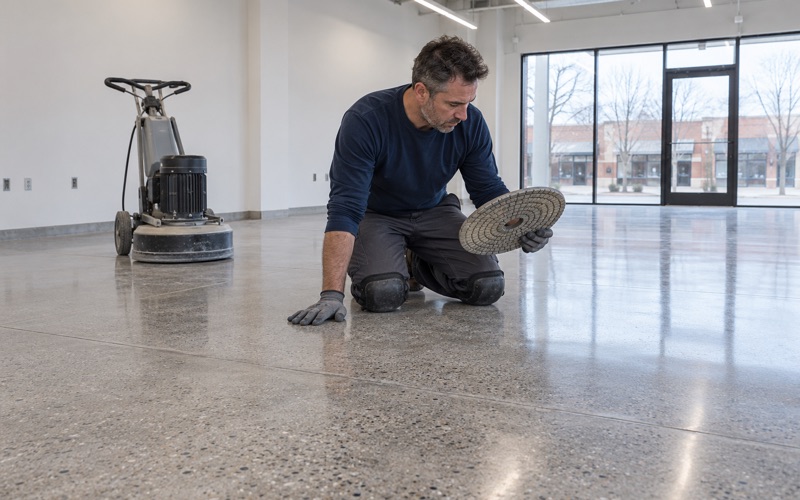
Northlake’s industrial land is being reformatted rather than added to. The city reports redevelopment of existing industrial sites, including several new data centers, as its development pattern, so many commercial floors we see here are older slabs taking on a new use. A warehouse floor can carry decades of sealer, adhesive and oil that an acid etch would never reach, which is why we grind or shot blast to the ICRI CSP profile the chosen system calls for.
Before quoting on a converted building, we walk the slab for old saw cuts, patched trenches and the outlines of removed equipment, because each of those can telegraph through a new coating. Where the concrete needs repair, that repair is priced as its own line so you can see it.
Data halls and equipment rooms add a separate question. When a space needs static-dissipative or ESD flooring, the resistance range comes from the owner’s specification, and we build the system to that range and test it rather than assuming an ordinary coating will do.
Keeping the building running
Distribution buildings rarely close, so we schedule commercial work around the hours a building has to stay open, phasing rooms or bays so product keeps moving. Fire-code questions on a commercial job go to the Northlake Fire Protection District, a separate district with its station at 118 Parkview Dr, rather than to a department at City Hall.
Registering With the City of Northlake
Illinois issues no state license for flooring or coatings work, so a contractor’s credentials here are local ones. The City of Northlake requires every contractor and subcontractor to register: a $100 annual license that runs one year from the date it is issued, a $10,000 bond and a certificate of insurance naming the city. Instead of quoting a license number the state does not issue, we show you that registration, bond and insurance.
Owners sometimes ask why a coatings contractor needs its own registration on a short job. The city requires it of subcontractors as well as general contractors, so whether we work for an owner directly or under a general contractor on a reformatted building, the paperwork is the same.
Permit and code questions go to the City of Northlake Building Department, which administers the municipal building code at section 8-1A-1, adopted in 2003. The same department serves as floodplain administrator under the flood damage prevention ordinance adopted June 6, 2005. That matters for owners finishing a lower level near Addison Creek, where the Doyle Retention Basin was built to relieve recurring flooding.
On every home job, a written contract and the Home Repair: Know Your Consumer Rights pamphlet come before any grinding, as the Illinois Home Repair and Remodeling Act requires. Paid renovation in pre-1978 housing also calls for EPA lead-safe certification, which the city points contractors to, so if prep will disturb old paint on a wall or curb, we settle that before work begins.
Semi-Finished Houses and the Floors Owners Finished
Wartime worker housing
Northlake incorporated in 1949 with an initial population of 3,000, and much of its first housing was built for workers. After a Buick defense factory came to nearby Melrose Park, Midland Development Company built homes sold semi-finished, with buyers completing the interiors themselves. The city takes its name from North Avenue and Lake Street, which intersect on its west border.
That history still shapes the housing stock. Of 4,526 housing units, 1,799 were built in the 1950s and 630 in the 1940s, and 88.6 percent of all units predate 1980.
What we find on a hand-finished slab
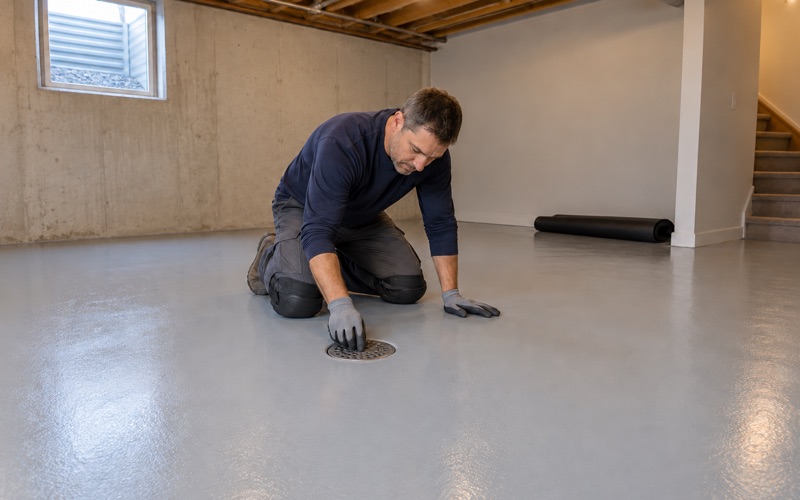
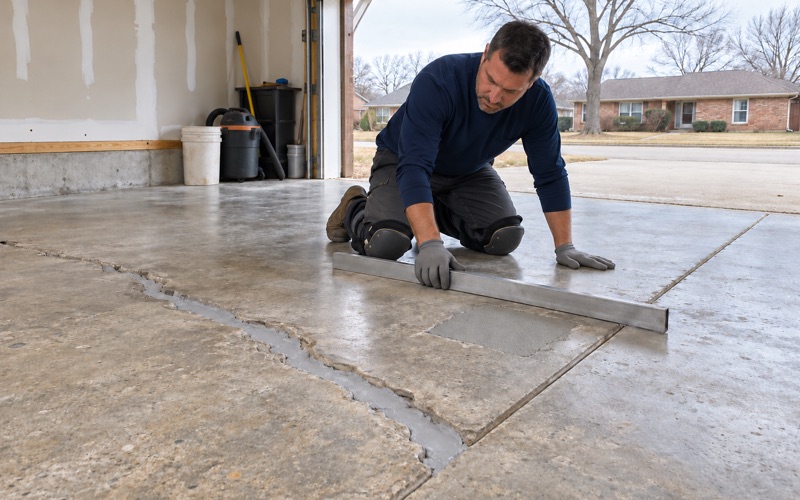
A basement or garage finished by its owner seventy years ago can hold almost anything: paint, tile adhesive, a hand-poured patch, an old sealer. We read the cracks and the existing coating before we quote, and when a slab needs repair before it can be coated, we say so plainly. An older basement slab may have no vapor retarder under it, so a quick ASTM D4263 plastic sheet test is only a first look; the number that sets the scope comes from a probe or a calcium chloride test.
Water history matters as much as the test result. If a floor drain has backed up or efflorescence shows at the wall line, we want to know before choosing the system, because hydrostatic pressure under a basement slab is something a coating rides on rather than stops.
One line we hold firmly: a floor coating is not radon reduction. In Illinois that work requires an IEMA radon mitigation license, and we do not sell an epoxy floor as a substitute for it.
Garage floors that face salt season
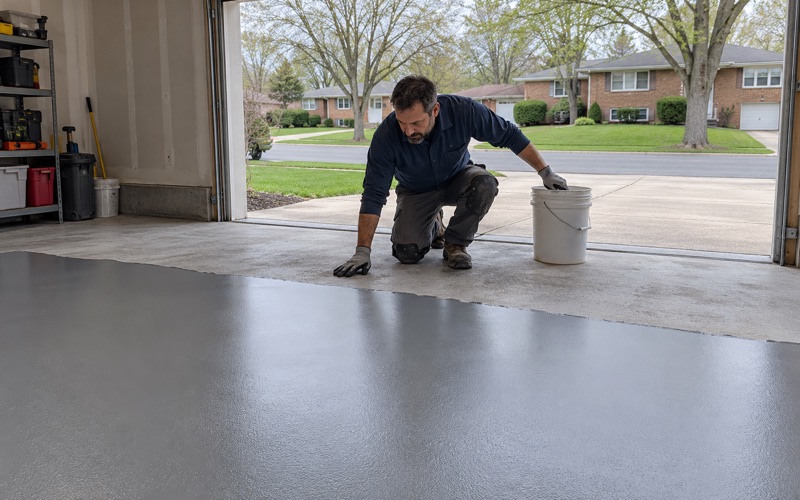
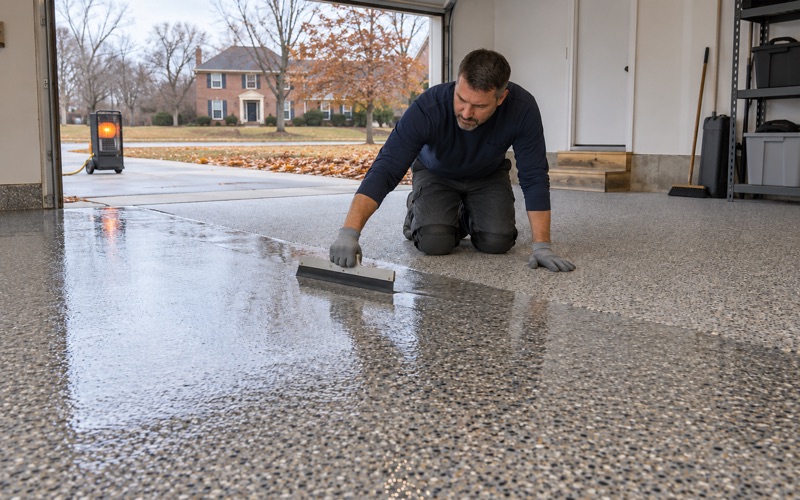
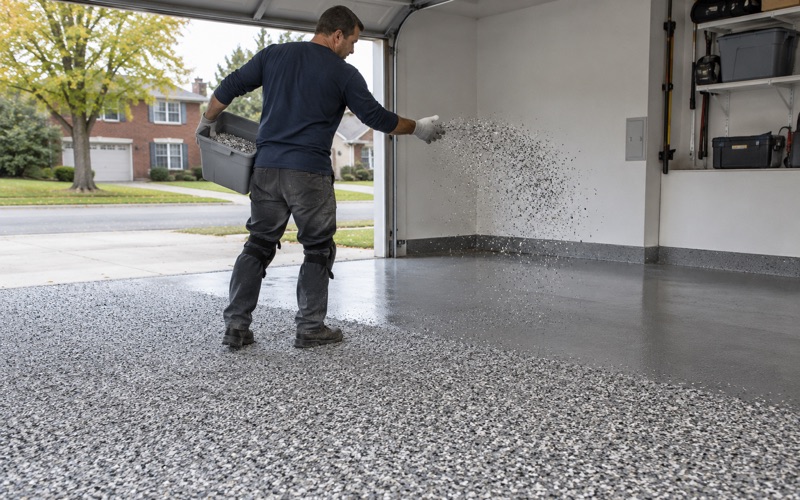
About 70.6 percent of occupied homes here are owner-occupied, and most of those are detached single-family houses. Where a garage is part of the job, we build the floor for the calcium chloride brine and rock salt a northern Illinois winter brings in on the tires, typically a vinyl flake broadcast locked under a polyaspartic topcoat that resists hot tire pickup. Flake also disguises the patching an older slab often needs before it can be coated.
Cure timing follows slab temperature and dew point rather than the calendar. If an unheated garage is too cold to coat properly, we tell you it has to wait for spring instead of putting a coating on a slab that will not cure.
- 20+ Years Coating Concrete
- Moisture Tested Before Quoting
- Itemized Written Proposals