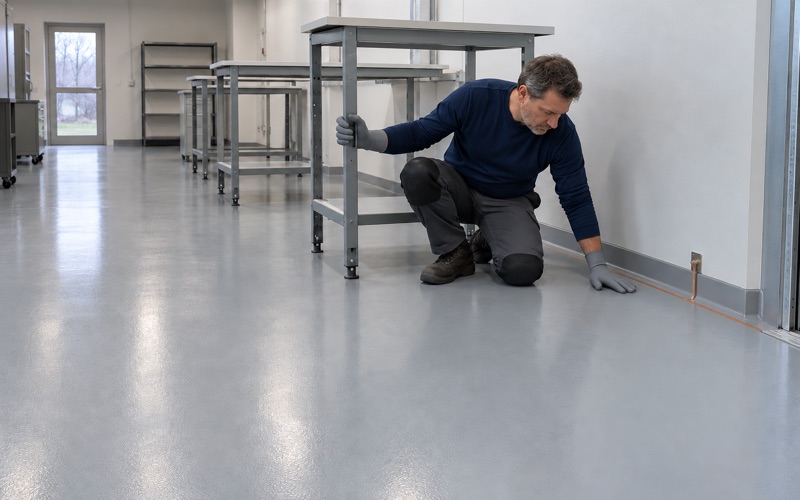
Arlington Heights Epoxy Flooring brings more than 20 years of slab work to epoxy-flooring in Norridge, and nearly all of it here happens in one place: the homeowner’s own garage. This is a village of people who own the house, own the slab and plan to stand on it for a long time, so the questions we hear are about how long a floor lasts and who answers for it, not about how fast it can be rolled out.
Our proposals are written for that kind of owner. Each one names the product, the system build and the finished thickness, which means the floor in your garage can be held up against the paper that sold it. Moisture testing appears as its own priced line rather than something brought up after a coating has lifted.
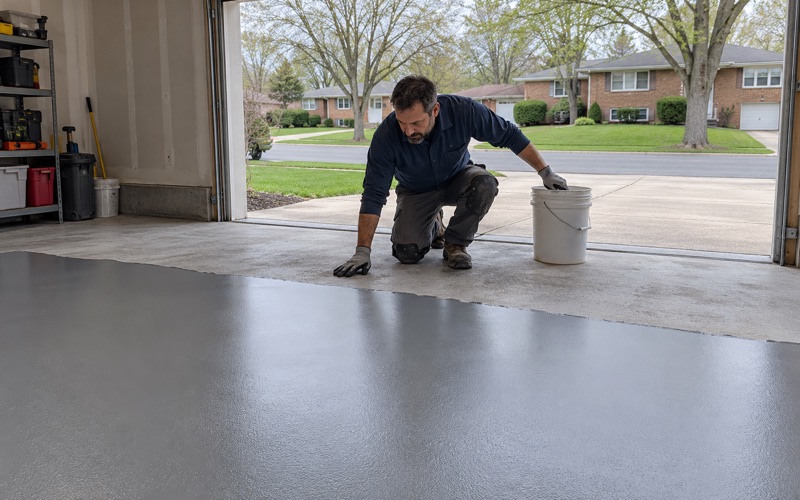
Before we quote, we look at what is already there. Old paint, a failed kit coating and the cracks running through the slab all tell us something, and when the concrete needs repair before it can take a coating, we say so in writing instead of coating over the problem.
An island village of owner-occupied garages
Norridge was incorporated in 1948, when a local improvement association made the area a village and stopped an effort by Chicago to annex it. Together with Harwood Heights to its east, it forms an enclave inside the city, which is why it is sometimes called the “Island Within a City.” What that island holds, overwhelmingly, is owner-occupied housing.
Who owns the floor
Of 5,767 occupied units in the village, 4,750 are owner-occupied, or 82.4 percent. Of those owned homes, 3,971 are single-family detached houses. That is the market for garage coatings in Norridge, and it shapes how we work: the person signing our contract is almost always the person who will live with the result.
There is a second group worth naming. Another 401 owner-occupied units sit in buildings of 50 or more, where a shared parking level or storage floor is a decision for an association rather than one household. We quote those differently, with the board’s schedule and approval process built into the timeline.
The garage is the job
We did not find an industrial or warehouse base in Norridge to build a business around, and we do not pretend otherwise on this page. Our Norridge work is the detached or attached residential garage, a few tenant spaces and the retail floors along Harlem Avenue. That focus lets us talk plainly about the slab most owners here actually have.
Looking for epoxy-flooring closer to Northlake? See Northlake Epoxy-Flooring.
Garages on the village registration list, and the $25,000 concrete bond
Norridge treats garage work as something worth tracking. The Village of Norridge Building Department registers contractors every year by calendar year, and registration is required for garages, alongside new construction, additions, second-floor additions, basement, kitchen and bath remodels, and every commercial project. Separately, all construction, remodeling or upgrading of property in the village requires a permit.
What registration is and is not
Registration is not a trade license, and we never describe it as one. Illinois issues no state license for flooring or coatings work, so the proof we hand a Norridge homeowner is the village registration itself, the bond posted with it and a certificate of liability insurance naming the village. If a contractor offers you a license number for floor coating, ask what agency issued it.
Because registration runs on the calendar year, timing matters. A contractor who registered in December is registered only until the year ends, so a job booked across the new year should be checked against a current registration, not last season’s.
Why concrete carries the higher bond
The village asks for a trade-specific license and permit bond naming the village. For most trades that bond is $10,000. For concrete and roofing contractors it is $25,000, two and a half times as much.
We read that difference as the village saying slab work deserves more security behind it, and we agree. A garage floor that is ground, patched and coated touches the concrete itself, and if the slab needs crack repair or a section patched before coating, that work is concrete work. We plan the paperwork around the scope that is actually going to happen.
The paperwork before the grinder starts
Every home job gets a written contract and a copy of the “Home Repair: Know Your Consumer Rights” pamphlet before work begins, as the Illinois Home Repair and Remodeling Act (815 ILCS 513) requires. Warranty exclusions are read aloud at the same table, with moisture named first, so nothing about coverage surprises anyone later.
Recoating a 1950s or 1960s garage slab
Norridge’s housing came in one large wave. Of 6,002 housing units, 1,938 were built in the 1950s and 1,553 in the 1960s, which together make up 58.2 percent of the village. Only 447 date from 1939 or earlier. In practice that means most garage slabs we meet here are more than 55 years old and have had decades to collect oil, paint and earlier coating attempts.
Opening an old slab properly
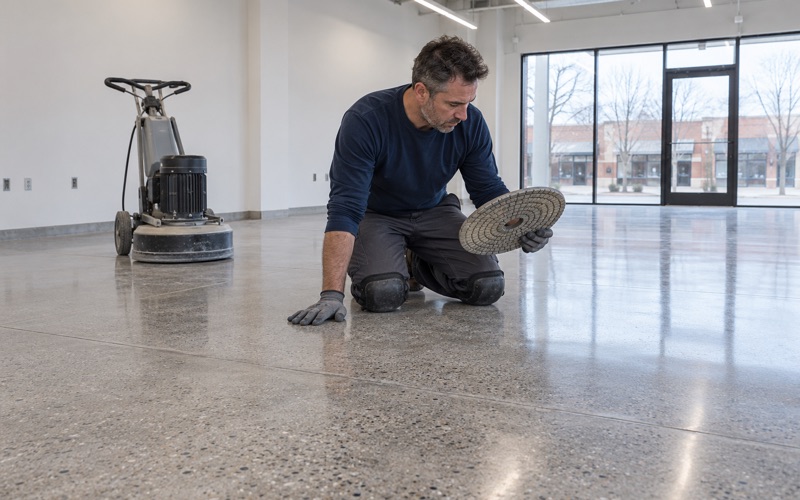
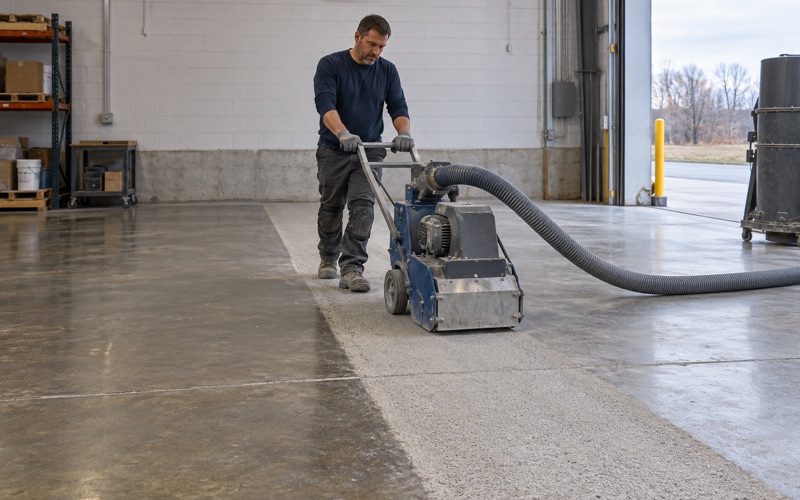
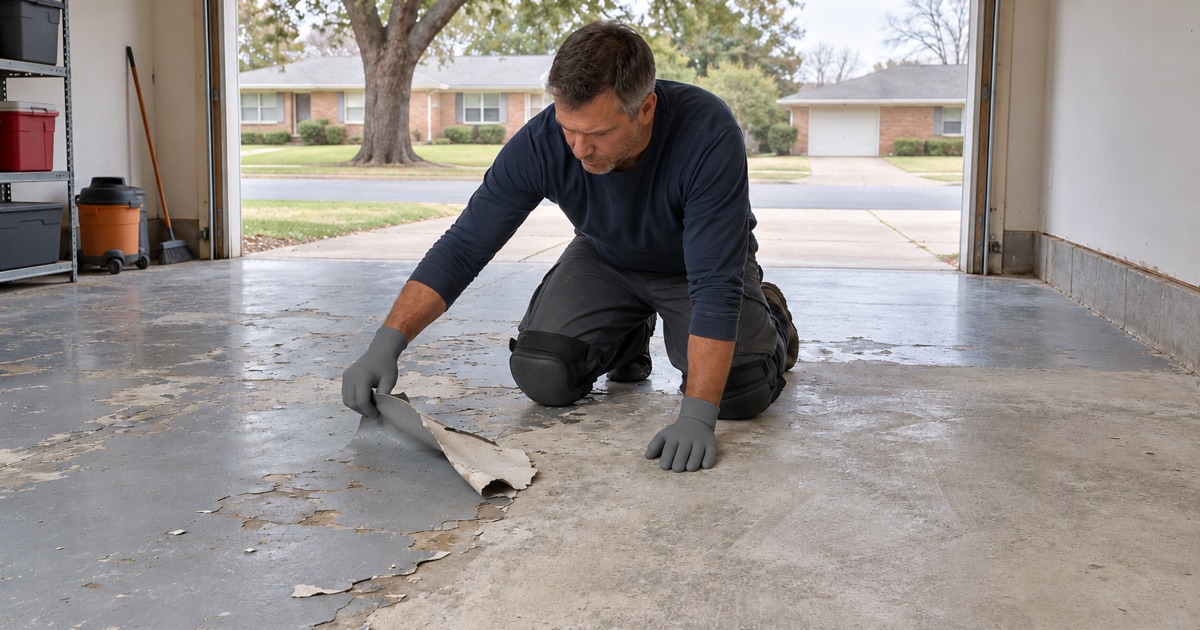
A slab that old does not take a coating just because it has been swept. We open every floor mechanically with diamond grinding or shot blasting to reach a surface profile in the ICRI CSP range the system calls for, and we do not acid etch. Grinding also tells us quickly whether an earlier coating is still bonded or is simply sitting on top, ready to peel and take a new floor with it.
Where a previous owner rolled on a hardware-store kit, we grind it off rather than coat over it. A new film is only as good as the layer it is bonded to, and an unknown coating from decades ago is not a layer we will put our name on.
Testing before trusting
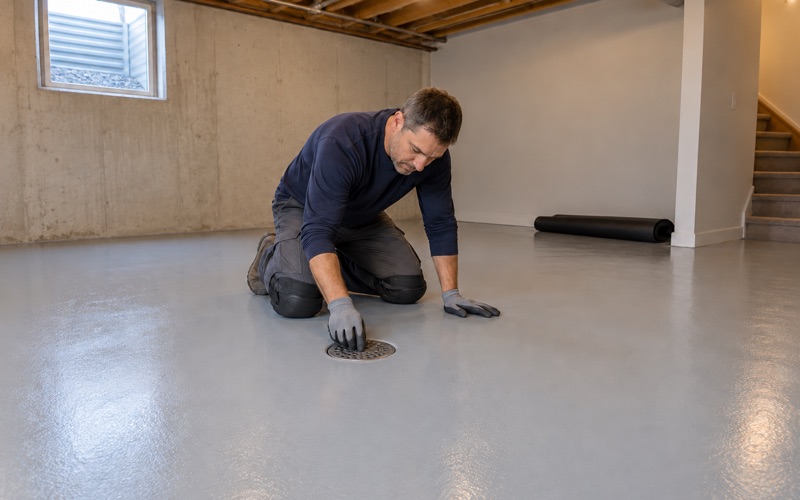
An older slab often has no record of whether a vapor retarder went under it. We test rather than guess, using ASTM F1869 calcium chloride readings or ASTM F2170 in-situ relative humidity probes, with an ASTM D4263 plastic sheet check where it helps. If readings run high, a moisture-mitigation primer goes into the build before the color coats.
We will not tell you that the area’s old “Swamp” nickname means your slab is wet. That name describes conditions before 1948, and nobody has measured what it means for present-day concrete. The test on your floor is the only evidence we act on.
Cracks and what a coating can do
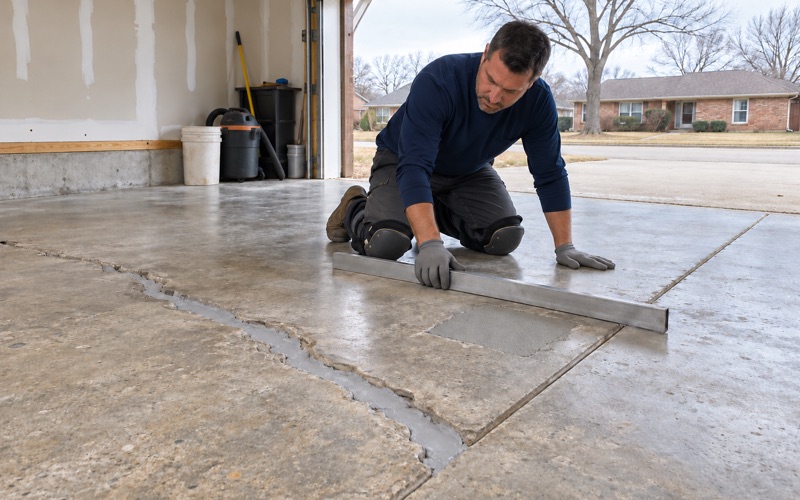
Sixty-year-old concrete has usually cracked somewhere, and we read those cracks before quoting. Some are stable and can be filled and coated; others are still moving. A coating is a film that follows the slab under it, so we explain before the job that it will not stop a moving crack, and we tell you when a repair should come first.
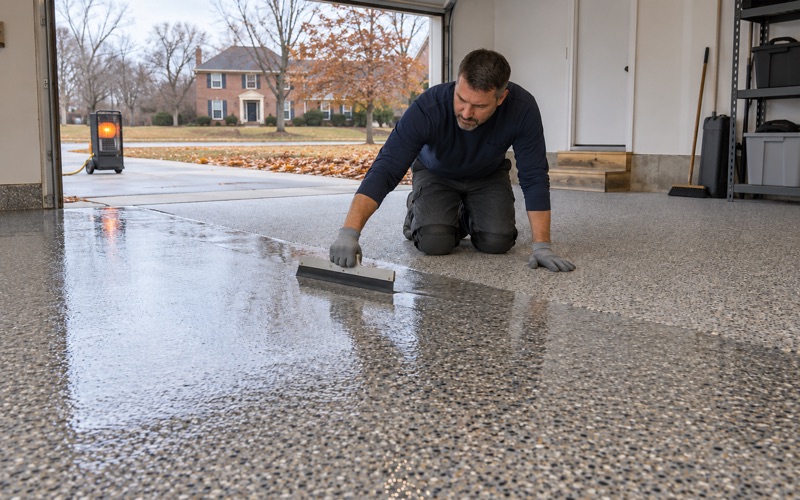
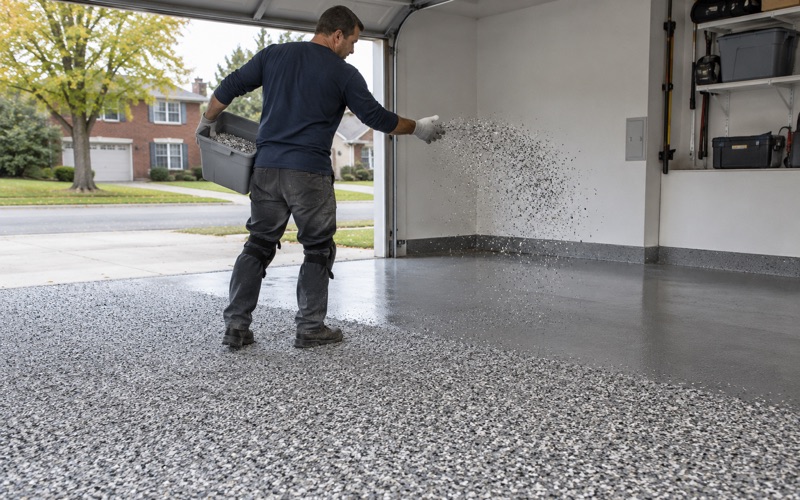
For most of these garages we recommend a 100% solids epoxy base with a vinyl flake broadcast and a polyaspartic topcoat. The flake hides the small surface marks an older slab carries, and the topcoat resists hot tire pickup on a floor that will see the same cars parked on it for years.
Harlem Irving Plaza: retail and food-court floors under a village health department
The largest commercial floor area in the village belongs to Harlem Irving Plaza at 4104 North Harlem Avenue. It opened in 1956 on a former livestock farm as a 337,000-square-foot strip mall of about 45 tenants. Today it spans 725,000 square feet with over 100 stores and a food court, owned and managed by Harlem Irving Companies.
Tenant spaces that change hands
Retail floors here are rebuilt as tenants turn over. Graycor served as general contractor when the former Carson’s anchor was redeveloped into six potential tenant spaces with an expanded loading dock, a high-ceiling atrium and a new entryway. Splits like that leave behind slabs with old adhesive, patched trenches and different finishes side by side, and each needs grinding and repair before a coating will hold.
Commercial jobs in Norridge also fall under the village registration requirement, which covers every commercial project. We schedule the work around the hours a building has to stay open, so a store or a shared corridor is not closed longer than the cure demands.
Food-court floors and the village inspector
A food-service floor in Norridge answers to the Village of Norridge Health Department, not to the county. The department inspects roughly 80 establishments on a regular basis, requires a licensed sanitarian on site at every food-serving business, and has adopted the Illinois Food Service Sanitation Code.
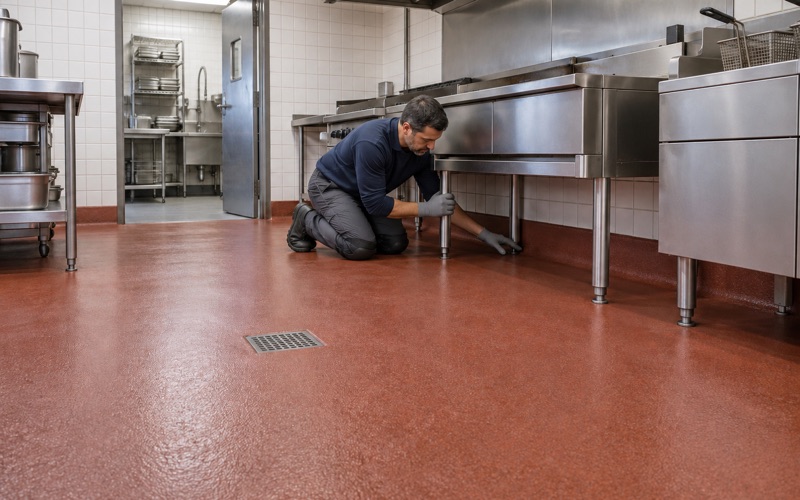
For a kitchen or food-court counter area, that means a floor built to be cleaned. We typically specify urethane cement or a quartz aggregate broadcast with coved floor-to-wall junctures, the detail FDA Food Code 6-201.13 describes, so water and debris have no seam to settle into. The operator’s sanitarian knows what the inspector looks for, and we plan the finish with them.
The fire district on a commercial job
Fire protection here is a separate district, not a village department. The Norwood Park Fire Protection District, reorganized from a volunteer department in 1958, covers Norridge, Harwood Heights and unincorporated Norwood Park Township from one station on Lawrence Avenue in Harwood Heights. On a tenant space, we confirm with the property manager at the start whether the work touches anything the district reviews, rather than assuming it does not.
- 20+ Years Coating Concrete
- Moisture Tested Before Quoting
- Itemized Written Proposals