Arlington Heights Epoxy Flooring has spent more than 20 years on concrete, and our epoxy-flooring in Lindenhurst work is almost entirely one kind of job: putting a new coating system over a slab that has already lived a long life. We are rarely the first trade to touch these floors. Somebody poured them decades ago, somebody parked on them, and often somebody rolled a paint or sealer over them at some point along the way.
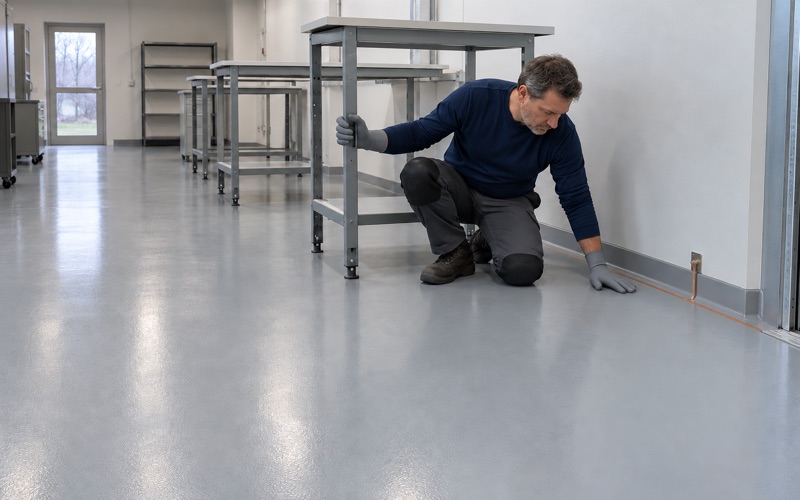
That shapes how we quote. Before a number goes on paper, we look at the cracks, the patches and whatever finish is already on the concrete, and we tell you plainly if the slab needs repair before it can take a coating. Our proposal then names the product, the system build and the finished thickness, so you can hold the floor that went down against the floor you were quoted.
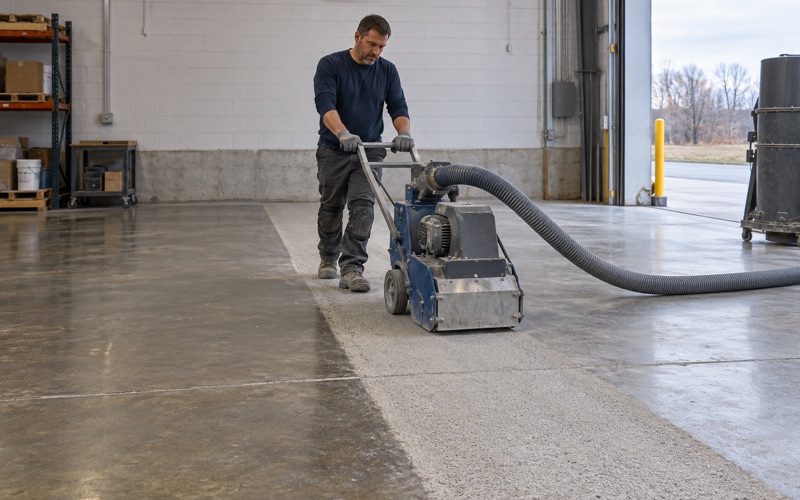
We also open every slab with a diamond grinder or a shot blaster rather than an acid wash. On an older floor that step matters more than anything else in the scope, because it is the only reliable way to get past what earlier owners left behind and reach sound concrete the new system can bond to.
A Built-Out Village Where the 1990s Garage Rules
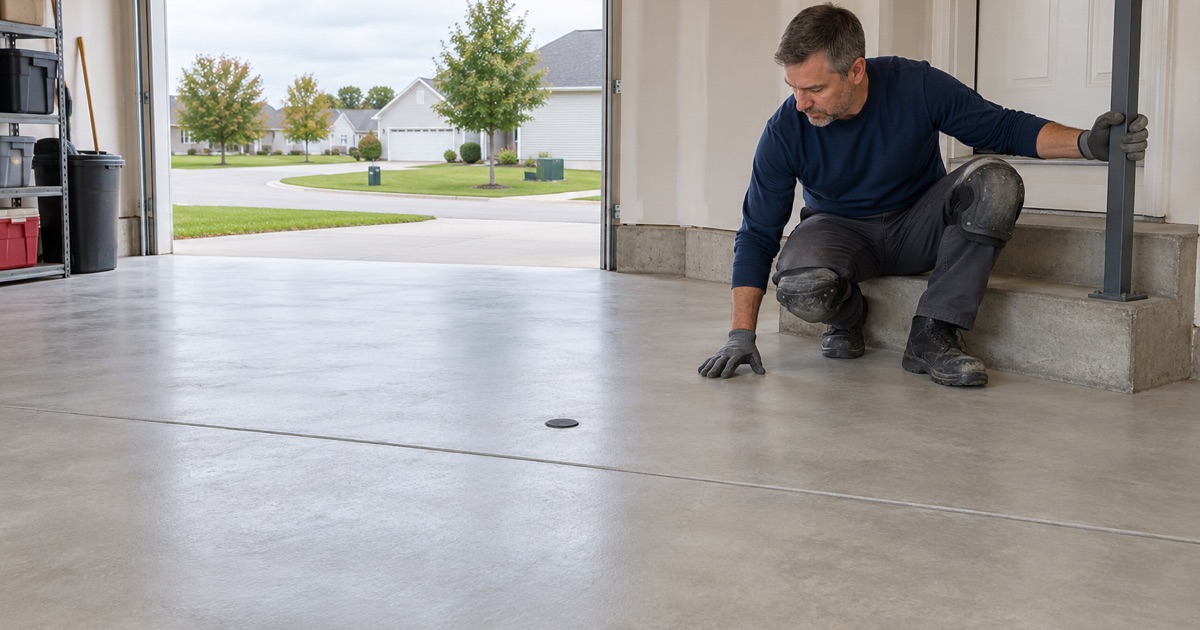
The housing numbers explain why our work here looks the way it does. Census survey data counts 5,224 housing units in the village, and 3,431 of them, or 65.7 percent, were built between 1970 and 1999. Only 153 units, about 2.9 percent, date from 2010 or later.
Almost no builder channel left
In a growing suburb, a share of coating work comes from fresh slabs in brand-new garages. That channel has nearly closed in Lindenhurst. With fewer than 3 percent of homes built since 2010, the realistic customer is an owner of an established house whose garage slab is somewhere between its mid-twenties and its mid-fifties.
That changes the conversation from the first visit. A fresh slab mostly needs time to cure and a clean profile. An older slab comes with a history: patched spalls, settlement cracks, oil that has wicked into the surface, and sometimes two or three generations of coatings that were each applied over the last.
The single biggest decade
The 1990s alone account for 1,486 units, or 28.4 percent of the stock, which makes them the largest single decade in the village. The 1970s add 1,035 units and the 1980s another 910. If you live here, the odds are good that your garage floor was poured during one of those three decades, and quite likely the last of them.
A slab in its late twenties or early thirties is usually structurally settled. The shrinkage cracks it was going to develop have mostly shown up, and the question becomes whether each crack is stable or still moving. We read that before quoting, because a coating is a film that follows the slab under it. It will not stop a crack that is still opening, and we say so up front rather than promising otherwise.
Detached homes, mostly owned
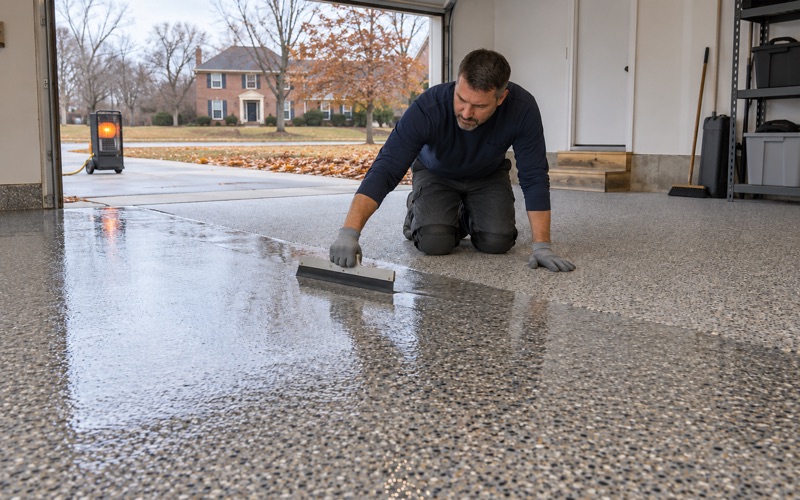
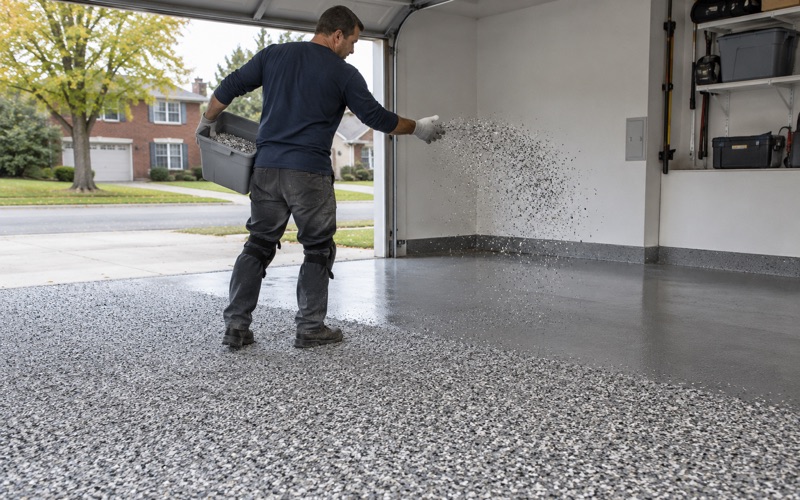
The same survey counts 4,276 detached houses in the village and 4,389 owner-occupied units, so the typical job is an owner improving a single-family garage they plan to keep. That suits a full system: a 100% solids epoxy base, a vinyl flake or quartz aggregate broadcast for texture, and a polyaspartic or polyurea topcoat chosen to resist hot tire pickup from cars that come in warm off the road.
Looking for epoxy-flooring closer to Summit? See Epoxy-Flooring in Summit.
Retrofit Over an Old Finish: What Comes Off First
Most failures we are called to look at in older garages trace back to one mistake: a new product applied over an old one that was never removed. The coating that peels is rarely the one that failed. It is the layer underneath, letting go of the concrete and taking everything above it along.
Grinding past paint and sealer
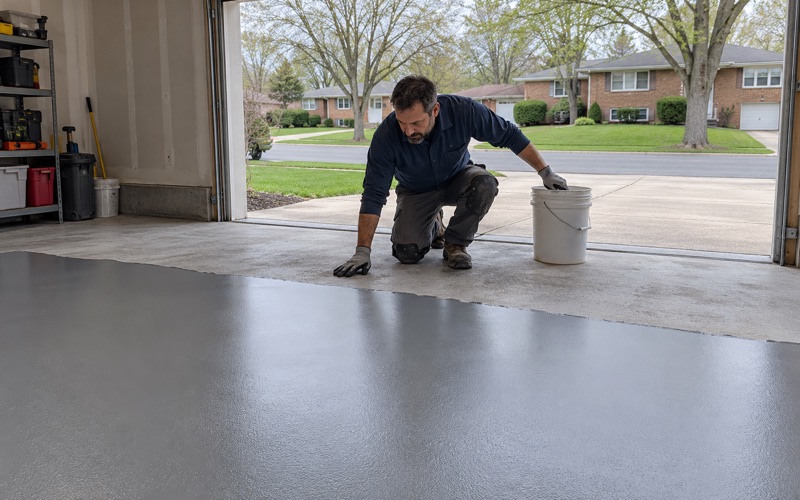
We start by identifying what is already on the floor. A big-box garage paint, a solvent sealer and an old water-based epoxy each behave differently under a grinder, and some gum up the diamonds or smear rather than cut. We take all of it down to bare concrete and grind to a surface profile in the ICRI CSP range the chosen system calls for, typically a medium profile for a broadcast system.
Acid etching does not work on a coated slab, because the acid cannot reach concrete it cannot touch. Even on bare concrete it leaves residue and an uneven profile, which is why it is not part of how we prepare any floor. Mechanical preparation is slower and louder, but it is the step that decides whether the floor lasts.
Cracks, spalls and patches
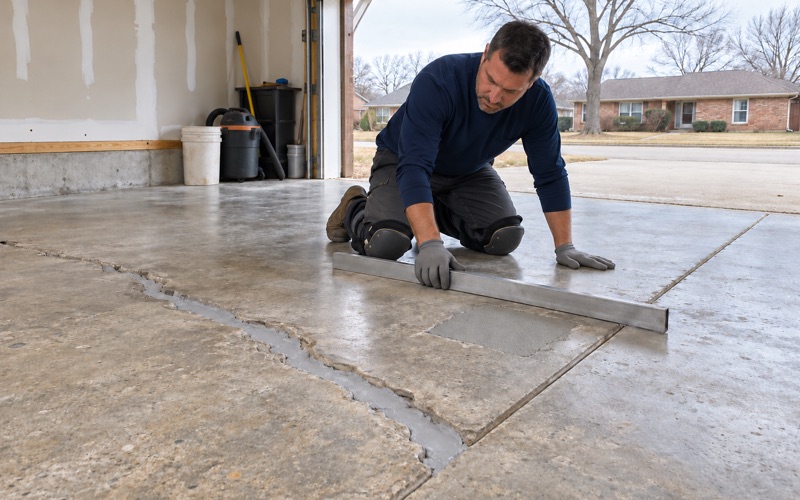
Once the old finish is off, the slab shows what it has been hiding. Hairline shrinkage cracks get chased and filled; wider or offset cracks get a closer look and sometimes a recommendation to address the cause first. Spalled areas near the garage door are rebuilt with a repair mortar compatible with the base coat.
If a slab needs work beyond what a coating can carry, we write that into the proposal as its own line rather than burying it. You see the repair, the coating and the price of each separately.
Moisture testing on an older slab
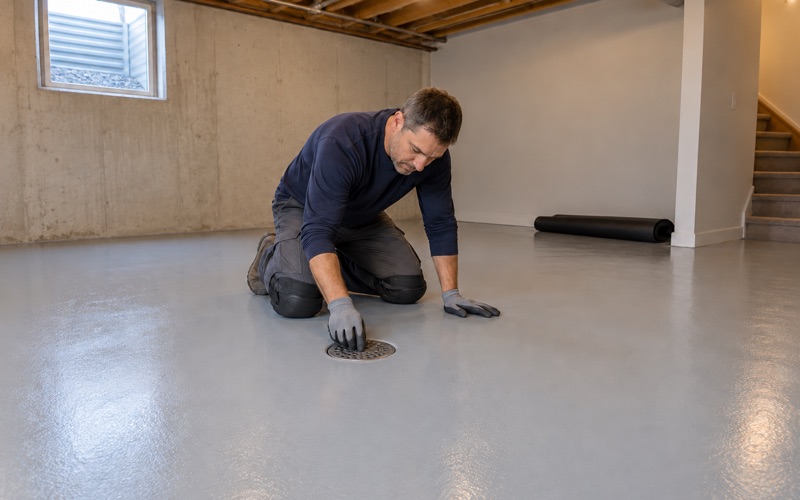
Age does not guarantee a dry slab. A garage slab of this age may have gone down without the kind of under-slab vapor retarder ASTM E1745 now covers, so moisture testing is a written line item in our scope rather than an upsell after a blister appears. Depending on the floor, that means an ASTM D4263 plastic sheet test, ASTM F1869 calcium chloride readings, or ASTM F2170 in-situ relative humidity probes.
When readings come back high, we specify a moisture-mitigation primer under the system. Before you sign, we also read you the warranty exclusions, and moisture is the first one we name, because it is the condition no topcoat can overcome on its own.
Call Village Hall About Flooring, and Expect the $5,000 Bond
The Village of Lindenhurst runs building permits through its Building & Engineering department, and its published guidance is more careful than a simple yes or no. Finished basements and garages are on the list of work that needs a permit. Patios, driveways, doors and same-size windows are not.
The permit question we do not answer for you
For projects such as kitchen cabinets or flooring, the village tells residents to call Village Hall to determine whether a permit is required. A garage floor coating falls into that flooring category, so we do not tell you a permit is or is not needed. We make the call to Village Hall at 2301 E. Sand Lake Road, and the answer we get back is the one we follow.
That is a small step, but it protects you. A contractor who settles the question on the village’s behalf is guessing, and the homeowner is the one left with the consequences if the guess was wrong.
What the License and Permit Bond is, and is not
For permitted work, the village asks every contractor except plumbers to file a one-year $5,000 License and Permit Bond payable to the Village of Lindenhurst. Plumbers submit their Illinois license instead. When a job here calls for a permit, the bond is part of our paperwork.
The village is explicit that a License and Permit Bond is not a certificate of insurance. The bond runs to the village; it is not coverage for your house or your belongings. Illinois issues no state license for flooring or coatings work, so instead of a license number we show you the village registration, the bond and our insurance certificate as three separate documents.
Written contracts for home jobs
Every residential job gets a written contract and a copy of the Home Repair: Know Your Consumer Rights pamphlet before work begins, as the Illinois Home Repair and Remodeling Act (815 ILCS 513) requires. The products we use are selected within the Illinois VOC limits for architectural coatings in 35 Ill. Adm. Code Part 223, which bind the installer as well as the manufacturer.
Grand Avenue Storefronts From the 1970s
Commercial floors in Lindenhurst are mostly neighborhood retail rather than industrial space. The clearest example is Lindenhurst Plaza at 2040 E. Grand Avenue, on the Route 132 corridor: about 85,119 square feet, built in 1973, anchored by an Ace Hardware and reported at 97 percent occupied, with roughly 14,700 vehicles a day passing on Grand Avenue.
Half-century-old retail slabs
A storefront slab from the early 1970s has usually been through several tenants and several floor finishes. Vinyl tile, carpet adhesive, mastic and old sealers all have to come off before a coating can bond, and that removal is often the largest part of the job. We grind it down, assess the concrete underneath, and test moisture before choosing a system.
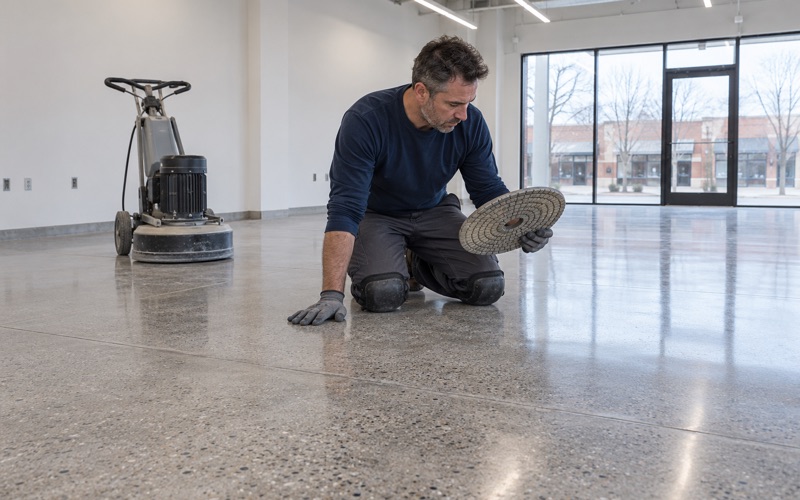
For a busy retail floor we often recommend a 100% solids epoxy base with a quartz aggregate broadcast for slip resistance and a durable topcoat. Back rooms and stock areas may only need a lithium silicate densifier and polish, and we will say so when that is the better value.
Food service in a retail center
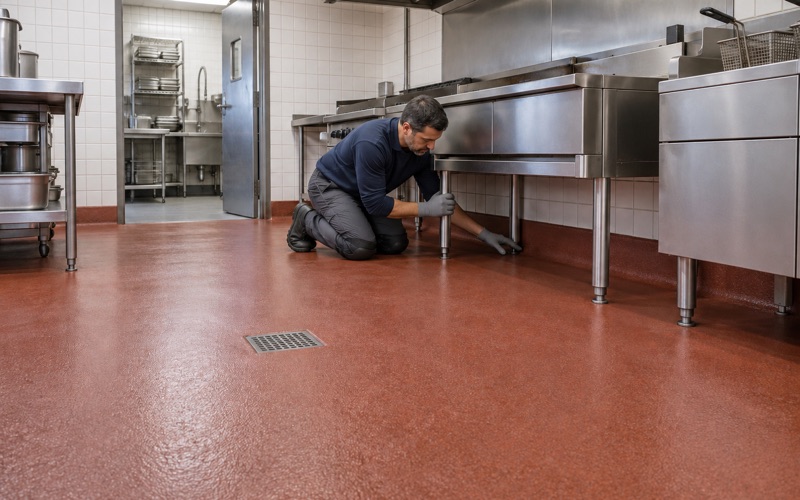
Restaurants in a center like this answer to the Lake County Health Department for food plan review, under an Illinois Food Code that adopts the 2022 FDA Food Code. We build kitchen floors to that code’s expectations, including coved floor and wall junctures under section 6-201.13 and a broadcast texture where the 6-201.11 antislip exception applies. Urethane cement is often the right choice where hot water and grease are constant.
Working around open hours
A plaza with a hardware anchor and steady traffic cannot close for a week. We schedule commercial jobs around the hours the building has to stay open, phasing the floor in sections or working nights so tenants keep trading. Fast-cure polyaspartic topcoats help shorten the return-to-service window when the schedule is tight.
Whether your floor is a 1990s two-car garage or a 1970s storefront off Grand Avenue, the process starts the same way: we look at what is on the slab now, test it, and write down exactly what we plan to put back.
- 20+ Years Coating Concrete
- Moisture Tested Before Quoting
- Itemized Written Proposals