Arlington Heights Epoxy Flooring has spent more than 20 years on epoxy-flooring in Lincolnwood and across the northern suburbs, and the jobs here usually begin with a floor older than the person who owns it. A coating is only as sound as the concrete it bonds to, so on a slab poured in the middle of the last century the real work happens before any resin is mixed.
Every quote we write for this village answers three questions up front: how we will open the surface, how we will test it for moisture, and what paperwork has to be filed before a permit can issue. The product, the system build and the finished thickness are named in the proposal, so you can check the floor that went down against the one you were sold.
That approach holds for a two-car garage, a finished basement or a working warehouse. The sections below explain how the age of the housing, the village’s own contractor rules and its commercial corridors each change the way we plan a floor.
Two in five houses from one decade
Lincolnwood’s housing is concentrated in time to a degree few suburbs match. Census survey figures count 1,967 of the village’s 4,955 housing units as built in the 1950s, or 39.7 percent, and 50.4 percent were built between 1940 and 1959. Established as Tessville in 1911 and incorporated in 1922, the village grew from 359 residents in 1910 to 12,929 by 1970.
For a floor contractor, that means most driveways we pull into lead to a garage or basement slab that has been in service for roughly seventy years. Age alone does not ruin concrete, but it shapes every step of the prep.
No vapor retarder under most of these floors
Slabs of that era predate the practice of laying an under-slab vapor retarder, the sheet that modern work specifies to ASTM E1745. Without one, moisture from the ground can keep moving up through the concrete, and a coating sealed over the top becomes the place where that vapor stops. That is how a floor that looked perfect in its first month starts lifting in small blisters a season later.
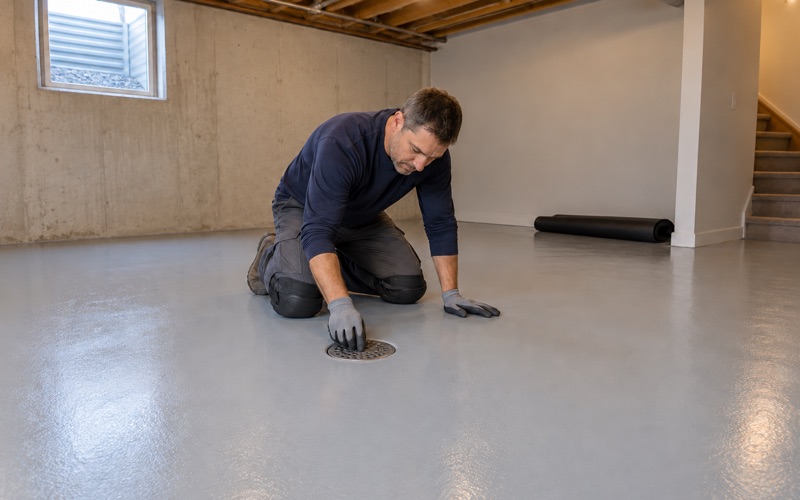
So moisture testing is a written line item on every Lincolnwood quote, garage or basement. We use ASTM F2170 in-situ relative humidity probes set into drilled holes and left to equilibrate, and on larger areas we add ASTM F1869 calcium chloride kits to measure the vapor emission rate. A quick ASTM D4263 plastic sheet test can flag trouble early, but it is a screen, not a number we build a warranty on.
Seventy years of paint, sealer and patches
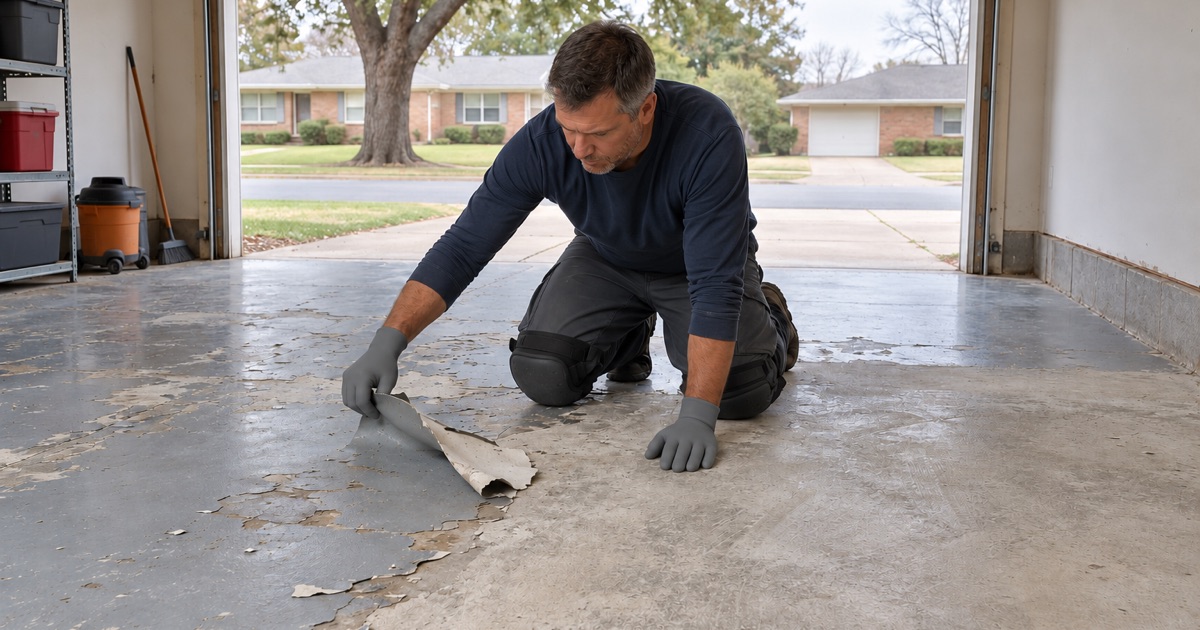
A floor this old has rarely gone untouched. We routinely find layers of porch paint, solvent sealer, mastic from old tile, or a one-part garage kit peeling in the tire lanes. None of that is a sound base, and coating over it only bonds the new system to whatever is loosest underneath.
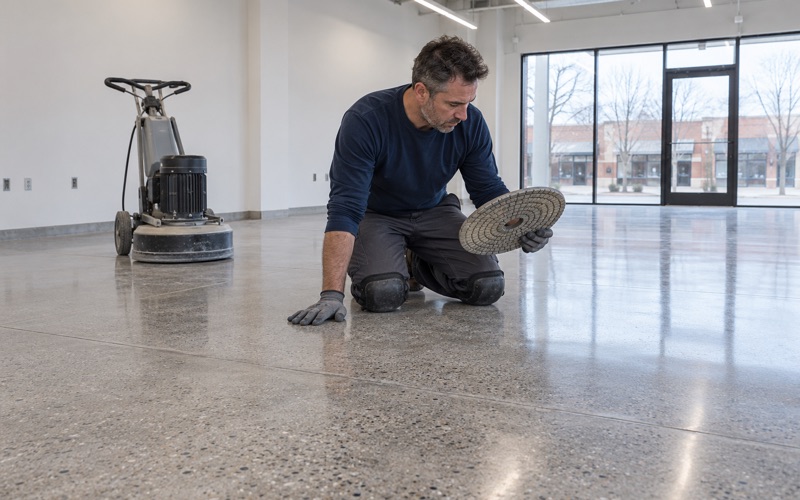
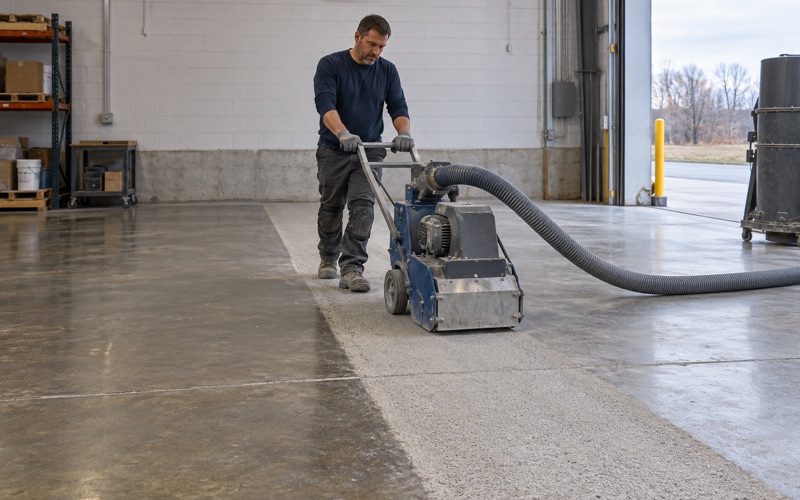
We remove it mechanically, by diamond grinding or shot blasting, until the concrete shows a clean ICRI CSP profile matched to the primer. We do not acid etch, because acid does nothing about coatings already on the surface and leaves residue in old, contaminated concrete. Where the tests show elevated vapor, a moisture-mitigation primer goes down before the build coats.
Cracks and honest repair calls
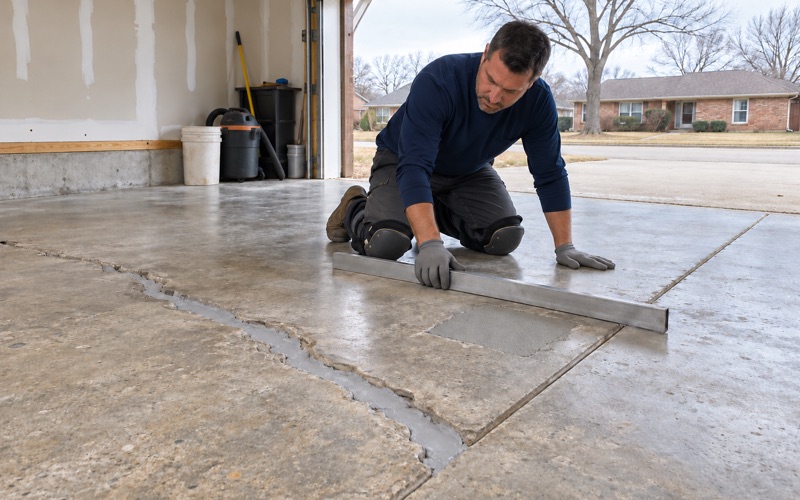
Seven decades also leave cracks, spalled joints and patches from past plumbing work. We read every crack and the condition of the old coating before we price anything, and when a section needs repair before it can take a coating, the quote says so plainly. A coating is a film that follows the slab beneath it, so a crack that is still moving will show through, and we tell you that before the job rather than after.
The system that goes on top
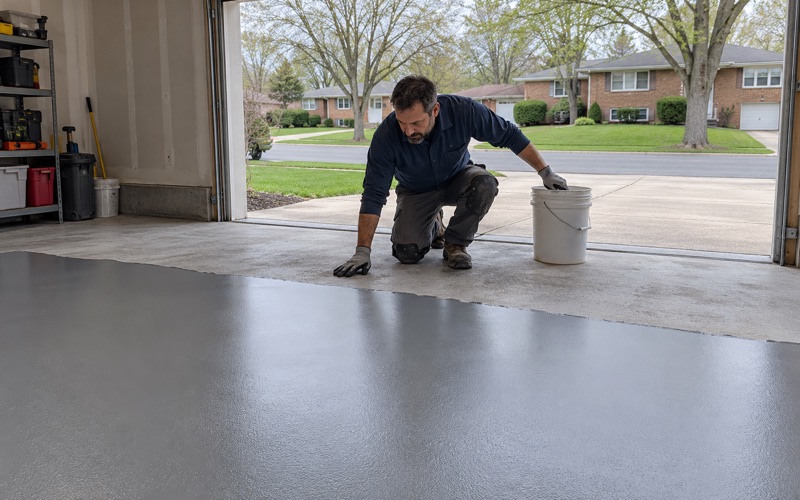
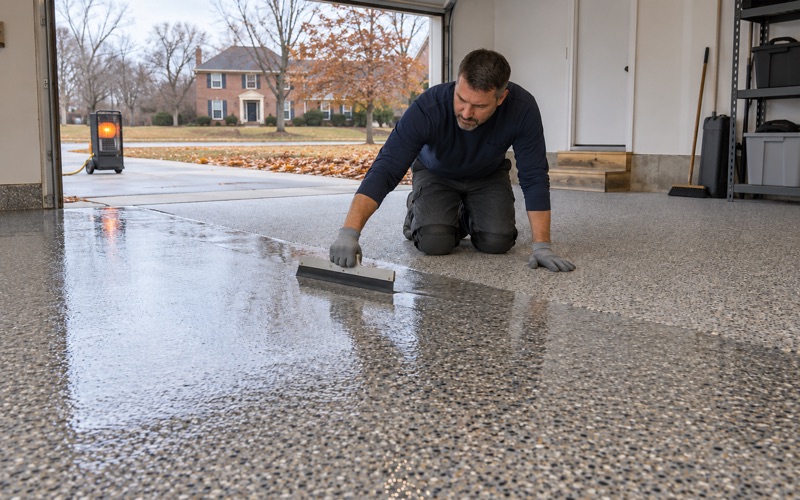
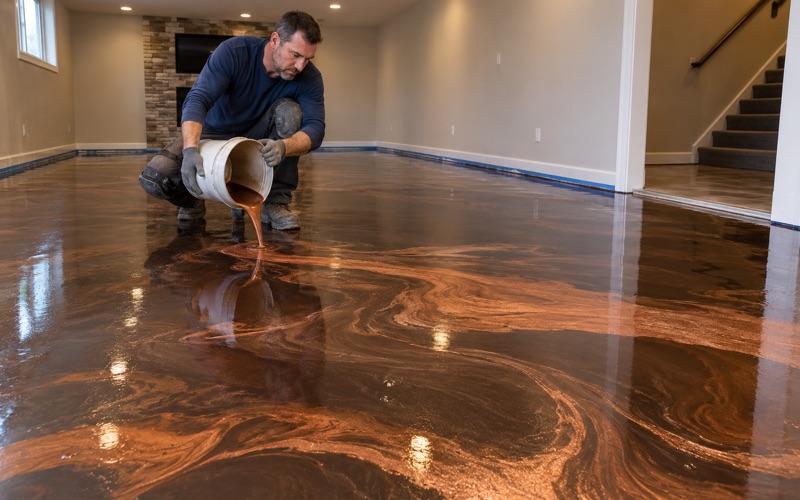
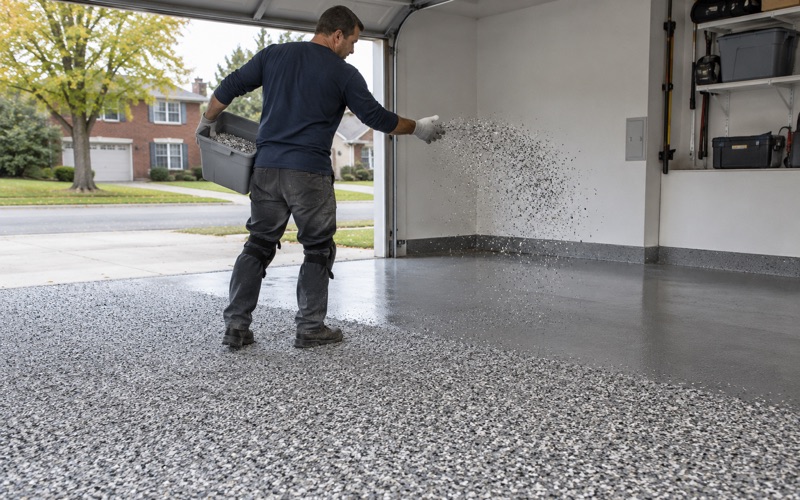
Once the slab is open, dry and repaired, most garages here get a 100% solids epoxy base with a vinyl flake broadcast and a polyaspartic topcoat, a build that also hides the patching a 1950s floor almost always needs. Basements used as living space often suit a quartz broadcast or a smoother decorative finish instead. Either way, the proposal states every coat and the finished thickness, so nothing about the build is left to memory.
Looking for epoxy-flooring closer to Wauconda? See Wauconda Epoxy-Flooring.
A village contractor license, a bond and an insurance certificate
Illinois issues no state license for general, flooring or coatings contractors, so in much of the state the credential question stops at insurance. Lincolnwood handles it differently. The village requires every contractor on a permitted job to hold a current Village of Lincolnwood contractor license, valid for one year.
What a general contractor posts
For a general contractor, that license comes with a $10,000 bond, a $1,000,000 certificate of insurance naming the village as additional insured, and a $100 license fee. These are village requirements tied to village building permits, not a state credential. Instead of quoting a license number that does not exist at the state level, we show the village registration, bond and insurance certificate.
No permit until every contractor is registered
The village does not issue a permit until every contractor on the job has been identified and registered. In practice the license, bond and insurance paperwork must be in order before the schedule is set, not the week the crew arrives. We build that step into our timeline so a garage or basement job is not waiting at the counter. Whether a given coating project needs a permit at all is the building department’s call, and we confirm it on each job rather than assume.
The homeowner’s paperwork
The village license protects the village; Illinois law covers the homeowner’s contract. Under the Illinois Home Repair and Remodeling Act, every home job gets a written contract and the Home Repair: Know Your Consumer Rights pamphlet before work begins. We also read our warranty exclusions aloud before the job is sold, and moisture is the first one named. Nor do we sell a floor coating as radon reduction, since in Illinois that work requires an IEMA radon mitigation license.
Warehouse floors on McCormick Boulevard and Pratt Avenue
The village’s industrial stock is largely 1970s warehouse product along McCormick Boulevard and Pratt Avenue. A representative example is the building at 7080 N. McCormick Blvd: 229,540 square feet, built in 1975 and renovated in 1984, with a 20-foot clear height, two exterior dock-high doors and six drive-in doors.
Drive-in doors and forklift lanes
Drive-in doors change the floor brief. Trucks, forklifts and pallet jacks roll straight onto the slab, so wear concentrates in the lanes near the doors and at turning points. On floors like these we look at a thicker 100% solids epoxy build, often with a quartz aggregate broadcast for traction, or a lithium silicate densifier where the owner wants hardened bare concrete rather than a film. Where electronics or sensitive stock are stored, a static-dissipative system can be specified to a measured resistance range instead.
Fifty years of oil and old repairs
A slab poured in the 1970s has usually absorbed decades of hydraulic fluid and oil, and many have been patched more than once. That contamination has to be ground out or the coating will not bond, and an industrial floor needs a heavier surface profile than a garage. We test, grind and degrease before laying a sample area, and the proposal names the system and finished thickness so the facility manager has something to check against.
Keeping the building running
Warehouses rarely close for a floor. We schedule commercial work around the hours the building has to stay open, sequencing sections so dock doors and main aisles stay usable. Fast-return polyaspartic topcoats can shorten downtime where the window is tight, and cure is planned against slab temperature and the dew point spread at the surface rather than a calendar date.
Coatings within the VOC limits
Large floors mean large volumes of product, and the coatings we choose fall within the Illinois VOC content limits in 35 Ill. Adm. Code Part 223 Subpart C. That limit binds the installer as well as the manufacturer, so it is part of how we pick a system for an occupied building, not a label someone else already checked.
Touhy Avenue’s changing commercial frontage
Touhy Avenue is where the village’s commercial floor stock is shifting most visibly. District 1860, a $155 million redevelopment of the former Purple Hotel site at 4500 W. Touhy Ave, brings 299 apartments and an Amazon Fresh store, the kind of mixed project that carries back-of-house, amenity and retail floors.
The former mall site at Touhy and McCormick
Lincolnwood Town Center opened in March 1990 and closed on July 23, 2026, after Prairie Ridge Development and Xroads Real Estate Advisors acquired it for $12.3 million in December 2025. The village has approved a redevelopment that includes a large retail store, an automobile dealer and other commercial space, with demolition in three phases. Approval is not construction, but if a dealership is built, its showroom and service bays would be among the most demanding floors in the village.
Service bays, showrooms and food space
Service bays take hot tires, dropped tools and spilled fluids, which is where hot tire pickup and chemical staining show up first on a weak system. A urethane cement base or a polyurea and polyaspartic build handles that abuse better than a thin epoxy. Food retail and prep areas answer to the Illinois Food Code, which adopts the 2022 FDA Food Code, including coved floor and wall junctures under section 6-201.13, so those floors are detailed differently from a showroom.
Fire inspection in a contracted department
Commercial floors are often one piece of a larger tenant buildout. Lincolnwood’s fire department is unusual in Illinois: 28 of its 31 members are provided under contract by Paramedic Services of Illinois, a relationship that began with paramedics in June 1977 and added firefighting in December 1989. The department provides fire inspection services for the village, which is worth knowing when a floor is scheduled alongside other work on Touhy.
- 20+ Years Coating Concrete
- Moisture Tested Before Quoting
- Itemized Written Proposals