Arlington Heights Epoxy Flooring has spent more than 20 years installing epoxy flooring in Lake Zurich and the rest of the northwest suburbs, and the requests we get here tend to fall into two piles. One is a working plant floor that has to keep moving product while we coat it. The other is a garage slab under a house that has had several decades to collect oil drips, old paint and hairline cracks.
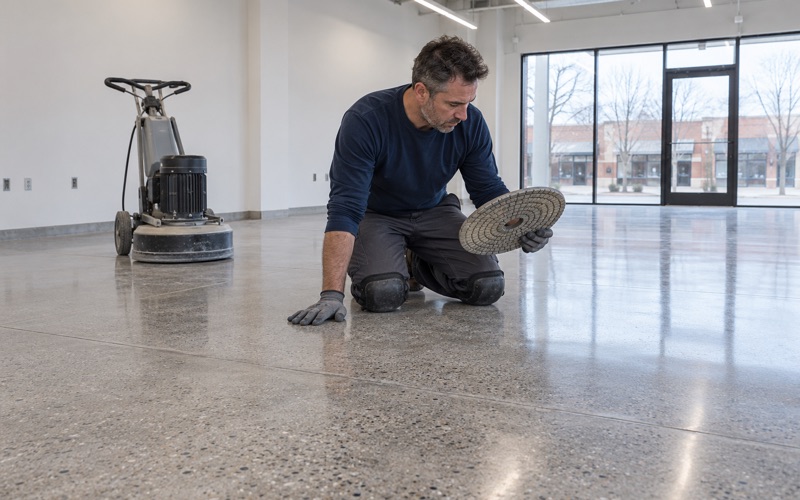
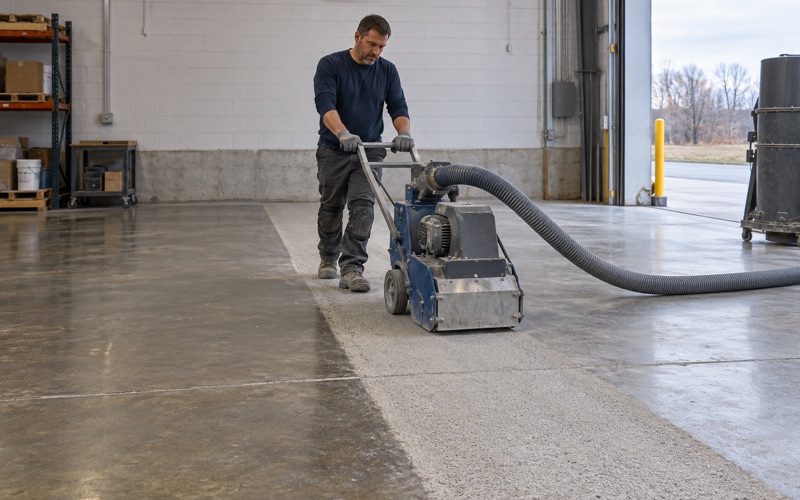
Both jobs begin in the same place. We open the concrete mechanically with a diamond grinder or a shot blaster, never with acid, and moisture testing appears in the scope as its own priced line instead of a remedy offered after a coating lets go. The proposal names the product, the system build and the finished thickness, so the floor that goes down can be checked against the paper that sold it.
What differs between those two piles is the schedule, the traffic the floor will carry and who has to sign off before a crew arrives. Here is how each of those plays out in this village.
Floors That Build, Store and Ship

A campus that manufactures as well as warehouses
ECHO Incorporated runs its corporate headquarters, manufacturing and distribution from one 35-acre campus at 400 Oakwood Road, inside the village and within Ela Township. A planned 49,835-square-foot expansion was set to bring the buildings there to about 578,000 square feet. That combination is a useful picture of the local industrial floor: production, storage and shipping sharing one site rather than spread across three addresses.
The surrounding Lake Zurich Industrial Park, which takes in Rose Road, carries I-1 and I-2 industrial zoning. So the commercial slabs we price in this village are mostly real production and distribution space, not office suites with a showroom up front. A floor in that kind of building is planned around forklift lanes and a plant calendar, not around a quiet weekend.
Forklifts, racking and production lines
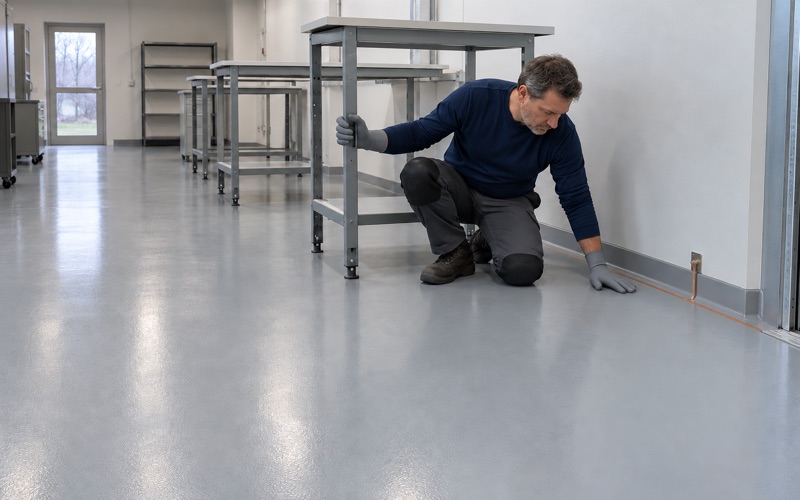
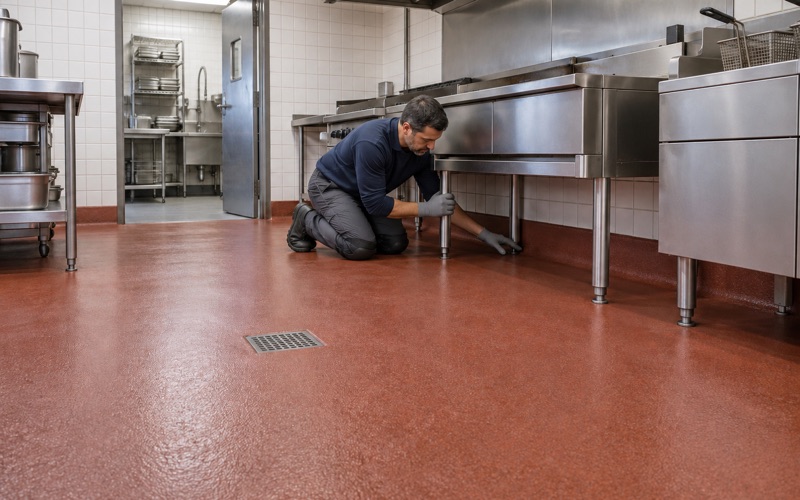
A forklift does its damage in the turns, where hard wheels twist against the surface, and at the dock edge, where pallets drop. In those lanes we build with 100% solids epoxy and a quartz aggregate broadcast locked in with a topcoat, which gives the wheels texture to grip and gives the film enough body to take point loads. Where a line sees hot rinse water or wash-down chemicals, urethane cement is usually the better material, and we say so in the proposal rather than stretching an epoxy past its limits.
Racking adds its own decision. Base plates are anchored into the slab, so the coating either goes down first and the racking is reset on a cured floor, or it is cut neatly around plates that cannot move. Saw-cut control joints keep moving after we leave, and we tell a plant manager plainly that a coating is a film following the concrete under it. It will not hold a moving joint or a working crack together, so those get a filler or repair detail of their own.
Working inside a production calendar
We phase plant work by bay or by aisle, so one zone cures while the next stays in use. When a line can only spare a short window, a polyaspartic topcoat returns the floor to traffic faster than a standard epoxy build. Cure timing is set by the slab temperature and the dew point spread at the surface, measured on site, rather than by the date on the schedule, because a coating laid on a slab sitting near its dew point can blush and lose adhesion.
Before a zone goes back to forklifts, we walk it with the plant contact. We check the cure against the product data, confirm the finished thickness matches the number in the proposal, and agree on when loaded pallets and racking can return. Handing a floor back an hour early to save a shift is how a fresh film gets its first gouge.
Looking for epoxy-flooring closer to Wood Dale? See Epoxy-Flooring Services in Wood Dale.
Multi-Tenant Buildings: One Roof, Several Customers
Each bay is its own job
Not every industrial building in the village has a single occupant. The building at 61-95 Oakwood Road, for example, holds nine units leased to seven tenants. For a flooring contractor, every one of those bays is a separate customer with its own lease, its own operating hours and its own idea of when the floor can go dark.
We confirm early who controls the slab. A tenant often needs the landlord’s written approval before altering a floor, and a landlord coating an empty unit between leases is working toward a different finish than a tenant fitting out for a specific process. Whoever signs, the proposal goes to that party and spells out the same product, system and thickness it would for anyone else.
Neighbors on the other side of the wall
In a shared building the work happens while the bays next door stay open. We pick coatings within the Illinois VOC limits, which bind the installer as well as the manufacturer, and we plan ventilation and noisy grinding around the neighbors’ hours where we can. Dust collection runs on every grinder, because fine concrete dust drifting under a demising wall turns into a complaint against the tenant who hired us.
Testing every bay on its own terms
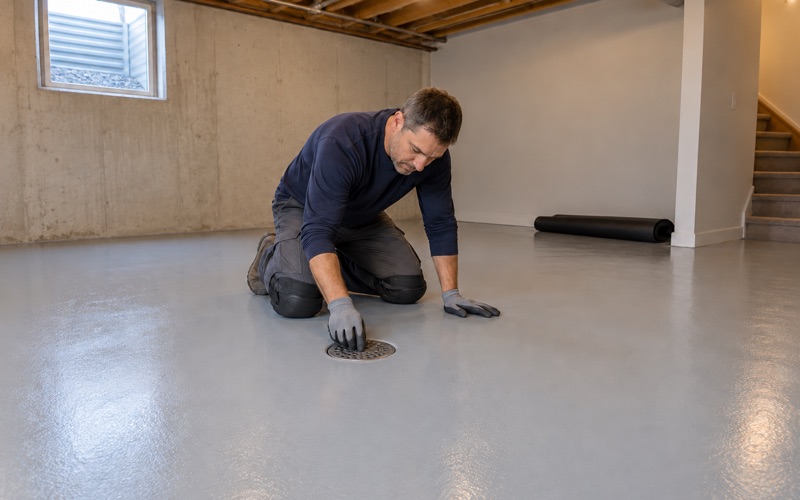
A moisture reading taken in one unit does not speak for the unit beside it. Slabs in multi-tenant buildings may have different histories, different floor drains and different coatings left behind by earlier occupants, so we test each bay, using ASTM F2170 in-situ relative humidity probes or ASTM F1869 calcium chloride tests depending on the product’s requirements. When a reading runs high, a moisture-mitigation primer goes into the scope before anything else is applied.
Permits, Lead Times and the Right Village
The village’s review window
The Village of Lake Zurich handles permits through its Building and Zoning Division, part of the Community Services Department, and applications go to the permit desk by e-mail. The village says most applications take up to 15 business days to process. On any commercial floor job that needs a permit, we build those three weeks into the start date from the first conversation, so a plant shutdown is not booked for a week the paperwork has not cleared.
Illinois issues no state license for flooring or coating work, so there is no license number for us to quote. What we provide instead is the contractor registration, bond and insurance certificate the village asks for, along with any certificate a landlord or property manager requires before a crew enters a building.
Fire service and occupied buildings
Fire protection in the village comes from Lake Zurich Fire Rescue Department, a village department running four stations that also serves the neighboring rural fire protection district by agreement, and both carry an ISO class 3 rating. When a coating job in an occupied building narrows an exit path or puts curing material near a sprinkler riser or fire lane, we lay out the sequence with the building owner in advance so the life-safety routes stay clear throughout.
Check the parcel, not the mailing address
A Lake Zurich mailing address does not always mean the Village of Lake Zurich is the permitting authority. Some properties published under the name sit in a different municipality or in unincorporated Lake County, so we check the parcel before naming the village on an application. Filing with the wrong building department is how a fifteen-day wait becomes thirty.
The 1980s Garage Slab, Thirty-Five Years On
What the housing record says
The village has 7,588 housing units, and the 1980s were its largest building decade, with 2,393 homes, or 31.5 percent of the total. Taken together, 69.2 percent of local houses were built between 1970 and 1999, and 5,322 are owner-occupied detached homes. A typical garage floor here is roughly thirty-five to fifty-five years old.
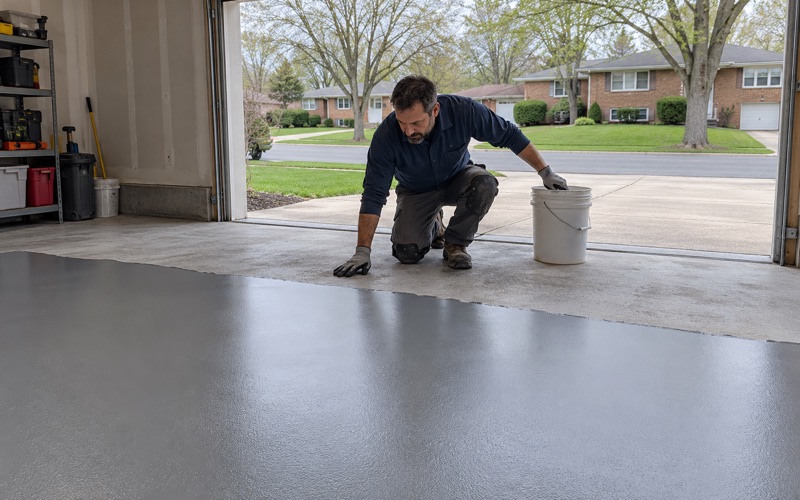
That age carries a particular history. The slab is old enough to have been sealed, painted or coated at least once, and its owner may well be the original buyer who did that work on a weekend years ago. Whatever is on the surface now has to come off before a new system can bond.
Reading the old coating and the cracks
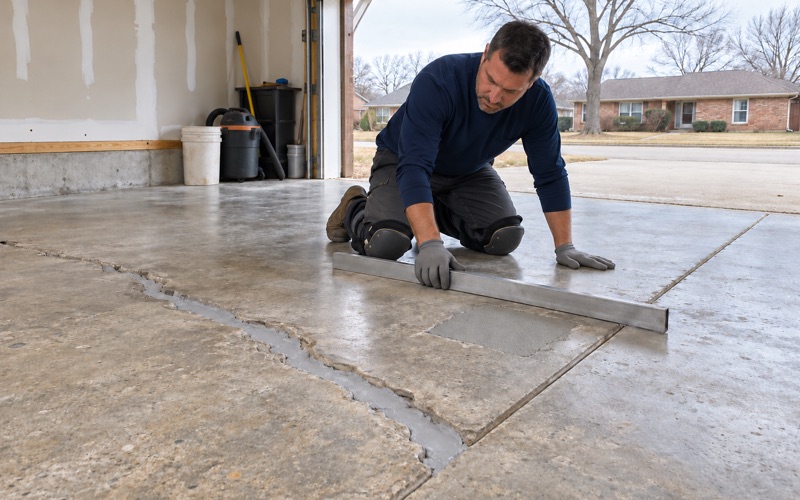
We start a residential quote by looking hard at what is already there. Peeling garage paint, a clear sealer gone cloudy, or a hardware-store epoxy showing hot tire pickup all tell us how the surface was prepared before, and all of them are removed by grinding to a fresh profile. Cracks get read rather than covered: a settled or heaved section needs repair first, and we say plainly when a slab is not ready to coat.
Moisture testing is part of the residential scope too. A simple ASTM D4263 plastic sheet test can flag a problem, and when it does we follow with a quantitative test before choosing a primer. A slab of this age may sit on a vapor retarder or on none at all, and the readings, not the build year, settle which system goes down.
White, powdery deposits along a wall or around a floor drain are efflorescence, salts carried up by water moving through the concrete. On a garage slab that age, that crust is a sign to test before quoting, not something to grind away and coat over. Where it shows, we explain what the readings mean before a homeowner commits to a system.
The system and the paperwork
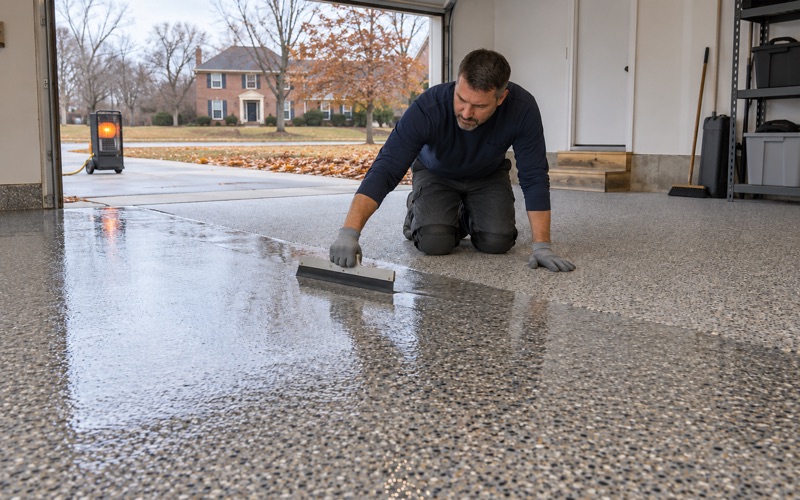
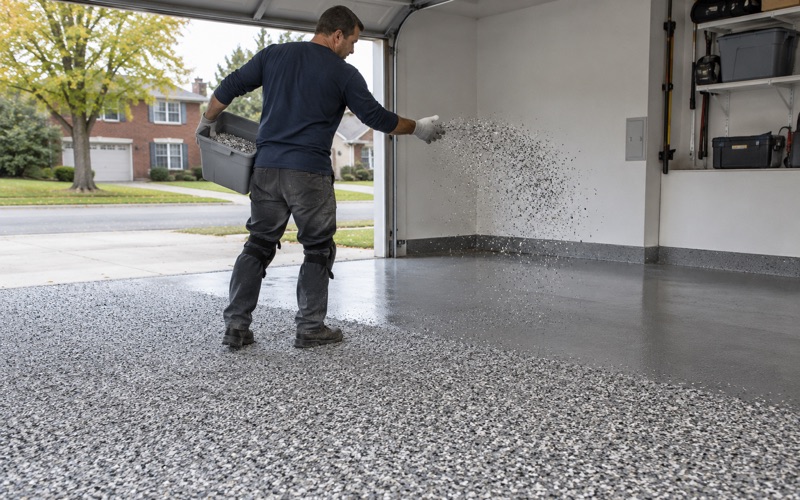
Most garages here end up with a 100% solids epoxy base, a full vinyl flake broadcast and a polyaspartic topcoat, which hides small surface flaws and stands up to tire traffic. Before any work starts, every homeowner receives a written contract and the Home Repair: Know Your Consumer Rights pamphlet, as the Illinois Home Repair and Remodeling Act requires. We also read the warranty exclusions aloud before the job is sold, and moisture is the first one on the list.
- 20+ Years Coating Concrete
- Moisture Tested Before Quoting
- Itemized Written Proposals