Arlington Heights Epoxy Flooring brings more than 20 years of coating concrete to epoxy flooring in La Grange Park, and the work here splits into two very different conversations. One is with a property manager responsible for hundreds of units under one roof. The other is with a homeowner standing in a detached garage that has outlived several cars and at least one coat of paint.
Both buyers get the same starting point from us: a written scope that names the product, the system build and the finished thickness. A building manager can file it next to a maintenance budget and check it later, and a homeowner can hold it up against the floor the day the crew leaves. Nothing on the page is left to a sample board or a verbal promise.
What differs is everything around the coating itself. Who approves the work, how many hours a floor can be out of service, and what kind of traffic it has to take next week all change the plan. The sections below walk through how those questions play out in this village.
A Life-Plan Campus on La Grange Road

Plymouth Place, a nonprofit life plan community at 315 N. La Grange Road, has served the La Grange area since 1944. The campus reports 182 independent living apartments at the Landing, 59 Arboretum Villas, 52 assisted living units, 26 memory support units and 86 skilled nursing units, along with a Center for Healthy Living focused on fitness and aquatics. We have no knowledge of what is on any floor there, and we name the campus only because it shows what one address in this village can hold.
That range matters to anyone who manages a similar property, or who supplies one. An aquatics center, a residential villa row and a skilled nursing wing sharing one site means a contractor has to switch between three kinds of floor work without carrying the assumptions of one into the next.
One campus, several floor briefs
A community built that way is really several buildings with several different floors. A villa garage is a residential job with a car on it. A dining room, a fitness area or the deck around a pool is an amenity floor with its own cleaning routine and appearance standard. A care unit hallway is something else again, a surface that takes rolling carts, wheelchairs and walkers all day and gets cleaned far more often than any garage.
We write each of those as its own scope rather than pricing a campus by the square foot. The primer, the body coat, the broadcast and the topcoat can all change from one wing to the next, and the proposal says which goes where.
Floors built for wheels and daily cleaning
Constant wheeled traffic and frequent wet cleaning are hard on a thin film. For that kind of use we generally look at a 100% solids epoxy body coat with a quartz aggregate broadcast, finished in a polyaspartic or polyurea topcoat chosen for the cleaning chemistry the staff actually uses. Seams, door thresholds and the edges around fixed equipment get detailed carefully, because that is where wheels catch and coatings start to lift.
We do not describe any floor as a safety device. Texture and finish are choices an owner makes with its own staff and advisers; our job is to install the system they select to the build we wrote down and to tell them plainly what a coating can and cannot do.
Kitchens answer to the county
Food-service floors at a care campus fall under Cook County Department of Public Health inspection, and the village lists a Cook County health inspector by name among its consultants. Where a kitchen is part of the scope, we detail coved floor and wall junctures in line with FDA Food Code 6-201.13, as adopted through the Illinois Food Code, so the inspector sees a cleanable curve instead of a raw corner.
Looking for epoxy-flooring closer to Brookfield? See Brookfield Epoxy-Flooring.
535 Units in Big Buildings: The Manager as the Buyer
La Grange Park is mostly single-family homes, but not entirely. Buildings of 50 or more units hold 535 of the village’s 5,629 housing units, about 9.5 percent of the stock, and 287 of those are renter-occupied. In those buildings the person signing the proposal is rarely the person who parks on the floor.
What a building manager needs from a quote
A manager answers to an owner, a board or an asset plan, so the proposal has to survive being forwarded. Ours names the product, the system build and the finished thickness in plain terms, which lets the manager compare bids line by line and confirm afterward that what was quoted is what went down. Moisture testing appears as its own line item, using ASTM F1869 calcium chloride tests or ASTM F2170 in-situ relative humidity probes as the slab calls for, rather than a surprise change order after the first coat.
Warranty exclusions get read out before the contract is signed, with moisture named first. A manager who knows the exclusions in advance can explain them upward instead of discovering them during a claim.
Working while residents are home
A large residential building does not close. Garages, storage rooms, trash rooms and amenity spaces stay in use, so we phase commercial work around the hours and areas the building has to keep open and agree on that sequence before mobilizing. Every slab is opened mechanically with diamond grinding or shot blasting to a measured ICRI CSP profile, with dust collection running, and we never acid etch.
We also keep coatings within the Illinois VOC limits for architectural coatings under 35 Ill. Adm. Code Part 223, which apply to the installer as well as the manufacturer. In an occupied building that choice matters to everyone who walks past the work area.
Owner-occupied units in large buildings
Not every large building here is a rental. Census figures count 57 owner-occupied units in buildings of 50 or more, which usually means a board or an association weighs in on shared floors. When that is the case, we ask who approves the scope and the schedule before we set a start date, and we keep the proposal written so a board can read it in one sitting.
Plan Review Through a Contracted Code Consultant
The Village of La Grange Park is a non-home-rule municipal corporation with a council-manager government, and its permitting is organized differently from a larger city with a full in-house plans staff. Building and Inspectional Services sits under a Building Director, and building code services are contracted to an outside consultant the village lists as Lakeside. Plumbing inspection is handled by a separate consultant inspector.
Ask before promising a date
Because plan review runs through a consultant, we ask the Building Department what a coating scope requires before we put a schedule in front of a client. A plain recoat in a house garage and a coating that touches drains or a commercial kitchen may be treated very differently. We would rather confirm that at the start than move a crew date twice.
Fire service in the village comes from the La Grange Park Fire Department, which runs two stations: Station 1 alongside Village Hall and Station 2 at 1010 E. 31st Street. On a commercial job inside a larger building, we ask the property manager whether the fire department needs notice of the work before we plan staging and ventilation.
Registration in place of a state license
Illinois issues no state license for flooring or coatings work. Instead of a license number, we show the village contractor registration, bond and insurance certificates the municipality asks for. Village Hall sits at 447 N. Catherine Avenue, and we handle that paperwork before any work begins.
The 1950s Garage on the Rest of the Block
Away from the big buildings, the village is a 1950s neighborhood. Of 5,629 housing units, 2,547 were built between 1950 and 1959, or 45.2 percent of all housing, and only 257 have gone up since 2000. Owners occupy 72.2 percent of homes, and 90.5 percent of owner-occupied units are detached houses, so the typical garage floor here is roughly seventy years old with its owner standing on it.
Reading a seventy-year-old slab
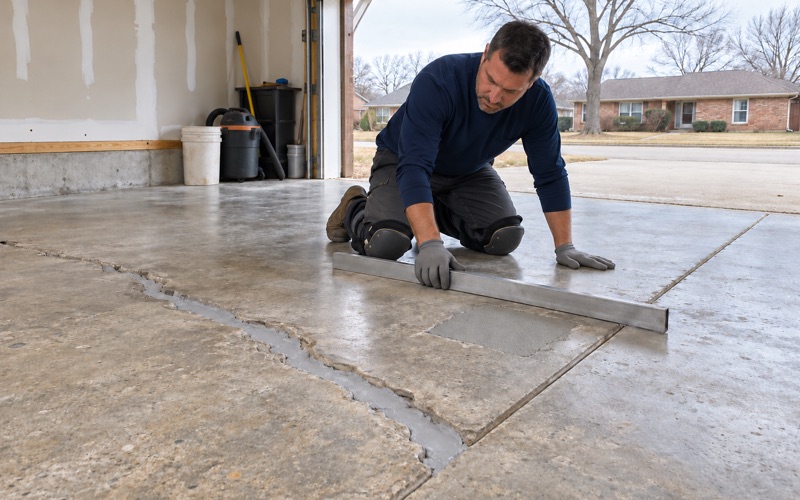
A slab poured in the 1950s rarely arrives clean. It may carry settlement cracks, patched spalls, decades of oil and a failed coat of porch paint. We read the cracks and any old coating before quoting and say plainly when the concrete needs repair before it can be coated. A coating is a film that follows the slab under it, so it will not stop a crack that is still moving.
Slabs of that era were also often poured without the under-slab vapor retarder a modern spec calls for, so moisture testing is a written line item on every garage job. A quick ASTM D4263 plastic sheet test can be a first look, with calcium chloride or relative humidity testing where the result needs a number. If the readings call for it, we specify a moisture-mitigation primer before the body coat. White efflorescence along a wall line or a darker band near the floor drain is a hint worth testing, not a verdict, and we treat it that way.
Built for brine and paperwork
A La Grange Park garage takes rock salt and calcium chloride brine off the tires every winter, so we build the system to resist it: a ground slab, a 100% solids epoxy base, a vinyl flake broadcast and a polyaspartic topcoat that holds up against hot tire pickup. In a detached, unheated garage, curing depends on slab temperature and dew point, and when the slab will not stay warm enough, we tell you the job has to wait for spring.
Every home job comes with a written contract and the Home Repair: Know Your Consumer Rights pamphlet before work starts, as the Illinois Home Repair and Remodeling Act requires. The same rule applies whether the house is on a quiet side street or a few blocks from Nazareth Academy, the Catholic college-preparatory high school founded in 1900.
- 20+ Years Coating Concrete
- Moisture Tested Before Quoting
- Itemized Written Proposals