Arlington Heights Epoxy Flooring has spent more than 20 years on epoxy-flooring in La Grange and across the western Cook County suburbs, and a large share of that work has been under houses that are older than anyone who lives in them. A basement poured a century ago does not behave like a slab poured last year, and we price, test and build the floor around that difference instead of treating every gray concrete surface as the same job.
Most of the calls we take here are about a basement that has been painted, sealed or carpeted more than once, or a detached garage behind an older house. The owner wants a floor that can be cleaned and used. Before we can promise that, we have to learn what is actually under the old finishes and whether moisture is moving through the slab.
What follows is how we approach those floors, what the historic district around much of the village does and does not change, how condominium and storefront floors differ from houses, and the honest limits of any coating laid over old concrete.
Reading and Testing a Basement Slab From Before 1940
What an early basement floor usually is
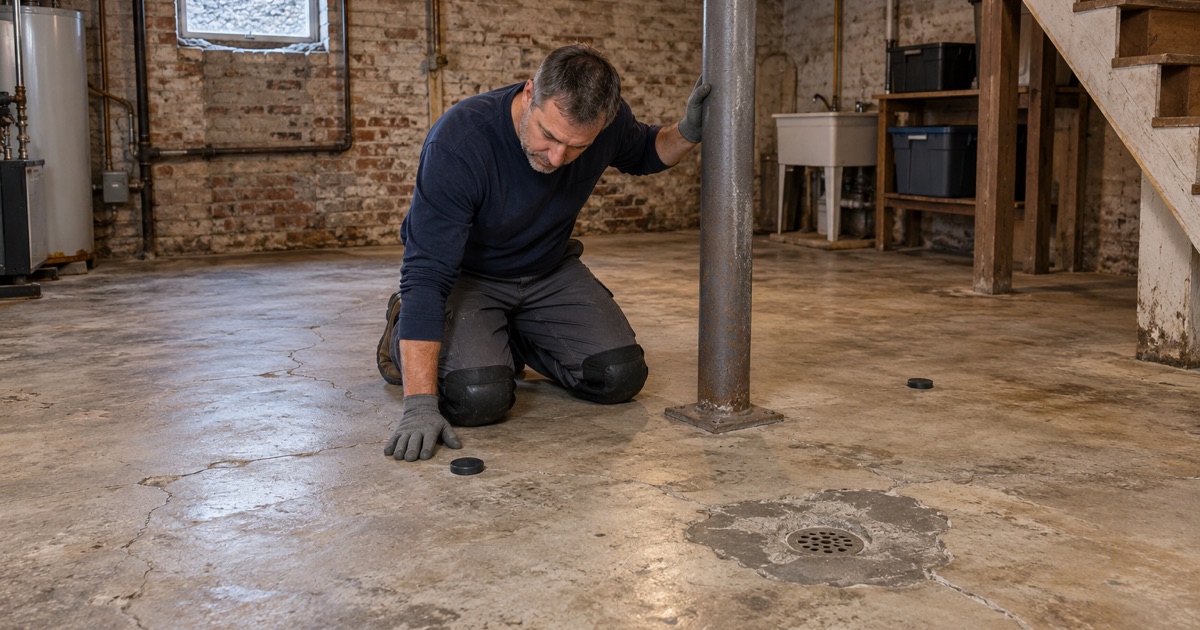
A basement floor from the decades before World War II was often a thin topping placed over a rougher base, or a single pour laid straight on the soil with nothing between the concrete and the ground. Many have been patched where a coal room, a floor drain or a laundry stand was moved. Some carry layers of oil-based paint, asphalt-based mastic from old tile, or a clear sealer that someone rolled on decades ago.
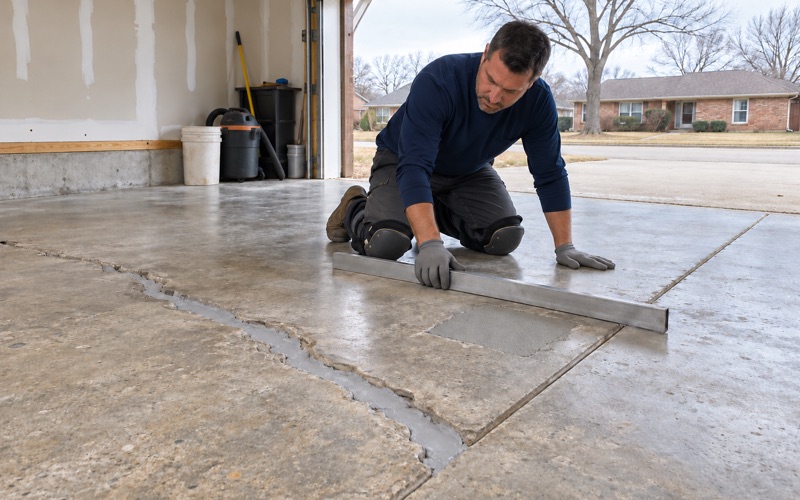
None of that rules out a coated floor. It does mean the slab has to be opened and read before anyone decides what goes on it. We read the cracks and the old coatings before we quote, and if a section needs to be cut out and repoured, or a delaminated topping has to come up, we say so plainly rather than coating over a surface that is already letting go.
Why the age of the house sets the testing plan
In La Grange, 2,237 of the village’s 6,196 housing units, or 36.1 percent, were built in 1939 or earlier. Every one of those slabs went in decades before ASTM E1745, the standard that defines a modern under-slab vapor retarder, was first published in 1997. On a floor that old, we assume there is no vapor barrier until a test tells us otherwise.
That is why moisture testing is a written line item in our scope on every basement and garage job, not an add-on we raise after a floor has blistered. On a basement, we start with an ASTM D4263 plastic sheet test to look for obvious moisture, then use ASTM F2170 in-situ relative humidity probes or ASTM F1869 calcium chloride vapor emission tests to put a number on it. Those readings get compared against published moisture thresholds such as those in ASTM F710 and against the limits of the product we intend to use.
Opening the surface the right way
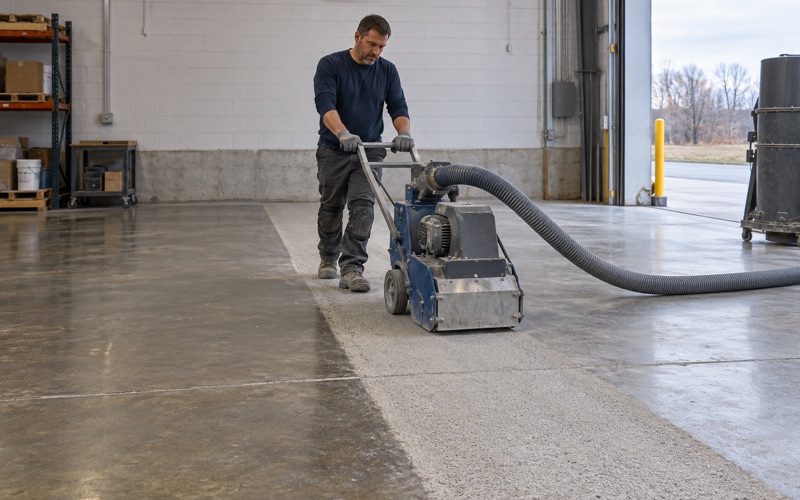
Once the old finishes are off, every slab is profiled mechanically. We use diamond grinding for most basements and shot blasting where the floor and access allow it, working to the ICRI CSP profile the chosen system calls for. We do not acid etch, because acid does little to old paint or mastic and leaves residue in a porous slab that can work against the bond later.
When testing shows the slab is releasing more moisture than a standard epoxy can tolerate, the plan changes before the job is sold. That may mean a moisture-mitigation primer under the system, or a urethane cement build that handles vapor better than a thin film. Warranty exclusions are read out with the proposal, and moisture is the first one we name.
Looking for epoxy-flooring closer to Western Springs? See Western Springs Epoxy-Flooring.
The La Grange Village Historic District and Your Floor
What the listing covers
A large part of the village sits inside the La Grange Village Historic District, listed on the National Register of Historic Places on August 8, 1979. It covers 215.1 acres and more than 1,000 buildings, most of them residences, nearly all built between the 1870s and 1930. The district includes three Frank Lloyd Wright designs along with work by John S. Van Bergen and Enock Hill Turnock.
Owners inside those boundaries often ask whether coating a basement or garage floor needs some kind of historic sign-off. It is a fair question in a district of that size and age, and the answer is worth having before the first contractor walks in.
What the listing does not do
The Village of La Grange describes National Register listing as honorary. Its own guidance states that owners are free to maintain, manage or dispose of their property as they choose, provided there is no federal involvement, and are not legally obligated to restore or maintain it. Landmarks Illinois reported in 2019 that La Grange did not have a local historic preservation ordinance.
In practical terms, an interior floor coating in a district house answers to the ordinary Village of La Grange permit process, not to a preservation review. If your project involves federal funding or another federal tie, that is a separate conversation, and we would ask you to confirm it before work is scheduled. We have not checked whether an ordinance has been adopted since 2019, so if you have heard otherwise, we will look at it with you.
Who is actually buying the floor
The village is 81.5 percent owner-occupied, and only 121 detached houses are rented. On a detached-house basement or garage, the person signing the proposal is almost always the household that lives above the slab and will live with the result.
For that reason, every home job gets a written contract and the Home Repair: Know Your Consumer Rights pamphlet before work starts, as the Illinois Home Repair and Remodeling Act requires. The proposal names the product, the system build and the finished thickness, so what was promised can be checked against what was installed. Illinois issues no state license for flooring or coatings work, so we provide the village contractor registration, bond and insurance documents the Village of La Grange asks for instead of a license number that does not exist.
Condominium and Downtown Storefront Floors
Multi-unit buildings and associations
Nearly 30 percent of the village’s housing is in buildings of two or more units, and 244 units sit in buildings of 50 or more. A garage level, a storage room or a common corridor in one of those buildings is a commercial job in everything but name. The decision usually belongs to a condominium or apartment association board, and the work has to fit around residents who still need to park, store and move through the building.
On those jobs, we phase the floor so part of the parking or storage stays usable, and we schedule noisy grinding and coating work around the hours the building has to stay open. Systems are chosen within the Illinois limits on VOC content under 35 Ill. Adm. Code Part 223 Subpart C, which bind the installer as well as the manufacturer and matter even more in an occupied building with shared air.
Storefronts along La Grange Road and the rail line
Downtown La Grange centers on La Grange Road and the BNSF line, with Metra stations at La Grange Road and Stone Avenue. Many of the storefront buildings there are as old as the houses around them, and their floors carry the same mix of patches, old tile mastic and uneven slab as a district basement.
A shop, office or food business downtown usually cannot close for a week. We plan the grind, prime and topcoat steps around trading hours and use faster-curing polyaspartic or polyurea topcoats where the schedule calls for a quick return to service. A food space has its own requirements under the Illinois Food Code, which adopts the 2022 FDA Food Code, including coved floor and wall junctures under section 6-201.13, and we build those into the scope rather than leaving them for the inspection.
Confirm the address before the permit
Mailing addresses and municipal boundaries do not always line up, and a 60525 address alone does not settle which municipality is in charge. On a commercial job, we confirm the property is within the Village of La Grange before assuming its permit path, so the paperwork goes to the right office the first time.
What a Coating Will Not Fix on Old Concrete
Movement and cracks
An epoxy or polyaspartic system is a thin film bonded to the slab, and it follows whatever the concrete under it does. If an old basement floor is settling, heaving or cracking, the coating will eventually show the same lines. We say this before the job starts rather than promising that a floor coating will stop structural movement.
What we can do is repair active cracks properly, fill voids and spalls with compatible material, and choose a system with some flexibility where the slab calls for it. When a crack pattern points to a structural problem, we will tell you that a coating is the wrong first step.
Water, vapor and radon
A coating is not a waterproofing system. If water is entering through the walls, the floor-wall joint or an old floor drain, that problem needs to be solved first, and on a basement we look closely at sump pit and floor drain details before we plan the edges of the floor. White efflorescence on an old slab is a sign that moisture is carrying salts to the surface, and it is one more reason testing comes before quoting.
Some owners hope a sealed floor will also lower radon. We do not sell a floor coating as radon reduction. In Illinois, that work takes a state radon mitigation license through IEMA, and it should be handled by a licensed mitigator as a separate project.
Choosing a finish that suits the house
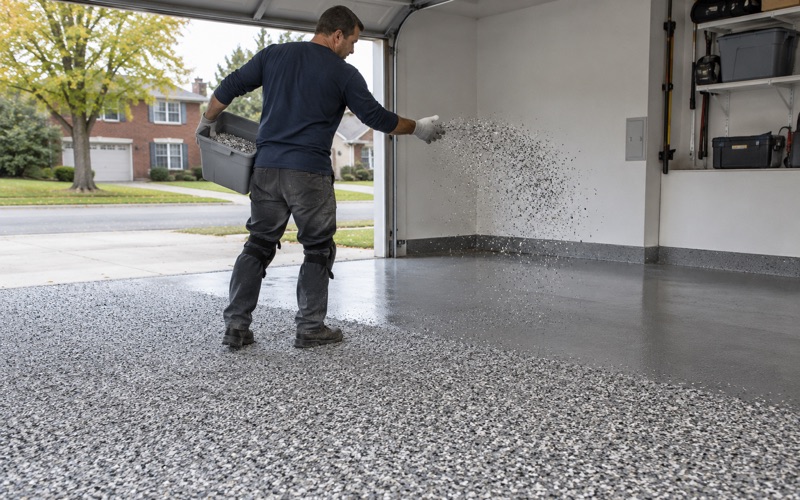
For a basement that will become a workshop, gym or storage space, we often recommend a 100% solids epoxy base with a vinyl flake broadcast and a durable topcoat. For a detached garage, we look at hot tire pickup risk and select a topcoat that can handle it. In older homes where the floor will be mostly decorative, a ground and densified surface with lithium silicate densifier can be a better fit than a heavy film.
Whatever system you choose, the goal is the same: a floor that matches the slab underneath it, the house above it and the way you actually use the space, with every limitation stated in writing before work begins.
- 20+ Years Coating Concrete
- Moisture Tested Before Quoting
- Itemized Written Proposals