Arlington Heights Epoxy Flooring has spent more than 20 years on epoxy flooring in Hinsdale and the rest of the western suburbs, and a growing share of that work starts on concrete nobody has coated before. When a house comes down and a new one goes up, the garage and basement slabs underneath are new pours, and the first coating on fresh concrete is its own kind of job.
That job is less about scraping off a failed finish and more about timing and moisture. A new slab can look finished the week the drywall goes up and still be releasing water it will keep giving off for months. A coating applied on that schedule can blister or lose its grip, and no warranty we know of covers a floor laid over a slab that was still drying.
So our first visit to a new house is mostly measurement. We check what the slab is doing, tell the owner or the builder when it can take a coating, and put the product, the system build and the finished thickness in writing so the floor that goes down matches the floor that was quoted.
New concrete under a new house, and why the first coat is different
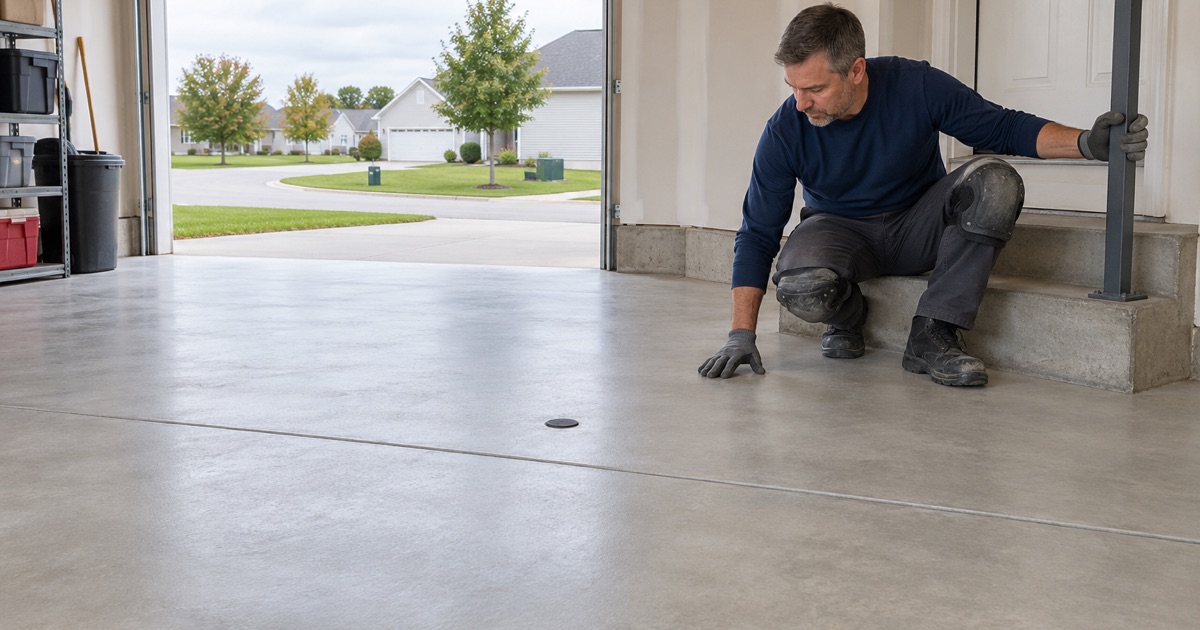
A replacement house is usually ready for furniture well before its slabs are ready for a resinous floor. Builders pour the garage and basement early, the framing and finishes follow, and by move-in the concrete has had a few months at most. Industry guidance commonly treats 28 days as the bare minimum before a coating, and a thick or enclosed slab often needs much longer than that.
Fresh concrete still has water to lose
Concrete cures by a chemical reaction that keeps going long after the surface hardens, and the extra mix water has to work its way out through the top. Seal that surface too early with a 100% solids epoxy and the vapor trying to leave pushes against the film from below. The result is the soft blisters and lifting edges people associate with a bad product, when the product was simply put down too soon.
A first coat is not a recoat
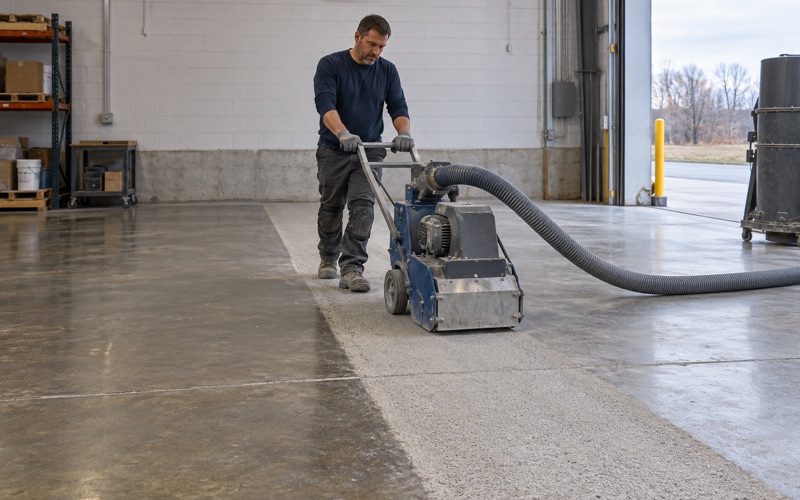
Most coating work in older suburbs is a recoat: an existing finish has peeled, and the work is grinding it off and finding out why it failed. A new slab carries none of that history, but it often has curing compound, sealer residue or a troweled surface so tight that nothing will bond to it as it is. We open every slab with a diamond grinder or a shot blaster to a measured ICRI surface profile, and we do not acid etch, new concrete included.
Densifiers and sealers already on the slab
Some builders finish a new garage with a lithium silicate densifier or a clear cure-and-seal product so the concrete looks clean at closing. Both are reasonable choices for bare concrete, and both work against a coating, because they close the pores a primer needs to grab. We ask the builder what went on the slab when we can, test the surface when we cannot, and grind deeper where a treatment is still sitting in the top layer. That extra pass is priced in the proposal rather than discovered halfway through the job.
What we read on a slab before quoting
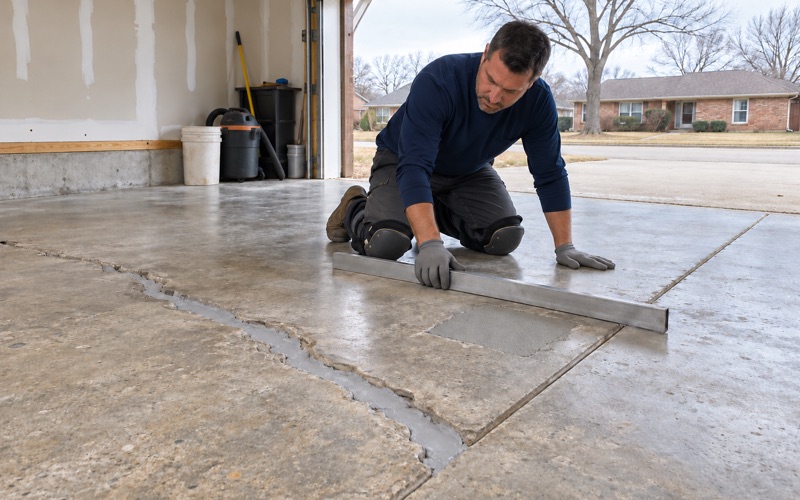
New does not mean flawless. Control joints, shrinkage cracks and the odd low spot by the floor drain all show up in the first year. We look at each one before we price the job, say plainly when something needs repair first, and explain that a coating is a film that follows the concrete under it. If the slab moves, the floor will show it, and we would rather say so now than after the fact.
Looking for epoxy-flooring closer to La Grange? See Epoxy-Flooring Services in La Grange.
A new garage slab still gets a moisture test
Owners of a brand-new house are sometimes surprised that we want to test a garage floor poured last year. The reason is in the building code. The residential code exempts garages from the under-slab vapor retarder requirement, so a garage slab poured in 2023 can sit directly on the base with nothing beneath it to slow ground moisture, exactly as a garage poured in 1950 did.
The tests we use and what they tell us
Moisture testing is a line item in our scope on every garage and basement job, not something offered after a floor fails. Depending on the slab, that means ASTM F1869 calcium chloride kits for the vapor emission rate, ASTM F2170 in-situ relative humidity probes set into the concrete, or an ASTM D4263 plastic sheet test as a quick first read. We compare the results against the thresholds the coating manufacturer sets and the guidance in ASTM F710.
When the numbers come back high
A high reading on a new slab usually means it needs more time, and sometimes it means the slab will stay damp. In the first case we schedule the work for later and say so. In the second, the build changes to include a moisture-mitigation primer under the base coat, or a urethane cement system that tolerates more vapor than a standard epoxy.
Neither option is a way to rush a slab that simply needs another few months, and we will not present it as one. Warranty exclusions are read out before anything is signed, and moisture is the first one we name.
Building the floor once the slab is ready
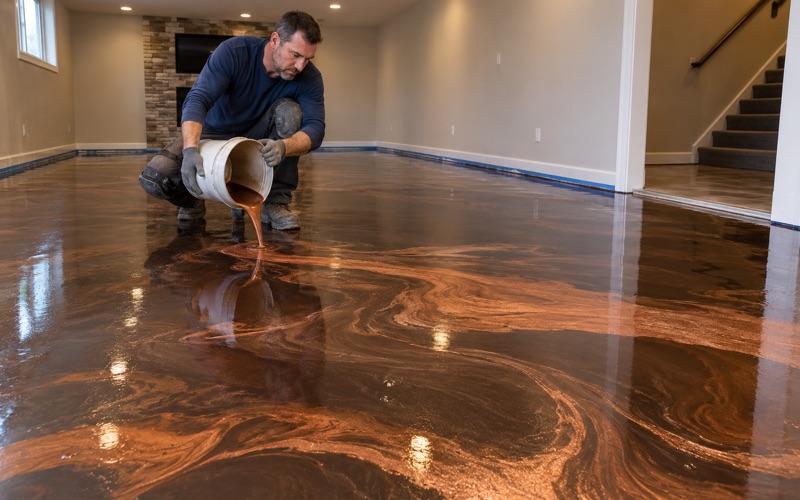
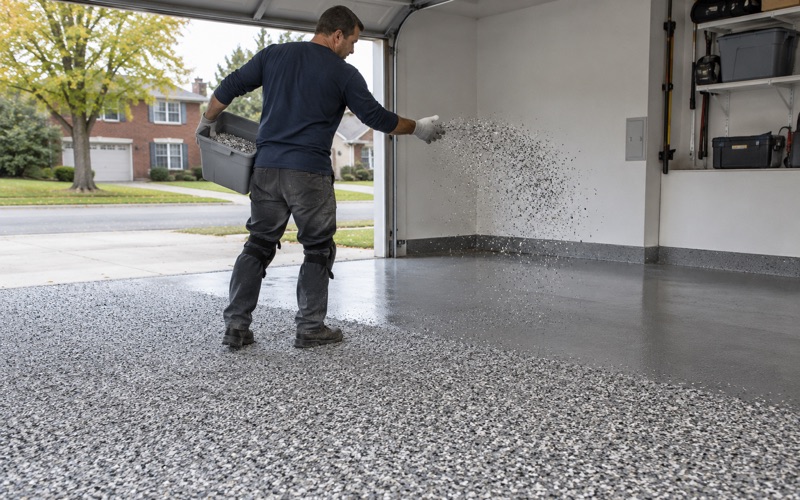
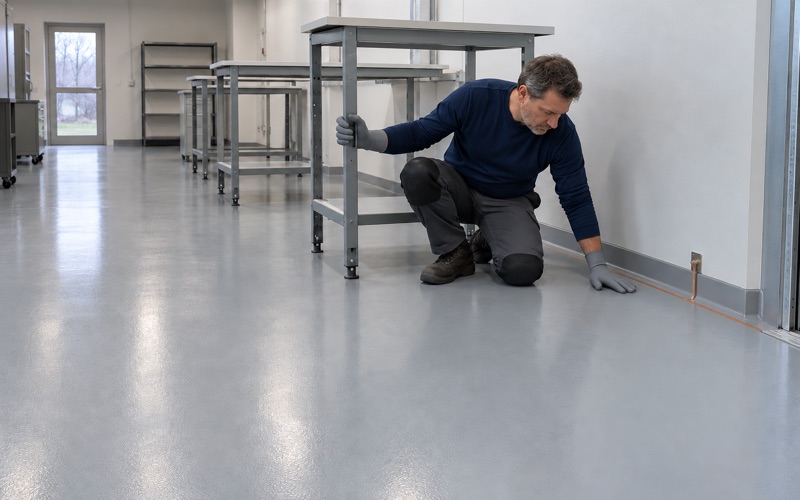
On a garage, a common first system is a pigmented epoxy base coat, a vinyl flake broadcast and a polyaspartic topcoat, which resists hot tire pickup and stays clear in sunlight. Basements in new houses often get a quartz aggregate broadcast for texture underfoot. Whichever system is chosen, the proposal states the product names and the finished thickness, and every coating is chosen within the Illinois VOC limits that apply to the installer as well as the manufacturer.
Robbins Park, demolition and what the commission does not review
Hinsdale rebuilds itself house by house, and the housing numbers show it. The 2000s are the largest single decade in the village’s housing table, with 1,148 of its 6,215 units, and 30.0 percent of all housing units here were built in 2000 or later. That is why so many of the floors we see in Hinsdale sit on slabs poured within the last two decades rather than on original concrete.
The historic district and its review process
Much of the debate over that rebuilding centers on the Robbins Park Historic District, which was added to the National Register in 2008. Roughly 30 homes there have been demolished. Demolition, relocation or new construction in the district requires a certificate of appropriateness from the Hinsdale Historic Preservation Commission, and an ordinance passed in April 2024 added a preliminary application and a design review team meeting ahead of it. The same ordinance raised Robbins Park demolition fees from $7,928 to $11,100.
Where a floor coating fits
None of that process reaches a floor coating. The commission’s opinions are non-binding, a denied certificate does not stop a demolition, and its review concerns demolition, relocation, new construction and changes to landmarked properties, not interior floor work in an existing house. If you are coating the garage or basement of a house in Robbins Park, the preservation review is not part of the job. If you are building a new house there, the slab we eventually coat arrives after that review is over, and the timing questions above apply to it like any other new pour.
Scheduling around a build
On a new house we try to be brought in early, even though we will not coat until late. A builder who knows our moisture targets can plan the garage pour sooner, keep the slab clear of drywall mud and paint, and leave the curing compound choice open for a conversation. Every home job also gets a written contract and the state’s Home Repair: Know Your Consumer Rights pamphlet before work begins, as the Illinois Home Repair and Remodeling Act requires.
Which county’s rules apply on your side of County Line Road
Hinsdale sits mostly in DuPage County, with a smaller portion in Cook County, and its territory spans parts of Downers Grove, York, Lyons and Proviso townships. For a homeowner coating a garage, that split rarely matters. Most of our residential calls here come from the people who live in the house, since 89.9 percent of occupied units are owner-occupied, and the paperwork for a garage floor is the same on either side of the line.
Permits run through the Village of Hinsdale, whose Community Development department handles residential and commercial permits, and Illinois issues no state license for coatings work. In place of a license number we show the village registration, bond and insurance it asks for.
Commercial kitchens and the health department line
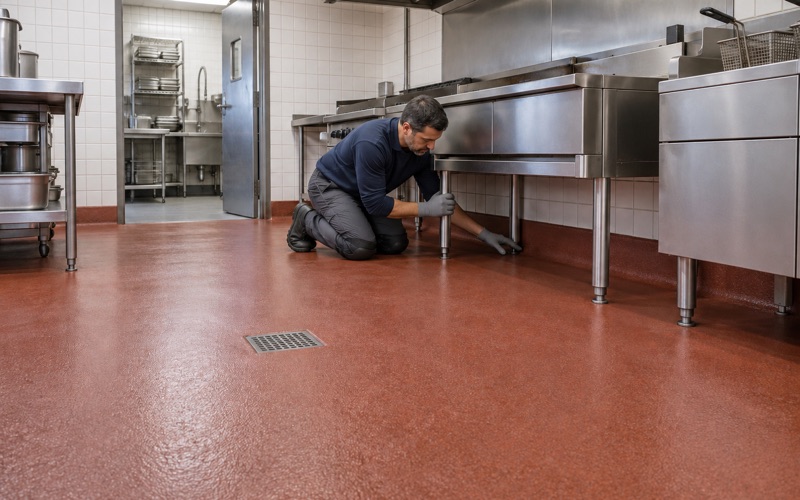
The county line matters more on commercial floors. A restaurant or food service kitchen answers to the DuPage County Health Department if its parcel is on the DuPage side and the Cook County Department of Public Health if it is on the Cook side. Both enforce the Illinois Food Code, which adopts the 2022 FDA Food Code, including coved floor and wall junctures under 6-201.13 and the antislip allowance under 6-201.11. We confirm which department covers the address before we build the cove detail.
Working around buildings that stay open
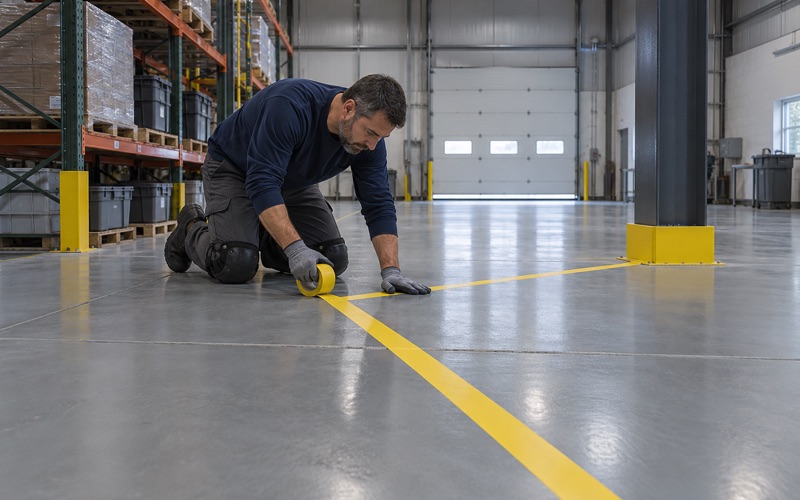
Hinsdale’s largest employer, UChicago Medicine AdventHealth Hinsdale Hospital, is a reminder that plenty of buildings in the village cannot close for a floor. On commercial work we plan grinding, coating and cure around the hours the building has to stay open, sequence areas so traffic always has a path, and pick topcoats with cure windows that fit the closure we are actually given.
One more thing we will not promise
Some owners ask whether a sealed basement floor helps with radon. We do not sell a floor coating as radon reduction, because in Illinois that work takes a state radon mitigation license. What we will do is give a new slab in Hinsdale the time and testing it needs, then put down a first coating with a fair chance of outlasting the house’s first owners.
- 20+ Years Coating Concrete
- Moisture Tested Before Quoting
- Itemized Written Proposals