
Arlington Heights Epoxy Flooring has installed epoxy garage floor systems for more than 20 years in Arlington Heights, IL, serving surrounding cities including Prospect Heights, Deerfield, Barrington, Lake Zurich and Wood Dale. A garage floor here works harder than almost any other surface in the house, taking studded snow tires, salty slush and the weight of a car parked on the same two strips of concrete for years. We build each one to carry that load rather than just to look good the week it is finished.
The finished coating is only as strong as the bond beneath it, so most of our attention goes into the slab. We grind it open with diamond tooling, read every crack and patch, test for moisture as a line item in the quote, and only then choose the primer, body coat and topcoat. You get a proposal that names the products, the layers and the finished thickness, so there is nothing vague about what will be on your floor.
Most garages we coat are residential, from tight one-car detached garages behind older bungalows to three-car attached garages on newer homes. The same method covers both, with the system adjusted to how the space is heated, how much salt comes in, and whether the garage doubles as a workshop or a gym.
What Goes Into an Epoxy Garage Floor System
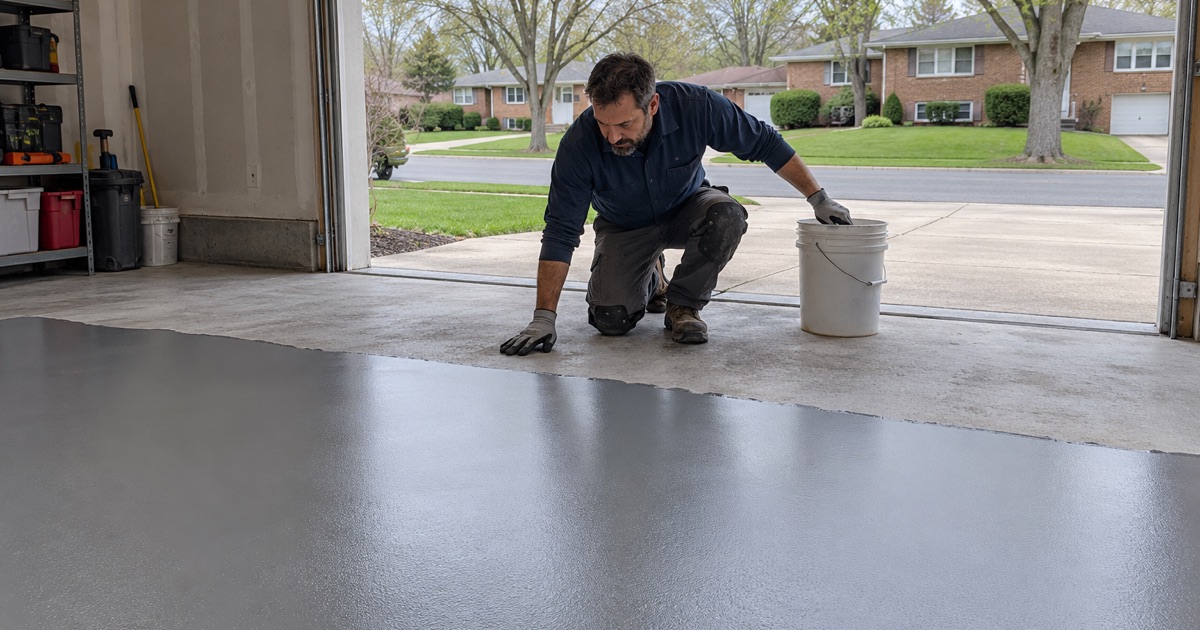
Primer That Penetrates the Slab
The first layer is a low-viscosity epoxy primer worked into the freshly ground concrete so it soaks into the pores rather than sitting on top. That penetration is what anchors the whole system, and it is the layer a store kit usually leaves out. Where moisture readings run high, this coat becomes a moisture-mitigation primer instead, priced separately so you can see why.
A 100% Solids Epoxy Body Coat
The body coat gives the floor its thickness, color and impact resistance. We use 100% solids epoxy, which has no water or solvent to evaporate, so the film that goes down is the film that stays. Thin water-based coatings shrink as they dry and leave far less on the floor, which is part of why they fail under hot tires and dragged equipment.
A Polyaspartic or Polyurea Topcoat
The topcoat takes the wear. Polyaspartic and polyurea topcoats resist abrasion, chemicals and ultraviolet light better than epoxy alone, and they do not amber where sunlight comes through the open door. On a flake floor the topcoat also locks the chips in place and sets the final texture, so its thickness decides how smooth or grippy the finished floor feels underfoot.
Preparing a Garage Slab in Arlington Heights
Grinding to a Real Surface Profile
We diamond grind or shot blast the entire slab to a measured ICRI concrete surface profile, the texture a primer needs to grip. Grinding also removes the weak top layer of paste, old sealers, oil-soaked spots and tire residue that acid etching leaves behind. Dust is pulled into a vacuum system at the grinder head, so the rest of the house stays clean.
Cracks, Spalls and Old Coatings
Before quoting, we map every crack, spalled edge and patch of peeling paint, because each one changes the plan. Stable cracks and spalls are filled with a rigid repair material and ground flush, and failed coatings come off completely. A crack that is still opening is a slab problem, and since a coating follows the concrete under it, we tell you that before you buy the floor.
Moisture and the Missing Vapor Barrier
Many older garage slabs were poured with no vapor barrier at all, and the village’s current replacement guidance still calls for one only under attached garages. Moisture rising through a slab can lift a coating from below, so we test with an ASTM F1869 calcium chloride kit, ASTM F2170 relative humidity probes, or an ASTM D4263 plastic sheet as a quick screen, and write the result into the proposal.
Built for Brine, Cold and Hot Tires
Calcium Chloride and Rock Salt
The village pre-wets its road salt with brine and liquid calcium chloride, and that mix drips off every car parked inside from November through March. On bare concrete, calcium chloride reacts with the cement paste to form calcium oxychloride, an expansive compound that scales and pits the surface. A sealed topcoat keeps that brine on top, where a floor squeegee can push it out the door.
Cold Slabs and Curing Windows
The Barrington weather station records about 137 nights a year at or below freezing, and an uninsulated garage slab carries that cold well into spring. Epoxy applied below about 50 degrees cures slowly, can form amine blush and may never reach full strength. We check slab temperature and dew point before every coat and reschedule rather than coat a floor that is too cold to cure.
Stopping Hot Tire Pickup
Tires come off a highway hot and soft, and as they cool on a thin or poorly bonded coating, they can grip it and peel it up in patches. Hot tire pickup is the most common complaint about bargain garage coatings. A ground slab, a penetrating primer, a full-thickness solids body coat and a hard topcoat together give the tire nothing loose to grab.
Our Step-by-Step Epoxy Garage Floor Process
Step 1: Walk-Through and Moisture Test
We look at the slab, the cracks, any existing coating and how the garage is used, and we set up moisture testing. You get a written proposal naming the product, each layer and the finished thickness, plus the warranty exclusions read aloud, moisture first, before anything is signed.
Step 2: Grinding and Repair
On installation day the slab is diamond ground wall to wall with dust extraction, then vacuumed. Cracks, spalls and pits are filled and ground flush, and control joints are prepared according to whether they are still moving. This is the longest and loudest part of the job, and the part that decides how long the floor lasts.
Step 3: Primer and Body Coat
With the slab temperature and dew point confirmed, the primer goes down, followed by the pigmented body coat. On a flake floor, the chips are broadcast into the wet body coat at the density you chose, from a light scatter to a full broadcast that hides the base color entirely.
Step 4: Scrape, Topcoat and Texture
Once the body coat has cured enough, loose flake is scraped and vacuumed, and the clear topcoat is rolled on. Any slip-resistant grit is mixed in at this stage, and the coating is carried up the stem wall a few inches where you want a cleaner edge.
Step 5: Cure and Return to Service
We tell you when the floor can take foot traffic, when you can move storage back, and when a car can park on it, all of which depend on the products and the temperature. One widely used epoxy, for example, takes about a day for foot traffic and about ten days for full cure at 50 degrees, so a warm garage gets back into service sooner.
Choosing the Look of Your Garage Floor
Flake Blends and Broadcast Density
Vinyl flake is the most popular garage finish because it hides dust, salt residue and small slab flaws while adding texture. Blends run from soft grays and tans to high-contrast mixes, and chip size changes the pattern from fine speckle to bold. We bring physical samples to your garage, because flakes look different under your lighting than on a printed card.
Solid Color and Metallic Finishes
A solid color coating suits a workshop where you want to spot a dropped bolt or a fluid leak at a glance. A metallic epoxy finish creates a marbled, glossy floor that makes a garage feel like part of the house, though it shows scratches and dust more readily. We will show you how each option wears before you commit.
- 20+ Years Coating Concrete
- Moisture Tested Before Quoting
- Itemized Written Proposals