
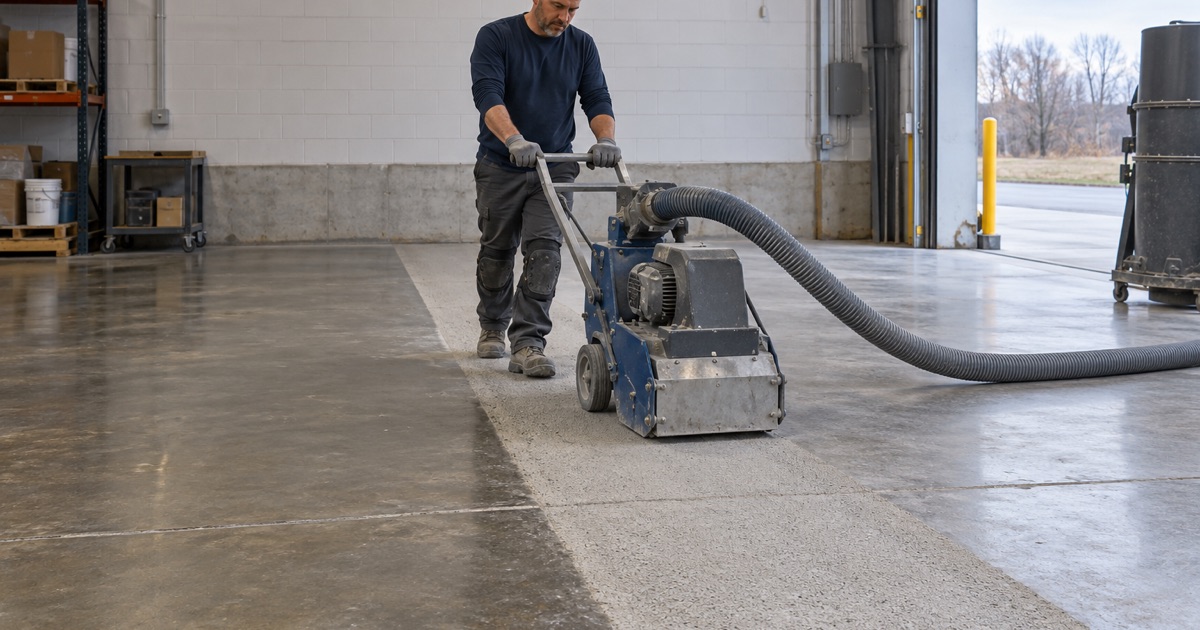
Arlington Heights Epoxy Flooring has been doing concrete grinding in Arlington Heights, IL for more than 20 years, serving surrounding cities including Prospect Heights, Deerfield, Barrington, Lake Zurich and Wood Dale. Grinding is the first step in every floor we install, and often a job in its own right: removing failed coatings, carpet glue and thinset, leveling lips at cracks and joints, and leaving a surface the next material can grip.
We use planetary diamond grinders and shot blasters with direct vacuum extraction, never acid etching. Acid only cleans the top of the slab, leaving behind weak surface paste, sealers and residue that the acid cannot reach, while grinding physically removes them. The result is a clean, open surface with a measured profile that suits the coating, overlay or polish going on next.
Whether the floor is a basement slab, a two-car garage or a warehouse, the proposal names the method, the target surface profile and any repairs found during grinding. That way you know what was done to the concrete before anything is applied over it.
What Concrete Grinding Accomplishes
Opening the Surface for a Coating
New and old concrete carries a weak top layer of fine cement paste, called laitance, along with any sealers, curing compounds and dirt. Coatings applied over that layer bond only to it and peel when it fails. Grinding removes it and opens the pores of the sound concrete below, giving primers a surface they can penetrate and lock into.
Removing Coatings, Glue and Thinset
Old paint, failing epoxy, carpet glue, vinyl adhesive and tile thinset all have to come off before a new floor goes down. Diamond tooling chosen for each material strips them without gouging the slab. We test what is on the floor first, because some old adhesives require special handling before anyone grinds them.
Leveling Lips and Rough Areas
Cracks and joints often develop lips where one side has lifted, creating trip hazards and visible ridges under a coating. Grinding takes those edges down, flattens trowel marks and rough patches, and smooths repaired areas flush with the surrounding floor. It improves flatness enough for most coatings, though major dips still need a leveling material.
Grinding, Shot Blasting and Acid Etching Compared
Diamond Grinding
Planetary diamond grinders use rotating heads fitted with metal-bond or resin-bond diamond segments. Coarser diamonds cut fast and remove coatings; finer diamonds refine the surface. Grinding works well on garages, basements and areas with walls, posts and edges, because the machines and smaller edge grinders can reach tight to every perimeter.
Shot Blasting
Shot blasters throw steel shot at the slab and recycle it through the machine, creating a uniform textured profile very quickly. They suit large, open commercial floors and heavier coating systems that need a rougher surface. Edges and corners still need a grinder, and shot blasting can leave visible track patterns under thin, clear finishes.
Why We Do Not Acid Etch
Acid etching uses dilute acid to roughen and clean concrete, and it is the usual step in a store-bought garage kit. It cannot remove sealers, oil or old coatings, leaves residue that must be thoroughly rinsed, and adds water to a slab that then has to dry. It also creates an inconsistent profile, so we use mechanical preparation on every floor.
Surface Profile and Matching It to the Floor
The ICRI Concrete Surface Profile Scale
The International Concrete Repair Institute publishes a scale of concrete surface profiles, from nearly smooth to heavily textured, with physical reference chips for comparison. Thin coatings need a fine profile, while thicker epoxy systems, urethane cement and overlays need progressively rougher surfaces. We match the profile to the system and check it against the reference chips.
Different Floors, Different Prep
A polished concrete floor starts with grinding but continues through finer diamonds instead of stopping at a coating profile. A flake or metallic epoxy floor needs a moderate profile for the primer, and a cementitious overlay needs a rougher one so it can bond mechanically. Getting that match wrong is a common cause of coating failure.
Testing After Grinding
Once the slab is ground, its true condition is visible. We check for hidden cracks, oil-soaked spots, soft concrete and old patches, and we test moisture with ASTM F2170 probes, ASTM F1869 kits or a quick ASTM D4263 plastic sheet. If the slab is carrying moisture or needs repair, we say so before any coating is applied.
Dust Control and Occupied Spaces
Vacuum Extraction at the Cutting Head
Concrete dust contains crystalline silica, which is hazardous to breathe. Every grinder and shot blaster we run connects to an industrial vacuum with HEPA filtration that captures dust at the source. Crews wear appropriate respiratory protection, and the floor is vacuumed again after grinding so no fine dust is left under the coating.
Grinding in Homes and Businesses
In homes, we seal doors to the living space, protect stored belongings and keep cords and hoses tidy. In businesses, we phase the work by zone and schedule the loudest stages for times the space is empty. Electric equipment keeps exhaust out of enclosed basements, offices and food facilities.
When Old Materials Need Testing First
Older floor tiles and black mastic adhesive can contain asbestos, and disturbing them by grinding releases fibers. Before removing old flooring of unknown age, we recommend lab testing, and if asbestos is found, a licensed abatement contractor removes it before we start. Grinding only begins once the slab is cleared.
- 20+ Years Coating Concrete
- Moisture Tested Before Quoting
- Itemized Written Proposals