
Arlington Heights Epoxy Flooring has been handling concrete floor repair in Arlington Heights, IL for more than 20 years, serving surrounding cities including Prospect Heights, Deerfield, Barrington, Lake Zurich and Wood Dale. Most of that work happens before a coating goes down, because a coating is only as sound as the concrete under it. We also repair floors that will stay bare, from cracked basement slabs to salt-scaled garage floors and broken warehouse joints.
Every repair starts with reading the damage rather than filling it. A crack can be harmless shrinkage, an old settlement line, or a sign the slab is still moving, and each calls for a different response. We look at the pattern, the edges and the history of the floor, and we tell you plainly when a slab needs more than patching before any coating would last.
Our written proposals list each repair by location and type, along with the materials we will use. That makes the work easy to check afterward and keeps repair costs from surprising anyone halfway through a coating job.
Reading Cracks Before Repairing Them
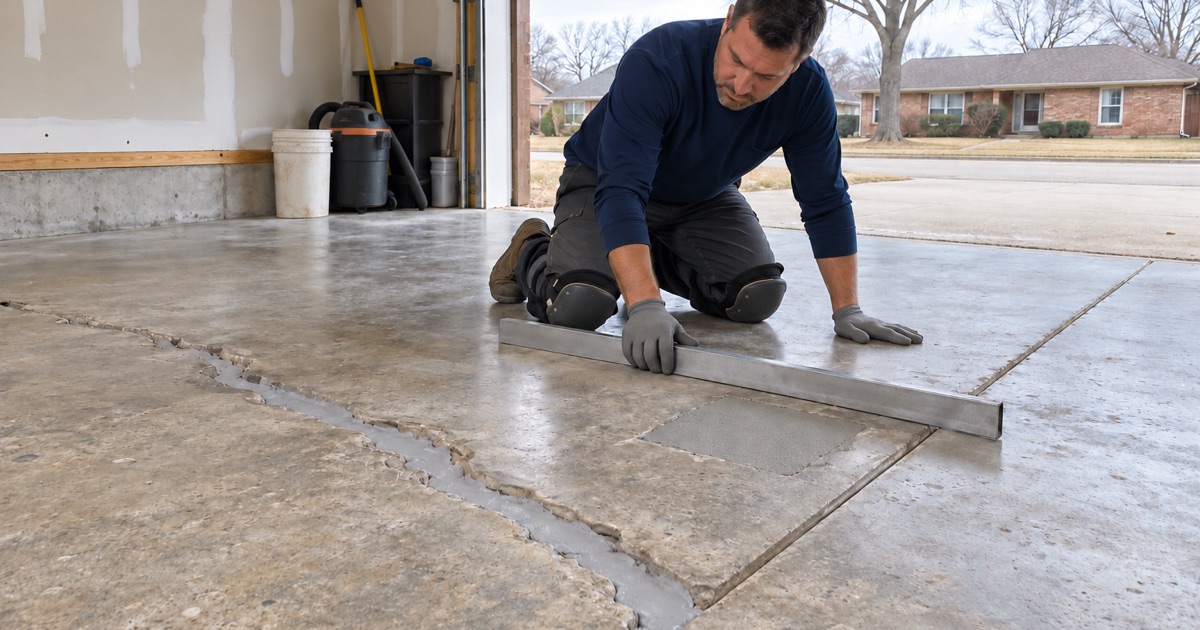
Hairline Shrinkage Cracks
Almost every slab develops fine shrinkage cracks as the concrete dries after it is poured. These are usually stable and shallow, and once cleaned out and filled they rarely cause trouble. We still map them, because their pattern tells us how the slab was placed, where it was jointed and whether any have widened since.
Settlement and Displaced Cracks
A crack with one side higher than the other, or one that has opened wider than a coin’s thickness, points to soil movement or settlement under the slab. The dense, slowly draining clay soils common around Arlington Heights can swell and shift with seasonal moisture, which shows up in floors over time. Displaced edges are ground level and filled, but we explain that movement may continue.
Active Cracks and Control Joints
Some cracks open in winter and close in summer, behaving like joints the slab chose for itself. Filling those with a rigid material only moves the crack next to the repair. We treat active cracks and existing control joints with flexible fillers and leave them as visible joints in a coating, because the coating is a film that follows the slab and cannot hold it still.
Spalls, Scaling and Salt Damage
Deicer Scaling in Garages
The flaking, pitted surface near the front of many garages is deicer scaling. The road salt blend used here includes liquid calcium chloride, which reacts with cement paste to form calcium oxychloride, an expansive compound that breaks the surface apart. The Federal Highway Administration also notes that concrete above about 86 percent saturation can be damaged in a single freeze-thaw cycle, and brine-soaked garage slabs reach that easily.
Spalled Joints and Edges
Spalls are chunks broken from the edges of joints, cracks or the slab at the garage door, usually from impact, freeze-thaw damage or wheel traffic over an open joint. We saw back to sound concrete, clean out loose material and rebuild the edge with an epoxy or polyurea mortar that bonds to the surrounding slab and takes traffic quickly.
Pitting and Pop-Outs
Small craters left where surface aggregate has popped out, or pitting from years of wear, collect dirt and telegraph through thin coatings. We grind the surface back, fill the voids with a fast-setting patching compound and grind again so the floor is flat. On bare floors, this step alone makes a slab far easier to sweep and clean.
Repair Materials and Where Each Fits
Rigid Epoxy and Polyurea Fillers
For dormant cracks and spalled edges, we use rigid, high-strength epoxy or polyurea fillers, often mixed with sand for larger voids. They bond strongly, cure quickly and can be ground flush within hours, giving a coating a smooth, continuous base. They are not meant to accommodate movement, which is why we only use them where the slab has stopped moving.
Flexible Joint Fillers
Where a slab is expected to move, such as control joints, expansion joints and active cracks, we use semi-rigid or flexible fillers that stretch and compress without tearing loose. In commercial floors, semi-rigid joint fillers also support the joint edges against forklift wheels while still allowing slight movement.
Cementitious Patches and Resurfacers
For wide areas of scaling or a worn surface, polymer-modified cementitious patching mortars and resurfacers rebuild the top layer of the slab. They must cure and dry before a coating goes on, and we test moisture again after a resurfacing because the new material adds water to the floor that has to leave before coating.
When a Floor Needs More Than Repair
Heaving, Sinking or Broken Slabs
A slab that has heaved, sunk unevenly, or broken into loose pieces cannot be fixed with fillers. In Arlington Heights, a garage floor replacement must follow the village’s concrete requirements, including a thickened edge at the overhead door about 14 inches deep and 20 inches wide and at least 4 inches of compacted CA-6 aggregate under the slab. When a floor reaches that point, we say so rather than coating over it.
Water Coming Through the Slab
Cracks that seep water, damp patches that never dry and white efflorescence along a crack all signal water moving through the concrete. Filling the crack will not stop the water for long. Drainage, grading or foundation work comes first, and then the slab is tested for moisture before any repair or coating is planned.
- 20+ Years Coating Concrete
- Moisture Tested Before Quoting
- Itemized Written Proposals