Arlington Heights Epoxy Flooring takes on epoxy flooring in Cary the way an engineer would want it quoted: as a written system with a named product, a stated build and a finished thickness, not a color picked from a sample board. After more than 20 years of coating concrete, we have learned that the floors which matter most to a business are rarely chosen for looks. They are chosen because a document says what the surface has to do.
That changes how a proposal reads. Instead of describing a finish in adjectives, ours lists the primer, the body coat, the topcoat and the mils each one adds, so a facilities manager can lay our quote beside the spec sheet and check every line. When a requirement sits outside what a coating can honestly deliver, we say so in the same document.
Homeowners get the same paperwork. A garage floor is a smaller job, but it still deserves a scope that names what goes down and a moisture reading taken before anyone opens a can.
What Cary Builds: Medical Products and Magnetic Components
Manufacturing is the largest employment sector in Cary, and the major employers in it account for almost 2,000 jobs. The list reads like a parts catalog for other industries: Sage Products, AptarGroup, Coilcraft, True Value Manufacturing and Durex Industries. Two of those names set the tone for what a production floor in this village is expected to do.
Sage Products on Three Oaks Road
Sage Products, a medical technologies manufacturer and a Stryker subsidiary, runs a 600,000-square-foot plant at 3909 Three Oaks Road that employs about 600 people. On September 22, 2016, the company announced a 27-acre expansion in Cary expected to create 350 new jobs within five years. A medical-products plant of that size is a building where floors get cleaned often, with real chemistry, and where a failed coating is a production problem rather than a cosmetic one.
We have no knowledge of what is on the floors inside that plant, and we would not claim otherwise. What the address tells us is the kind of buyer Cary has: someone whose floor decisions start from cleaning protocols and process requirements.
Coilcraft on Silver Lake Road
Coilcraft has been headquartered in Cary since 1945, designing, manufacturing and distributing magnetic components such as RF chip inductors, power magnetics and filters. Its address, 1102 Silver Lake Road, like the Sage plant, geocodes inside the village in Algonquin Township, McHenry County. Electronic component work raises a question most garage owners never have to ask: what happens when a charge builds up on a person walking across the floor.
Why that shapes the conversation
When the biggest employers in a village make medical products and electronic parts, the commercial work that follows tends to arrive with a specification attached. A coatings contractor quoting here is answering a plant engineer’s sheet, and the useful thing we can do is read it carefully and respond line by line.
Looking for epoxy-flooring closer to River Forest? See River Forest Epoxy-Flooring.
Production Floors Written Into a Specification
A specification turns a floor into a set of tests the surface has to pass. In a Cary plant those tests usually come down to three things: how easily the floor cleans, what it can survive being washed with, and, where components are handled, how it behaves electrically. Each one changes the system we propose.
Cleanability starts at the slab
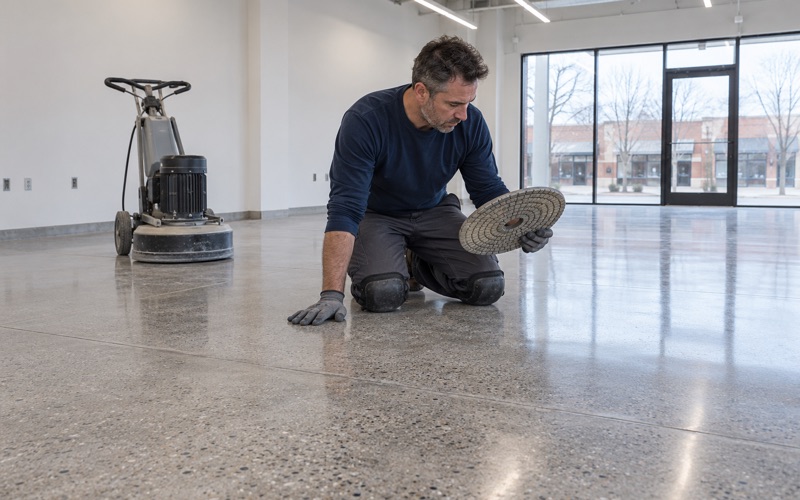
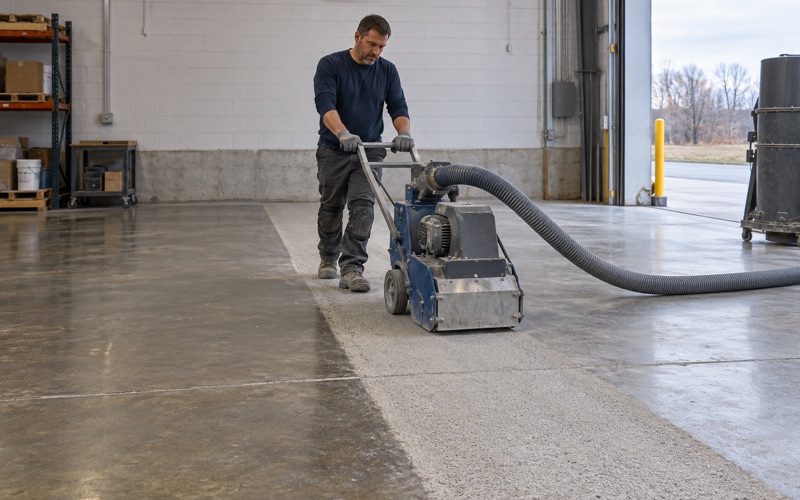
A floor that cleans well is seamless, dense and free of pinholes that hold residue. That starts with preparation: every slab we coat is opened mechanically with diamond grinding or shot blasting to a measured ICRI CSP profile, and we never rely on acid etching. A 100% solids epoxy body coat laid over a properly profiled surface leaves fewer voids for soil to settle into.
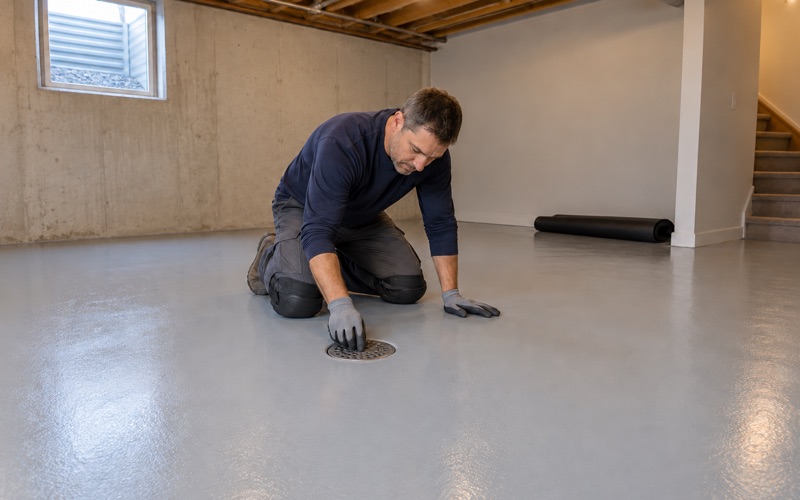
Transitions matter as much as the field of the floor. Where a specification calls for coved floor and wall junctures, we detail them so a mop or squeegee meets a curve rather than a corner. Drains, trench lines and equipment pads get the same attention, because those edges are where a coating usually lets go first.
Chemical resistance and the topcoat
Cleaning agents, process fluids and sanitizers each attack a coating differently, so we ask for the list before we choose a topcoat. Depending on what the floor sees, the answer might be a polyaspartic or polyurea topcoat over epoxy, or urethane cement where heat and harsh washdown are both in play. We name the product and the finished thickness in the proposal so the engineer can check it against the chemical resistance chart the manufacturer publishes.
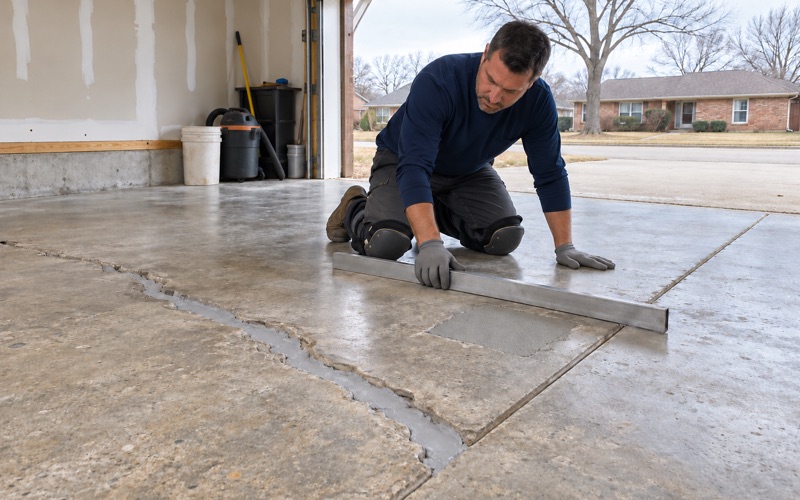
We also tell the client what the system cannot do. A coating is a film that follows the concrete under it, so a moving crack will reflect through no matter how good the resin is. We read the existing cracks and any old coating before we price the job, and we say plainly when the slab needs repair first.
Static control where electronic components are handled
Electronic assembly areas often call for static-dissipative or ESD flooring, where the spec sets a resistance range the finished floor must fall within. We install those systems to the range the client’s engineer writes, using conductive primers and grounding points as the product requires, and we test the result against that number rather than assuming it.
What we will not do is guess at a value. We have no sourced resistance figure for any Cary plant, and a static-control floor is only right when it matches the document the facility itself controls. If a sheet is missing, the first step is getting one.
Village Permits, the Fire District and Plant Hours
Knowing who signs off on a Cary job keeps a commercial project from stalling at the door. The village and the fire service here are two separate bodies, and the distinction trips up contractors who assume a single municipal office handles both.
The Village of Cary handles building permits
Both anchor plants sit inside village limits in McHenry County, so building permits run through the Village of Cary’s building and community development office. Cary also extends into Cuba Township in Lake County, so we confirm which county a residential address falls in before we file anything. Illinois issues no state license for flooring or coatings work, so we provide the village contractor registration, bond and insurance certificates the municipality asks for instead.
Cary Fire Protection District is its own agency
Fire protection in Cary comes from the Cary Fire Protection District, headquartered at 400 Cary-Algonquin Road and running two stations. It is a separate district rather than a village department. On a commercial coating job, fire questions go to the district, not to village hall.
We keep VOC content within the Illinois limits for architectural coatings, which bind the installer as well as the manufacturer. That choice tends to simplify ventilation planning on an occupied production floor.
Scheduling around a running line
A plant that runs shifts cannot simply close for a week. We schedule commercial work around the hours a building has to stay open, phasing areas so production keeps moving, and we time curing against slab temperature and dew point rather than a calendar. When the spread between air and slab is too narrow, amine blush can form on epoxy, and we would rather wait a shift than recoat a bay.
Garage Floors Across Four Decades of Cary Homes
Residential work in Cary looks nothing like a single-subdivision market. The village has 6,677 housing units, and they went up steadily over four decades rather than in one burst. Roughly 1,000 to 1,500 homes were built in each of the 1970s, 1980s, 1990s and 2000s, which together account for 76.5 percent of the housing stock.
Neighboring slabs of very different ages
That steady growth means a forty-five-year-old garage slab and a twenty-year-old one can sit on neighboring streets. The older floor may carry decades of oil, patching and a failed paint job; the newer one may have a cleaner surface but no record of what sits beneath it. We do not assume either condition from the age of the house.
Moisture testing is a line item in every residential scope here, not an upsell after a floor has blistered. Depending on the slab, that means an ASTM F1869 calcium chloride test, ASTM F2170 in-situ relative humidity probes, or a quick ASTM D4263 plastic sheet test as a first look. If the readings call for it, we specify a moisture-mitigation primer, and we read the warranty exclusions aloud before you sign, with moisture named first.
Townhome bays under association rules
Cary has 1,031 single-family attached homes, and 848 of them are owner-occupied. A meaningful share of local garages are townhome bays, where an association’s exterior rules can govern timing, access and sometimes the finish visible from the drive. We ask whether an association approval is needed before we schedule, so the crew does not arrive at a door that has not been cleared.
The owner lives over the garage
Owner-occupancy in Cary runs at 84.8 percent, and rental detached houses are few. The person reading our proposal is almost always the person who will park on the floor for the next decade, which is why every home job comes with a written contract and the Home Repair: Know Your Consumer Rights pamphlet before work starts, as the Illinois Home Repair and Remodeling Act requires.
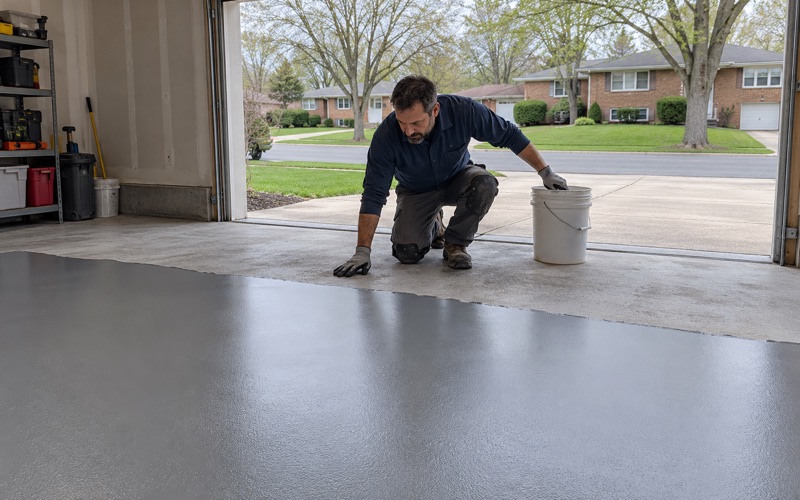
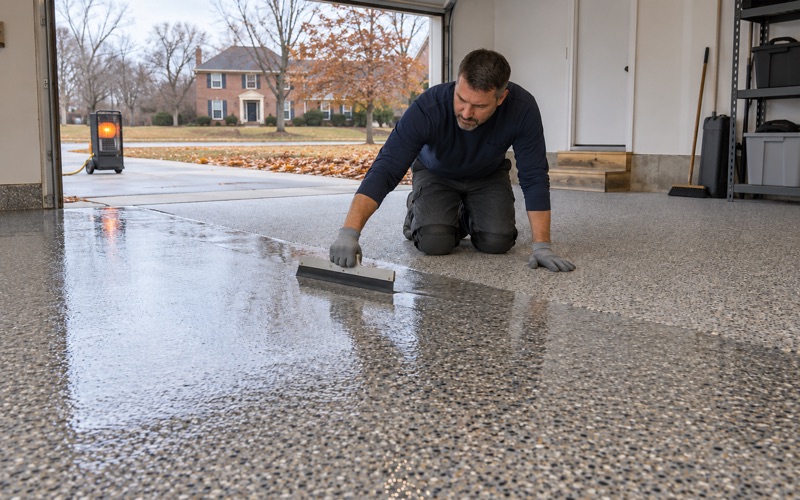
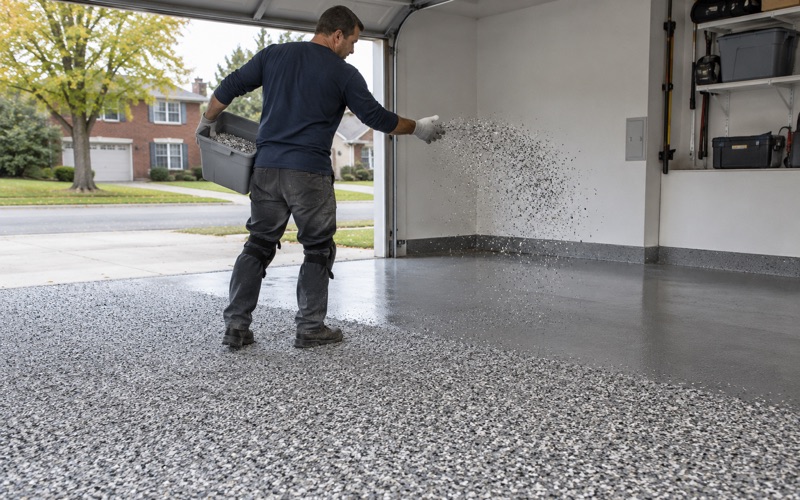
A typical garage system here is a ground slab, a 100% solids epoxy base, a vinyl flake broadcast and a polyaspartic topcoat that resists hot tire pickup. In an unheated garage, curing depends on the slab staying warm enough, and when it will not, we tell you the job has to wait for spring.
- 20+ Years Coating Concrete
- Moisture Tested Before Quoting
- Itemized Written Proposals