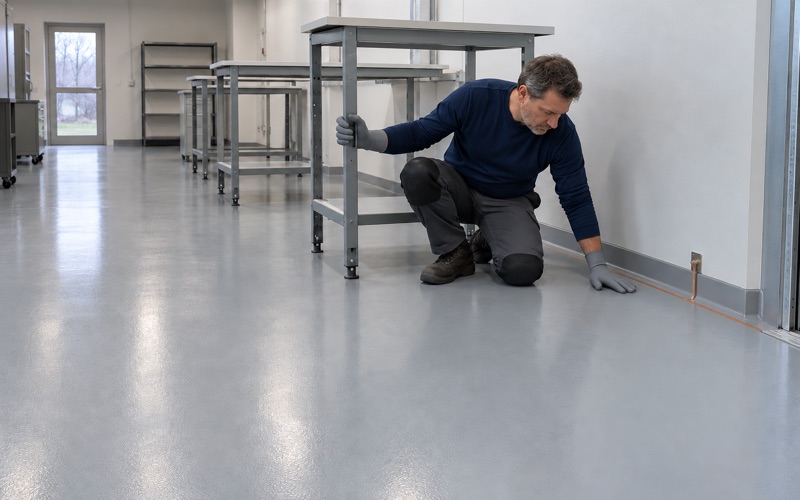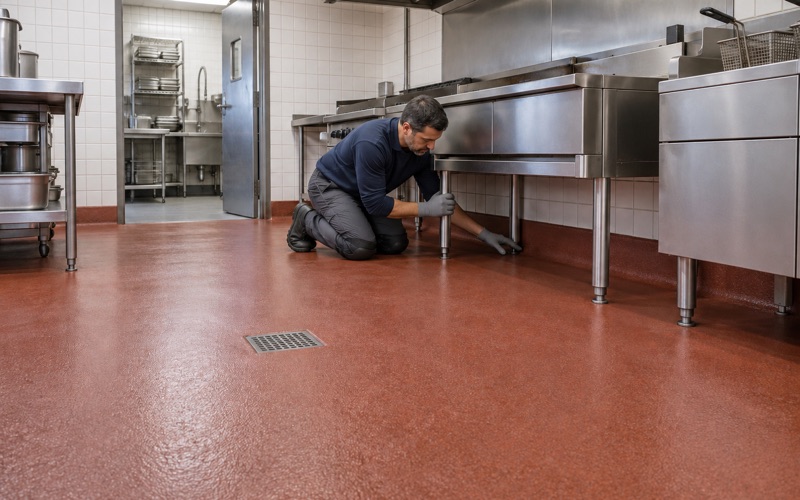
Arlington Heights Epoxy Flooring has handled epoxy-flooring in Brookfield basements and garages for more than 20 years, and on a basement slab here the first question we ask is not about color or flake. It is where the water comes from.
Water that rides in under a door is a drainage problem. Water that pushes up through the concrete is a pressure problem, and a coating answers the two very differently. A floor film follows the slab beneath it; it does not hold back groundwater, and we say that before a proposal is written rather than after a blister appears.
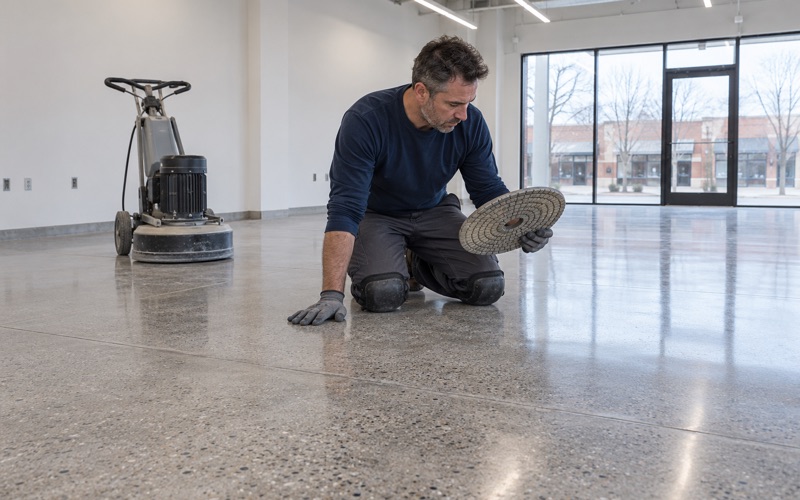
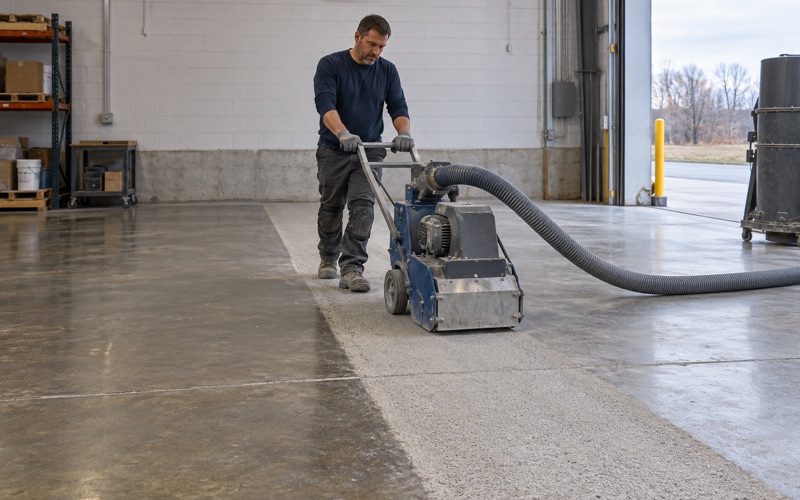
So every job starts with measurement. Moisture testing is a priced line in the scope, the slab is opened with a diamond grinder or shot blaster instead of acid, and the proposal names the product, the build and the finished thickness so you can check the floor against the paper.
Why Brookfield’s Own Plan Blames the Bedrock
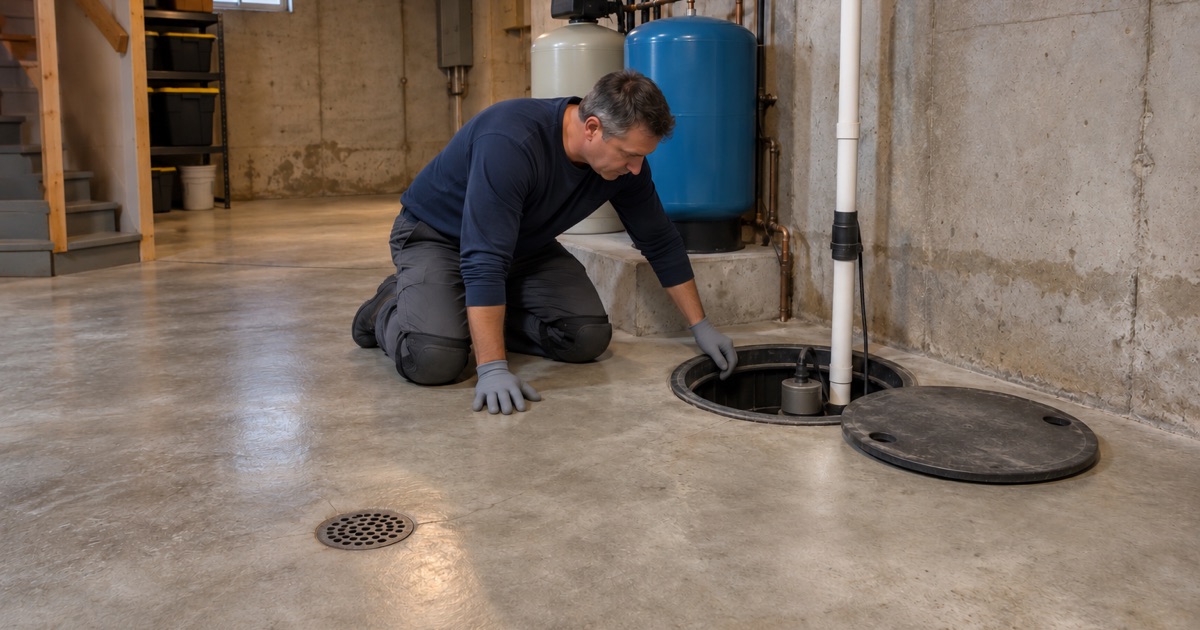
The Village of Brookfield’s annex to the 2024 Cook County multi-jurisdictional hazard mitigation plan names two reasons basement flooding is a major concern here. One is proximity to waterways. The other is a high water table that the village attributes to bedrock, which is a statement about the ground, not the weather.
Groundwater Sits Close to the Slab
When the water table is high, the soil under a basement floor can stay damp long after the last storm has drained off the streets. That moisture moves upward through concrete as vapor, and in wet seasons it can arrive as liquid pressing on the underside of the slab. Neither shows up in a quick look on a dry afternoon.
The village’s flood history backs the concern: widespread street and basement flooding was reported across Brookfield on June 23, 2010. A basement that took water that day may look dry now, but an old coating that sat under standing water is worth a close look before anything goes over it.
That is why we treat a Brookfield basement as a moisture job first and a coating job second. The reading decides the system, and on some slabs it decides that the floor should wait or take a different build altogether.
Hollywood, South Hollywood and the Salt Creek Streets
The same village annex lists the parts of town inside the Salt Creek floodway and floodplain that have historically flooded: Custer, Grove, Forest and Prairie, the Cantata retirement community, South Hollywood, and the Hollywood neighborhood that includes Village Hall. If your house sits on one of those streets, the creek and the water table are both working on the same basement.
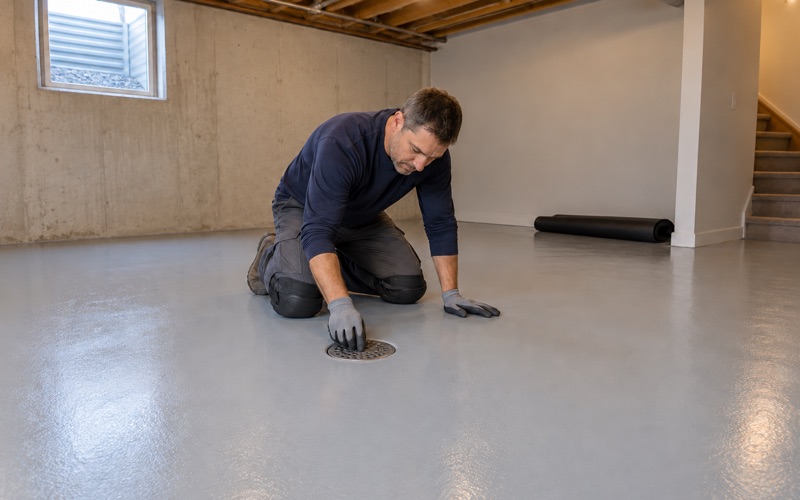
We do not treat a Hollywood address as a reason to refuse the work, and we do not treat it as a reason to oversell either. It is a reason to test before quoting and to look hard at how the floor drain and sump pit are detailed, because those are the openings where water and coating meet.
Looking for epoxy-flooring closer to Hinsdale? See Epoxy-Flooring in Hinsdale.
Pressure Under the Slab Versus Water Across It
Water across a floor and water through a floor leave different evidence, and they call for different answers. Across means a puddle, a tide line on the drywall and a cleanup. Through means a slab that never quite dries, a white crust at the cracks, and a coating that lifts in coin-sized blisters months after it went down.
Water Across: The Street-Flooding Blocks
Not every wet basement in Brookfield sits in the floodway. The village also names street-flooding blocks on 47th Street between Eberly and Raymond Avenues, 3800 Arden, 3300 Arthur and 3500 Forest, and a 2012 flash flood left Ogden Avenue impassable between Joliet and Lawndale. Those are surface-water problems, arriving from above, and on a low lot they add to the groundwater question rather than replacing it.
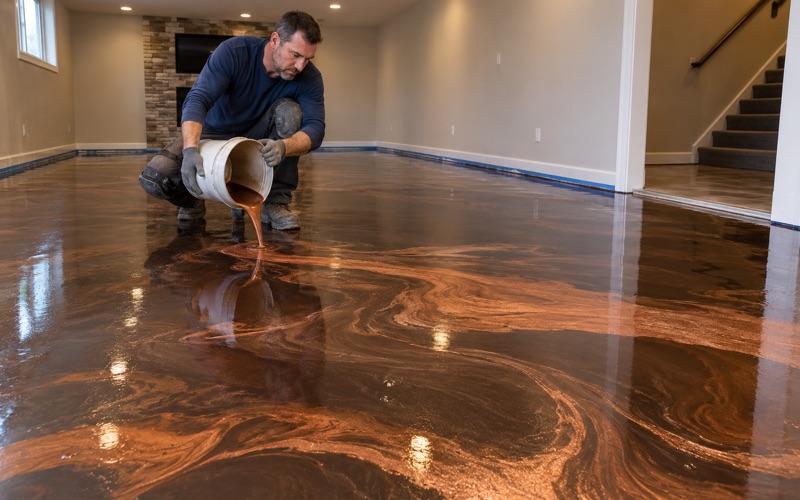
For a coating, water across the floor is the easier of the two. A seamless epoxy floor with a polyurea topcoat cleans up after standing water, and we detail the edges at the floor drain so water has somewhere to go. What it cannot do is change where the water came from.
How We Test Before We Quote
A sheet of plastic taped to the slab under ASTM D4263 is the first screen, and it only tells us whether moisture is present. For numbers, we use ASTM F1869 calcium chloride kits for the vapor emission rate and ASTM F2170 in-situ relative humidity probes set into the concrete, then compare the results to the limits the chosen product publishes.
Those tests are written into the scope at a stated price, whether the floor is in a basement or a garage. Testing after a floor has failed is the expensive version of the same information.
What a Coating Can and Cannot Do Here
Where the readings are high but workable, the usual answer is a moisture-mitigation primer under the 100% solids epoxy, built to the thickness the proposal states. Where a slab already shows efflorescence or an old coating peeling from below, we say plainly that the moisture has to be addressed by drainage or a waterproofing contractor before any floor system is worth buying.
None of this makes a coating a barrier against hydrostatic pressure, and we will not describe it as one. A mitigation primer manages vapor within a rated range; it does not turn a wet basement dry, and the warranty says so in the exclusions we read to you before signing.
Grossdale: An 1889 Workers’ Suburb on the Burlington Line
Brookfield began as Grossdale, founded in 1889 by Samuel Eberly Gross as a place where working families could buy affordable homes with train access to the city. It incorporated in 1893 and took the Brookfield name in 1905, and the BNSF line still stops at three stations in the village.
The village’s other famous name is Brookfield Zoo Chicago, known as Brookfield Zoo until 2024, which opened as the Chicago Zoological Park in 1934. The Forest Preserve District of Cook County owns it and the Chicago Zoological Society manages it; for us it is a neighbor, and the work stays in the houses, garages and businesses around it.
Old Houses, Old Basement Slabs
That origin shows in the housing. Of Brookfield’s 7,927 housing units, 2,543 were built in 1939 or earlier, and 69.2 percent of the whole stock predates 1960.
Basement slabs of that age were commonly poured straight on the soil, without the under-slab vapor retarder that ASTM E1745 now describes, so little stands between the concrete and the damp ground beneath it. Add the water table the village describes, and an older Brookfield basement is where a plastic-sheet test is most likely to fog.
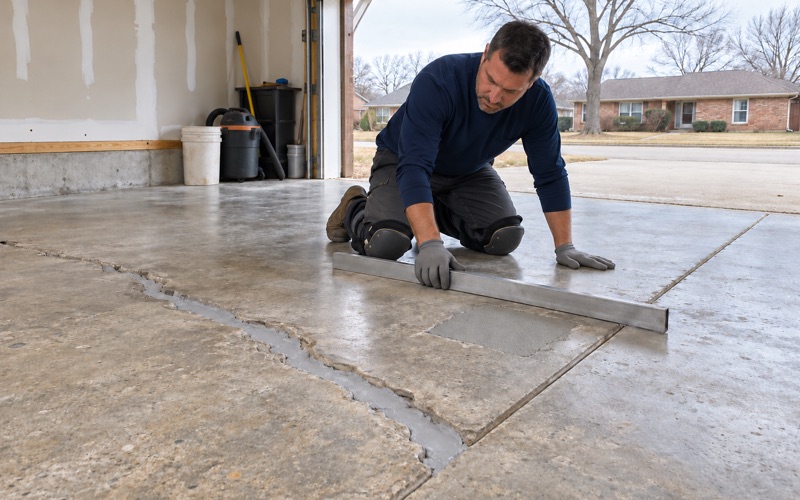
An old slab often comes with an old coating. Paint, a hardware-store kit or a previous epoxy has to come off or be proven sound, and a diamond grinder shows quickly which it is; acid etching would leave that question unanswered.
Detached Garages and Winter Salt
Most owner-occupied homes here are detached houses, 5,726 of the 6,284, and a garage floor on one of those lots faces a different enemy than the basement. Calcium chloride brine and rock salt drip off the tires all winter, working into bare concrete and any coating too thin to shed them.
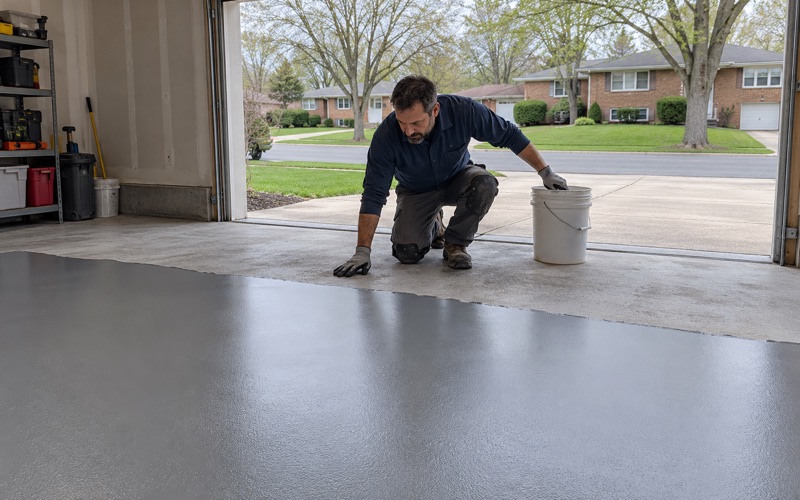
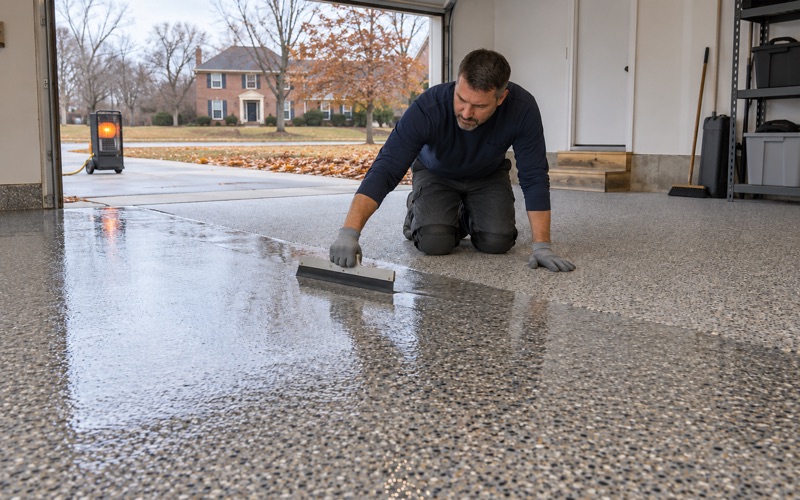
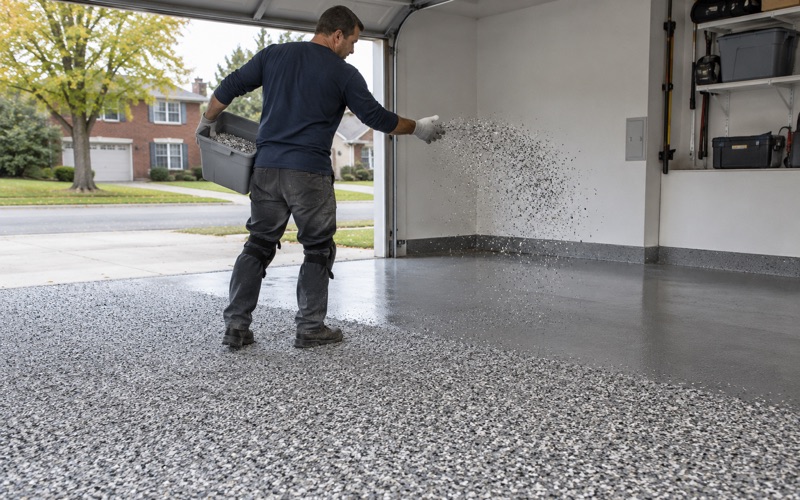
For those we grind to the ICRI CSP profile the system calls for, broadcast vinyl flake or quartz aggregate into the epoxy base, and finish with a polyaspartic topcoat that resists hot tire pickup. Curing is scheduled against slab temperature and the dew point spread at the surface, so an unheated garage may have to wait for spring.
A 2021 Code, Updated in 2023, and the Paperwork Around It
The Village of Brookfield’s Building and Planning divisions administer Chapter 12 of the municipal code, which the village updated on April 10, 2023 to the 2021 International Building Code and related codes, plus the 2023 National Electrical Code. Stormwater rules sit in Chapter 48, last updated February 12, 2024, with floodplain provisions in Article XII.
Asking the Village First
What a given job needs from the village depends on what it touches, so when a basement project goes beyond the floor surface, toward a drain, a sump or the stormwater questions a floodplain lot raises, we check with the Building and Planning staff before work starts rather than guessing. Illinois issues no state license for coating work, so what we show instead is the village contractor registration, bond and insurance that each municipality asks for.
Commercial Space and Open Hours
Brookfield’s commercial corridors include two tax increment financing districts, Ogden Avenue from 2008 and Congress Park from 2011. A shop or office there usually cannot close for a week, so we schedule grinding, coating and cure time around the hours the building has to stay open.
Before any commercial floor goes down, the slab gets the same moisture readings a basement does. A building in one of the village’s historically flooded areas is still sitting on the same water table when it has a storefront.
Contracts, Cracks and Radon
Every home job gets a written contract and the Home Repair: Know Your Consumer Rights pamphlet before we start, as the Illinois Home Repair and Remodeling Act requires. Before that contract is written, we read the cracks and any old coating, and if the slab needs repair first, the proposal says so.
A coating covers the slab, so it is fair to ask whether it lowers radon. We do not sell it that way: in Illinois, radon mitigation takes a state license through IEMA, and a floor film is not that work. The products we use are chosen within the Illinois VOC content limits, which bind the installer as well as the manufacturer.
- 20+ Years Coating Concrete
- Moisture Tested Before Quoting
- Itemized Written Proposals