Arlington Heights Epoxy Flooring brings more than 20 years of work to epoxy flooring in Bellwood, and the floor we are asked about most here is a basement that has already been wet. That fact shapes the job before any product is chosen. A slab that has sat under backup water carries residue, salts and trapped moisture that a showroom sample never had to survive.
So we start with the slab, not the color chart. Every floor is opened with a diamond grinder or shot blaster rather than acid, moisture testing appears on the proposal as its own priced line, and the cracks and any old coating are read before we put a number on the job. When a floor needs repair before it can take a coating, we say that first.
None of that keeps water out of a basement, and we will not pretend otherwise. What a well-built floor can do is come through a cleanup in better shape than bare concrete or carpet, and this page explains where that line sits.
240 Repeat-Loss Properties and Water That Rises Through the Drains
FEMA identifies 240 repetitive flood loss properties in Bellwood, and 231 of them are single-family homes. Five single-family homes carry the more serious severe repetitive loss label, and the count of mitigated properties stands at zero. Those figures come from the Bellwood annex of the 2024 Cook County multi-jurisdictional hazard mitigation plan, where the village ranks flood first among its hazards.
For a floor contractor, that means a basement here is frequently a floor that has already been under water at least twice. We plan for that history instead of treating it as bad luck that will not repeat.
Backup From Below the Slab Line
The village is direct about the cause. In its own words, the condition of the sanitary and storm sewers causes a great deal of basement flooding due to storm water migration into the sanitary sewer system. Rain overloads the pipes, and the water finds the lowest open fixture it can reach.
In a basement that means the floor drain, a laundry tub or a basement toilet, so the water arrives in the middle of the room rather than at the door. It is not clean water either. Sewer backup leaves contamination in the pores of the concrete, and that matters more to a coating than the water itself.
What We Look For on a Slab That Has Flooded
We ask how many times the room has taken water and how high it came. Then we look at the slab itself: white efflorescence along the walls and around the drain, soft or dusting paste, old paint or sealer lifting in sheets, and a sump pit or floor drain that sits in a low spot the rest of the floor slopes toward.
Those details decide whether the floor can be coated as it stands, needs repair first, or should be left alone until the drainage question is settled. We would rather lose a sale than coat over a problem that will push the film off later.
If the last event was recent, the cleanup and any drain or plumbing repair come first, and the concrete needs time to dry before it can be judged at all. We can look at the floor during that window, but we will not test or quote a coating on a slab that is still visibly damp.
Looking for epoxy-flooring closer to Cary? See Epoxy-Flooring Services in Cary.
Addison Creek, Washington Boulevard and the Blocks West of Mannheim
Sewer backup is not the only route. The village describes an extremely large floodplain area susceptible to Addison Creek flooding, and it names Washington Boulevard as a street that floods regularly. Village Hall, at 3200 Washington Boulevard, has flooded numerous times itself.
Where the Storm Sewers Fall Short
The village lists the entire residential area west of Mannheim Road as under-served by storm sewer capacity, along with the blocks around 23rd and Grant and around 25th and Van Buren. It also notes that the Mannheim Road storm sewers have inadequate capacity. Homeowners on those blocks have the clearest reason to plan a basement floor around the possibility of more water.
That is not a reason to skip a coating. It is a reason to choose the system, the base detail at the walls and the finish height around the drain with the next event in mind, rather than building a floor that only performs if the basement stays dry.
Who Oversees Floodplain Rules Here
The Village of Bellwood Building Department administers floodplain rules under Chapter 152 of the municipal code, first passed in May 2007. That chapter treats work costing 50 percent of a building’s market value as a substantial improvement. A basement floor coating sits far below that on its face, but repairs after flood damage are tracked against the same definition, so a written scope that separates the floor work from other repairs is worth having.
Bellwood is not a Community Rating System participant, and nothing about a floor coating changes a property’s flood insurance picture. We mention it only so no one hears otherwise from a salesperson.
What a Coating Can and Cannot Do After a Flood
A floor coating is a thin film bonded to the concrete. It will not stop backup water from reaching the room, and it follows any crack or movement in the slab beneath it. We say that before the job, in plain terms, because a homeowner who has paid for cleanup twice deserves a straight answer.
What It Can Do
A properly bonded 100% solids epoxy or urethane cement system gives the floor a seamless surface with no carpet pad, tack strip or vinyl seams to hold contaminated water. After an event it can be cleaned and disinfected instead of torn out. A coved base carried a few inches up the wall closes the joint where floor meets foundation, so cleanup is not chasing water into a seam.
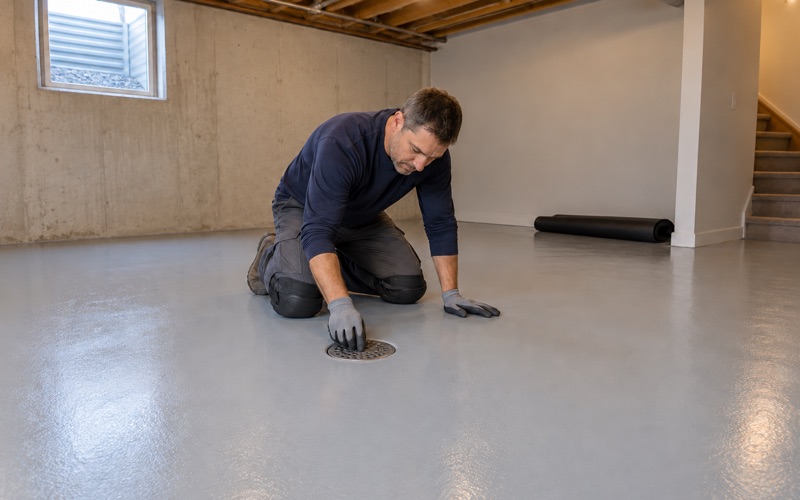
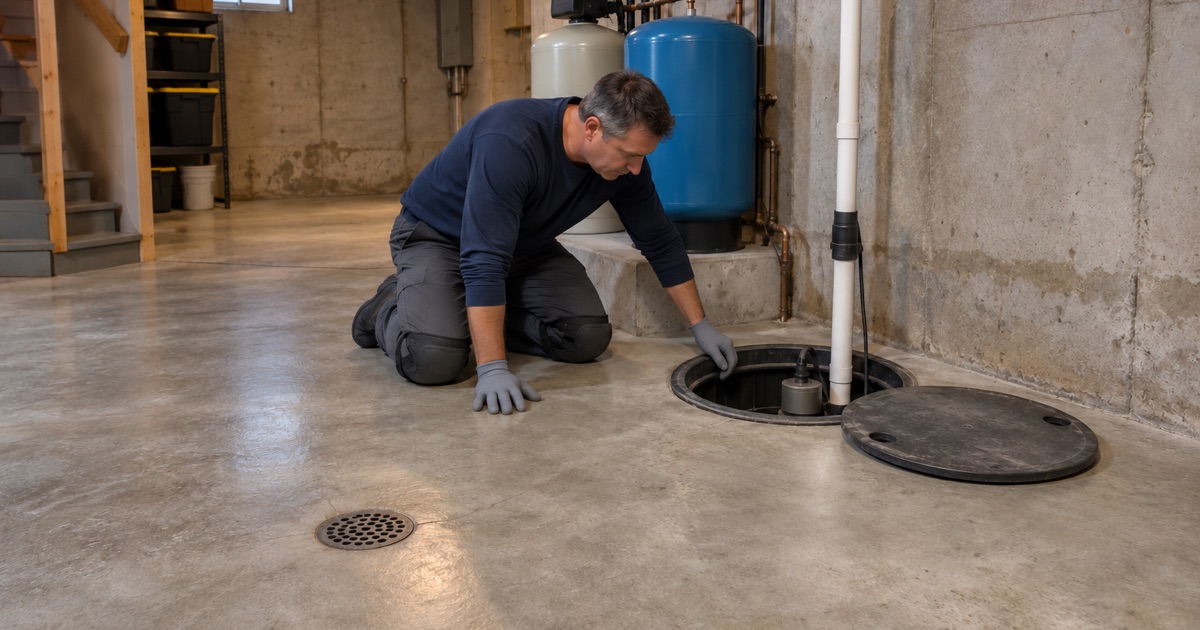
Since backup arrives through the drain, the details around the floor drain and sump pit deserve more care than anywhere else in the room. We terminate the coating cleanly at the drain body and the pit rim so the edge is not left feathered, where scrubbing and standing water would start to lift it, and we keep the drain grate removable for the plumber.
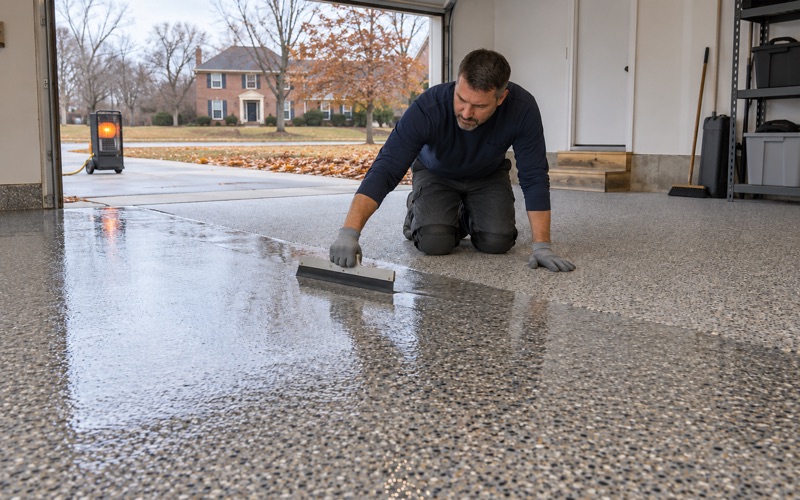
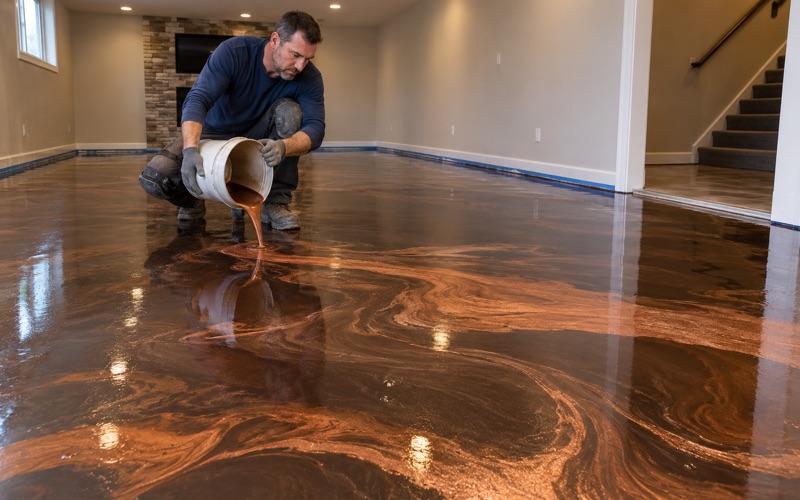
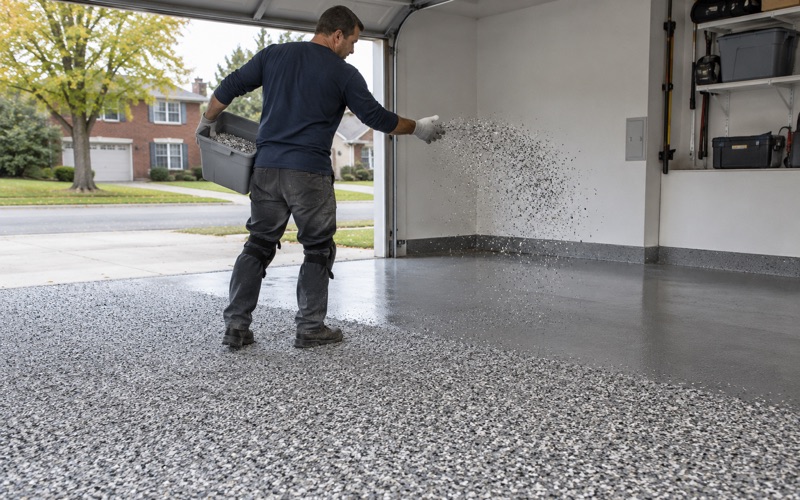
Finish matters too. A vinyl flake or quartz aggregate broadcast adds texture underfoot on a floor that may be wet during cleanup, and a polyaspartic topcoat gives a surface that stands up to repeated scrubbing. Our proposal names the product, the system build and the finished thickness, so you can check what went down against what was quoted.
Preparing a Slab That Has Been Under Water
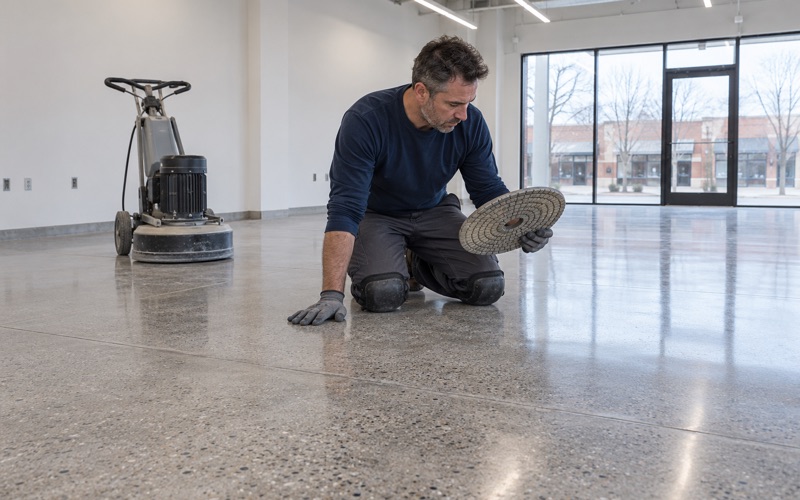
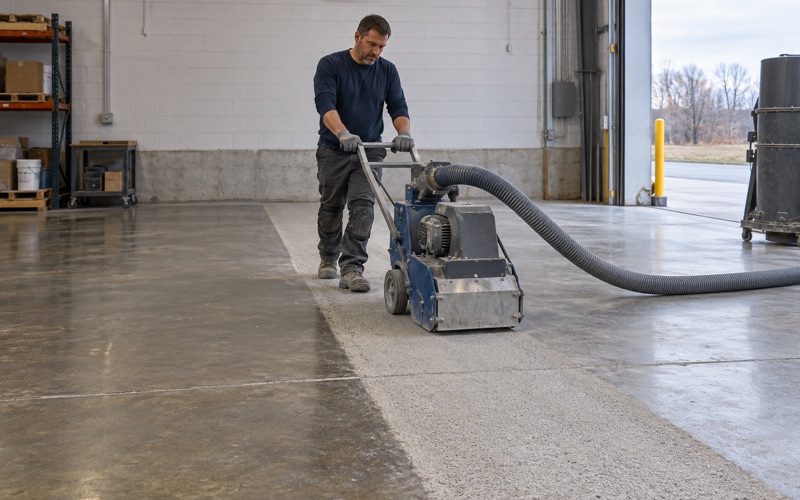
Flood residue and efflorescence sit in the top layer of the concrete, and no primer bonds reliably to them. We remove that layer by diamond grinding or shot blasting, cutting to the ICRI CSP profile the chosen system calls for. We never acid etch, which leaves salts and water behind in a slab that has already had too much of both.
Moisture testing comes next, and it is a written line item rather than an upsell. On a recently flooded slab we use ASTM F2170 in-situ relative humidity probes, which read conditions inside the concrete, and may add ASTM F1869 calcium chloride tests for the surface emission rate. A taped plastic sheet test under ASTM D4263 can flag an obvious problem overnight, but it is a screen, not a measurement, and we do not let it stand in for the probes.
Where readings run high, a moisture-mitigation primer goes down beneath the coating. Warranty exclusions are read to you before you sign, and moisture is the first one named.
Brick Bungalows and 1950s Ranches: An Old Slab Under a New Finish
Apart from the flood record, the age of the house shapes the job almost as much. The village describes its many brick bungalows and ranch and Georgian homes, and Census Bureau housing figures back that up: of 6,340 housing units, 42.0 percent were built in the 1950s and 69.9 percent predate 1960.
That growth was fast. The population more than doubled between 1950 and 1960, from 8,746 to 20,729, which puts most slabs in the village at more than six decades old.
Built Before Under-Slab Vapor Retarders
These slabs were poured decades before ASTM E1745 under-slab vapor retarder practice took hold. That does not make them uncoatable, but it means we assume nothing about vapor moving through the concrete until the readings are in, which is one more reason testing comes before the product choice.
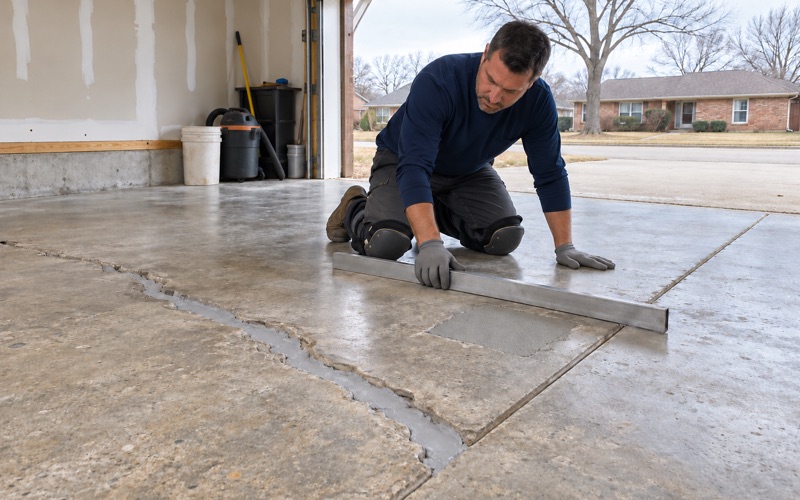
Old basements also carry old finishes. Layers of paint, a hardware store sealer or a patched area around a replaced drain all have to come off or be ground through before a new system can bond. Where cracks run across the floor, we say whether they need repair before coating and which ones are likely to show through the finish.
Code, Paperwork and What Changes Here
Bellwood reports its building code as the 2006 IBC, adopted in 2008, so a specification copied from a town on a newer code edition does not carry over automatically. Illinois issues no state license for flooring or coating work, so in place of a license number we show the contractor registration, bond and insurance each municipality asks for.
Basement work also raises the radon question. We do not sell a floor coating as radon reduction, because in Illinois that work takes a state radon mitigation license from IEMA.
Every home job also gets a written contract and the Home Repair: Know Your Consumer Rights pamphlet before work begins, as the Illinois Home Repair and Remodeling Act requires. If you are weighing a coating for a basement that has flooded, we will walk the floor, take readings and give you a written scope that says plainly what the floor can and cannot do.
- 20+ Years Coating Concrete
- Moisture Tested Before Quoting
- Itemized Written Proposals